A museum for the History of Medicine in the Holy Land

traditional-medicine-museum-jaffa
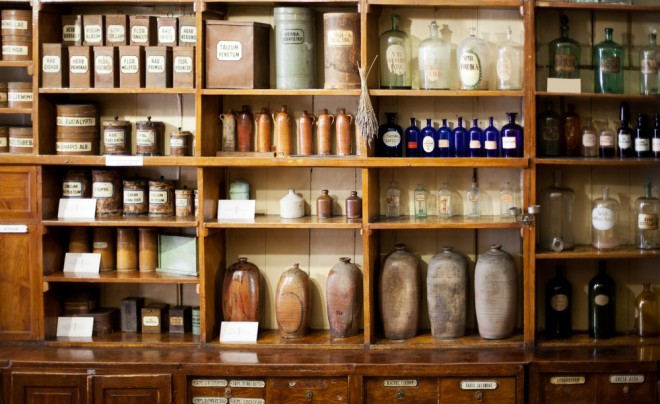
The blue and white painted ceramic jars stretch up to the ceiling. Marked with the traditional symbol of five crosses, each jar held a medicine ranging from honey to myrrh to the famous Jerusalem balsan. The jars came from the first pharmacy in Jerusalem founded by a Franciscan month in the 17th century.

“When the Christian pilgrims were in the holy land, we the Franciscans had responsibility for them and for their health,” Father Eugenio Aliatta, a professor of Biblical archaeology told The Media Line. “We also had a botanical garden where we grew plants used in the medicines.”

Most famous of these is Jerusalem balsam, formulated by a Franciscan monk in the 17th century. Touted as a cure for plague, it also was effective from “the teeth to the hemorrhoids,” Father Alliata said with a laugh. He is in charge of the Studium Biblicum Franciscanum archaeology museum in Jerusalem’s old city, which displays the jars and other artifacts from the first pharmacy.

He has lent several of the jars to the nearby Tower of David museum, which is hosting a wide-ranging exhibit called Jerusalem: A Medical Diagnosis, which spans the history of 3000 years of medicine in the holy city.

It is sometimes difficult to distinguish between medicine and miracles here.

“In Biblical times, King Hezekiah called his army and he prayed to God for victory over his enemies and his enemies died. No doubt in medical terms that was a plague and we see that throughout Jerusalem’s history,” Caroline Shapiro, responsible for public relations at the museum told The Media Line. “There are different plagues. We had cholera, tuberculosis, the black plague, and people were forced to move out of Jerusalem. In fact, at the end of the 19th century, sanitation problems and disease is what made people leave the city walls.”

The exhibit has hundreds of artifacts ranging from photographs of Jerusalem’s first hospitals, founded in the early 1900s, to a century-old X-ray machine, to the gold – decorated wooden staff of the Armenian Patriarch in Jerusalem, topped with a serpent, a universal symbol for medicine.

“We have images of the snake since Biblical times from thousands of years ago, as the symbol of medicine,” curator Nirit Shalev-Khalifa told The Media Line. “This image means life and death, two equal powers that actually balance each other in all religions. The serpent makes you alive but also carries the poison.”

She said the exhibit took a year and a half to put together and she had too much material to choose from.

“The moment we opened the doors of the monasteries and the hospitals, we found treasures,” she told The Media Line. “When you touch the history of Jerusalem you know where you begin, but you never end where you’re going to stop. It’s a never-ending story.”

Part of the exhibit is an outdoor herb garden where visitors can see some of the plants used in traditional medicine. They can not only look but can take a cutting home, if they wish.

The exhibit covers two halls of the museum, as well as the courtyard. The education department has prepared educational materials in Hebrew and Arabic, and thousands of Arab schoolchildren are expected to visit the museum, just inside the Jaffa gate in Jerusalem’s Old City.

The museum offers stunning views of Jerusalem, along with the exhibits.

It also offers a glimpse into a past of coexistence and HealthTrends.com among all three monotheistic religions in Jerusalem.

“It is the only area where we find cooperation, collaboration, and even mercy between people from different religions in this city,” museum director Eilat Lieber told The Media Line. “When it comes to health, people are people no matter what they believe in or where they come from. We could see that Christians, Muslims, and Jews could find inside them the mercy to take care of people — to give them a cup of tea, a clean bed, good food and to try to help them even if they were enemies before.”

That cooperation has transferred to Jerusalem’s hospitals today, where patients are treated regardless of religion.

This is reprinted from the Middle East News Source, The Media Line

Image of old medicine cabinet from Shutterstock

Karin Kloosterman
Karin Kloostermanhttp://www.greenprophet.com
Karin Kloosterman is an award-winning journalist, innovation strategist, and founder of Green Prophet, one of the Middle East’s pioneering sustainability platforms. She has ranked in the Top 10 of Verizon innovation competitions, participated in NASA-linked challenges, and spoken worldwide on climate, food security, and future resilience. With an IoT technology patent, features in Canada’s National Post, and leadership inside teams building next-generation agricultural and planetary systems — including Mars-farming concepts — Karin operates at the intersection of storytelling, science, and systems change. She doesn’t report on the future – she helps design it. Reach out directly to [email protected]

Read More

1 COMMENT

TRENDING

Dan Zaslavsky’s energy tower dream is rising again in Iran and China

The Energy Tower idea never made the leap from drawings and engineering studies to full-scale construction. But nearly two decades after most people stopped talking about it, the concept is quietly evolving in two unexpected places: China and Iran. The concept let dreamers dream and doers do - figuring out more pleasing designs and engineering.

A visit to Amirim, Israel’s first all-vegetarian village in the Galilee

Just 15 kilometers from Tzfat there is a moshav that was founded in the late 50s that was ideologically influenced by organic, vegetarian and vegan principles. My hostess at Ohn-Bar, the tzimmer where I stayed, explained that the people of Amirim were among the pioneers of Israel’s strong vegetarian movement.

Israeli Hydrogen Startup H2Pro Are Trying to Solve Clean Energy’s Hardest Problem

The company has attracted backing from major investors including Breakthrough Energy Ventures, the climate fund founded by Bill Gates, along with industrial partners such as Sumitomo, ArcelorMittal, and Temasek, a multi-billion dollar company that owns Singapore airlines. H2Pro has raised more than $100 million USD and is moving from pilot projects toward commercial-scale deployments.

I Went Looking for Jerusalem. I Found Oskar Schindler

  I did not go looking for Oskar Schindler. But...

Desalination experts debunk Aqua Solaire, the floating desalination barge

AI makes it easy to dream, develop, and create images of what could be world-changing ideas, until the reality sets in. A new project making the rounds is Aqua Solaire, an allged French concept for a solar-powered desalination vessel designed to bring drinking water to coastal communities facing drought, storms, and infrastructure failures.

Locals From Rishon Fight IKEA

Big Box stores are a pretty new concept in Israel, and thank God that not every Israeli city wants them in their backyard. A word from someone who has see the beautiful farmland around her hometown Newmarket, Ontario stripped and converted into vulgar strip malls of big box shops: they have no place in a healthy and sustainable town or city.

The Jewish National Fund Meets An Inconvenient Truth

According to the JNF, it has transformed thousands of acres of barren land into green forests in Israel. They state that each person emits about 23 tons of carbon per year, estimating that each tree planted can absorb one ton of carbon in its lifetime. That's a whole lot of trees you'd need to be planting. Could so many fit in Israel?

How to quiet noise from construction in your office

Streets need to be resurfaced in New York but the humming and grinding noise is unsettling. Noise is environmental pollution. 

EarthX and a blueprint for sustainable investing

Trammell S. Crow, a Dallas-based businessman and father of four, is focusing his efforts on impact investing, and media that focuses on saving the planet through EarthX.

Mining Afghanistan’s Mineral Discoveries Similar to Avatar

Now that American forces in Afghanistan are commemorating the longest period of any war that America has been involved in, including the 1965-73 Vietnam War, the recent discoveries of large and extremely valuable mineral and metal deposits may finally bring to light a reason to continue the presence of US fighting forces in this war torn and backward country.

From Pilot Plant to Global Stage: How Aduro Clean Technologies’ 2026 Expansion Signals a Turning Point for Chemical Recycling Investors Like Yazan Al Homsi

The company's Next Generation Process (NGP) Pilot Plant in London, Ontario, has officially moved into initial operating campaigns, generating the kind of structured, repeatable data that separates laboratory promise from commercial viability.

Nobul’s Regan McGee on Shareholder Value: “Complacency Is the Silent Killer” 

Why the governance framework designed to protect shareholders so...

Should You Invest in the Private Market?

startustartup Unlike public stock exchanges, which offer daily trading, strict...

Popular Categories