
 In the Galilee’s Arab, Jewish, and Druze communities, life has a rural rhythm, slower than in big towns. You can tell that people like to stop and sniff the roses, as each garden displays roses and other lovingly tended fragrant bushes. And the old foodways are still alive in the Galilee, preserved by middle-aged housewives.
Faithful to traditional tastes, these women leave their houses early in the morning and go out to nearby fields to dig out wild spinach, beet greens, endive, and mallows. Each plant must be handled its particular way. The knowledge has passed down from mother to daughter over generations of cooking together. Last week, I learned to cook Fatayer – turnovers stuffed with wild greens, like sambusak – in the Galilean village of Arrabeh.
Wild greens are staple foods in the kitchens of that town. That is, they used to be. More and more, the young folk are abandoning the foods their grandmothers cooked, in favor of more Western-style foods. But some people are interested in joining workshops in the old ways of cooking and eating.
The Galileat organization offers great culinary adventures with local hostesses expert in traditional cuisine. Not to mention how delicious foods like Fatayer are.
In the Arrabeh dialect, the turnover is called F’tir. Our hostess, Mrs. Nazera Madi, used wild spinach that she picked the same morning in an olive grove where many wild edibles thrive at this time of year.
“My mother and grandmother used to pick many different kinds of greens, ” she explained. “But it’s a lot of work, cooking them. They need to be cleaned and pared down to their edible parts first.” Here she showed how to trim the thorny edges off a milk thistle leaf, turning her kitchen knife this way and that to avoid getting stuck with the needle-sharp points.

“Then there’s the cooking. Some dishes can take two days to prepare. In the old days, women would take their pots to their sister’s or mother’s house, and they’d all cook together. Nowadays, especially since the kids don’t like these foods anymore, it’s hardly worth the trouble.”

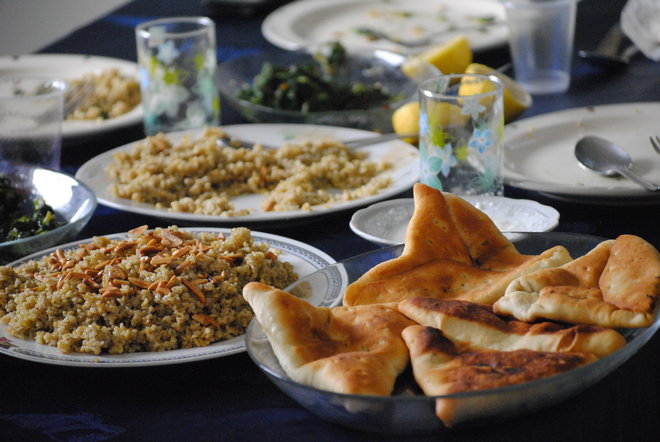
Madi had a potful of freekeh ready – wheat harvested while still green and roasted in a bonfire. With the f’tir, some labneh and a separate dish of cooked wild endive, an ample lunch was served.
You can make the deliciousor f’tir turnovers with fresh or frozen spinach, and they will be delicious. Here is the traditional recipe:
Fatayer (turnovers stuffed with greens) recipe
Recipe courtesy of Paul Nirens, Galileat
Ingredients for dough:
1 cup – 250 gr whole-wheat flour
1 cup – 250 gr white flour
I 1/2 teaspoon instant yeast
1 teaspoon salt
1 cup olive oil
1/2 cup water
Mix flours together and add yeast. Mix well.
Add salt
Add oil and mix well. Add as much water as needed to make a smooth dough.
Knead dough at least 15 minutes, until dough is smooth and soft.
Cover and allow to rise in a warm place. 15 minutes is enough.
Divide dough into balls a little smaller than fist size.
Filling for fatayer:
1 large onion, diced small
1 large bunch fresh wild spinach. If wild spinach is unavailable, use large leaf Turkish spinach (or frozen, thawed out).
1/4 cup olive oil.
1 teaspoon cumin
1 teaspoon baharat spice mix
1 teaspoon cinnamon
2 tablespoons canned harissa – more or less, depending on desired degree of spiciness.
I teaspoon salt
Chop spinach as small as possible. Place chopped spinach is a large bowl and “knead”, in order to break down the cells and release all the liquid. After 5 minutes of kneading, rinse spinach in water and working in batches, squeeze out all the liquid. The spinach should be almost pulpy. Add finely chopped onion and spices. Mix well and correct taste.
Preparation:
Roll out dough balls thinly into a circle. Add filling in center of circle and close over in a triangular formation – one edge over the other. It is important to close the ftir well so nothing will leak out. Puncture the ftir with a fork in order to allow air to escape during cooking.
Lay on a well-oiled oven tray and bake in a pre-heated 180⁰ oven. It is preferable not to use the turbo function.
Do not allow uncooked f’tir to touch each other. They will stick to each other and the dough will rip. Separate with greaseproof paper.
More Mouthwatering Traditional Arab Recipes:
All photos by Miriam Kresh


There’s nothing wrong with living off the land a bit. In many locations, however, even wild plants are loaded with pesticides that “drifted” over from nearby fields.