If Gaza Goes Dry, Where Will All the People Go?

Gaza, water shortages, UN, desalination, fuel shortage, humanitarian disasters, Israel

The United Nations has warned that the Gaza Strip, the small slice of land bordering Egypt and Israel that has been the scene of so much political tension, could be “uninhabitable” as soon as 2016 if serious action isn’t taken to address a chronic water shortage, The Independent reports. If that happens, where will its 1.6 million residents go?

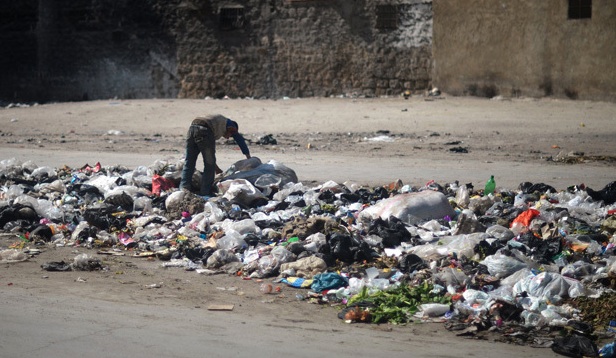
Up to 95 percent of the coastal aquifer that supplies the Gaza Strip’s water has been contaminated with chemicals, saltwater and sewage, according to The Independent. Already the number of children being treated for diarrhea has doubled in the past five years, a Save the Children and Medical Aid for Palestinians report shows.

The aquifer’s remaining five percent, the clean water, can really only be used for washing since it too ends up being contaminated in distribution pipes.

Desalination and public taps are an option for a small portion of the population, but the great majority of people have to pay for bottled water to satisfy their barest requirements.

“Families are paying as much as a third of their household income for water,” June Kunugi, a special representative of the UN children’s fund Unicef, told the paper.

The aquifer is unable to recover despite rainfall and runoff from the nearby Hebron Hills, since Gaza residents and Israeli farmers suck out more than double the amount of water seeping back in. As a result, seawater contaminated with sewage infiltrates the aquifer.

By 2016, the aquifer will be unusable, according to the UN, and by 2020, it could be lost for good unless action is taken now to address the problems.

Even though desalination plants are not feasible over the long term, they can produce vast quantities of potable water that will serve the local population. But these cost money to build and money to maintain and Gaza doesn’t have of that going around.

Foreign aid organizations offer the only real hope, and even Israel is scouting potential investors, a senior security official told The Independent on condition of anonymity.

“We have talked to everyone we know in the international community because 1.4 million people will be without water in a few years,” he said.

The Palestinian Water Authority (PWA) has plans to build a large desalination facility that could cater to more people, but it would cost nearly $500 million. Last year Europe announced it would help to finance a new plant with a 100 million cubic meter annual production capacity, but it is unclear whether that plan is still on the shelf.

Plus, as we’ve reported in the past, desalination plants require a lot of energy to run, so unless Masdar perfects its renewably-powered desalination plants in a big hurry, there’s a chance Gaza won’t be able to afford the fuel to power this and other plants.

A host of countries in the region face a fuel and water shortage, including Egypt, Lebanon, and Jordan. The Gulf countries aren’t short on fuel, though it’s not as abundant as it once was, but the majority of them have the cash flow to dig themselves out of the hole they’ve dug themselves.

Combine this with deadlocked politics and we have a potential humanitarian crisis on our hands.

:: The Independent

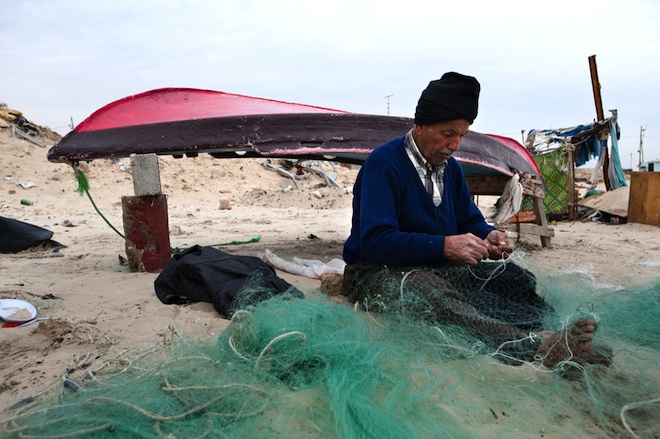
Image of Gaza fisherman, Shutterstock

Tafline Laylin
Tafline Laylinhttp://www.greenprophet.com
As a tour leader who led “eco-friendly” camping trips throughout North America, Tafline soon realized that she was instead leaving behind a trail of gas fumes, plastic bottles and Pringles. In fact, wherever she traveled – whether it was Viet Nam or South Africa or England – it became clear how inefficiently the mandate to re-think our consumer culture is reaching the general public. Born in Iran, raised in South Africa and the United States, she currently splits her time between Africa and the Middle East. Tafline can be reached at tafline (at) greenprophet (dot) com.

Read More

1 COMMENT

LEAVE A REPLY

Please enter your comment!
Please enter your name here

TRENDING

Desalination experts debunk Aqua Solaire, the floating desalination barge

AI makes it easy to dream, develop, and create images of what could be world-changing ideas, until the reality sets in. A new project making the rounds is Aqua Solaire, an allged French concept for a solar-powered desalination vessel designed to bring drinking water to coastal communities facing drought, storms, and infrastructure failures.

Abortion Pills, Plan B and Mifepristone and what the new US mail ban means

Abortion pills, often confused with Plan B (the morning-after pill), and historically referred to as RU486 (mifepristone), are part of a broader category of reproductive health medications that women have been using for decades. But they are not the same thing.

40 more migratory animals need protecting, warns UN group

The Convention on the Conservation of Migratory Species of Wild Animals (CMS), governments agreed to extend protection to 40 more migratory species, from cheetahs and striped hyenas to snowy owls, giant otters, and great hammerhead sharks. Too many of them are slipping toward extinction .

Nearly the half the world’s migratory species are declining, in new UN report for COP15

With larger, land-bound animals human encroachment and Middle East warns make it more troubling for the survival of migratory animals on land, air and at sea. A new United Nations report released this week warns that the situation is getting worse, not better.

How to quiet noise from construction in your office

Streets need to be resurfaced in New York but the humming and grinding noise is unsettling. Noise is environmental pollution. 

EarthX and a blueprint for sustainable investing

Trammell S. Crow, a Dallas-based businessman and father of four, is focusing his efforts on impact investing, and media that focuses on saving the planet through EarthX.

Mining Afghanistan’s Mineral Discoveries Similar to Avatar

Now that American forces in Afghanistan are commemorating the longest period of any war that America has been involved in, including the 1965-73 Vietnam War, the recent discoveries of large and extremely valuable mineral and metal deposits may finally bring to light a reason to continue the presence of US fighting forces in this war torn and backward country.

From Pilot Plant to Global Stage: How Aduro Clean Technologies’ 2026 Expansion Signals a Turning Point for Chemical Recycling Investors Like Yazan Al Homsi

The company's Next Generation Process (NGP) Pilot Plant in London, Ontario, has officially moved into initial operating campaigns, generating the kind of structured, repeatable data that separates laboratory promise from commercial viability.

Nobul’s Regan McGee on Shareholder Value: “Complacency Is the Silent Killer” 

Why the governance framework designed to protect shareholders so...

Should You Invest in the Private Market?

startustartup Unlike public stock exchanges, which offer daily trading, strict...

How to build a 100-year-company

Kongō Gumi is a Japanese construction company, purportedly founded in 578 A.D., making it the world's oldest documented company. What can we learn about building sustainable businesses from them?

How AI Helps SaaS Companies Reduce Repetitive Customer Support Work

SaaS products are designed for large numbers of users with different levels of experience, and also in renewable energy.

Popular Categories