
 This Green Prophet tours Turkey and sees a mosaic of eco-sensibility.
Little Eid, a Muslim holiday, is a great time for a getaway. So I reeled in my family from disparate zip codes for a week spent touring someplace new. Years back, plump thighs on my enormous babies tagged the kids as “turkey legs”. It feels right that we meet up in Istanbul. Turkey seems so sustainable. Look past the blinding kaleidoscope of colors and textures, tiled surfaces, carpets, spices and foods and spot clever detailing that tips off intrinsic enviro-awareness.
Atatürk International Airport has quiet little features that scream sensitivity to energy consumption. Overhead lighting throughout the main terminal is operated only when natural daylight is insufficient.
 Ceiling fixtures include artsy parabolic reflectors that amplify artificial lighting, bouncing brightness to the check-in counters and arrivals hall below.
Escalators spring to life when you alight, for an enormous power savings. Likely lots more happening there, and it warrants a closer look: this is just what I caught as we ran for a cab.
Turkey is clean. Very, very clean.
Unlike Amman, trash bins are everywhere in Istanbul and people use them. They come in all shapes and sizes.
 I saw covered metal bins, bigger versions of your kitchen pail: step on a foot pedal and the door pops open. The smart design keeps seagulls and cats at bay, and smells stay mostly inside.
But these gizmos have a brilliant maintenance feature: the bins sit atop enormous underground waste containers, giant metal boxes which are lifted out of the ground for efficient cleanout by special garbage trucks. (Jordan, are you seeing this?).
 Massive capacity to accept public waste means minimal garbage on footpaths and streets.
Even small businesses step up to the plate.
The two small city hotels we stayed in were loaded with green features. Sure, there were placards urging us to reuse towels, limit running water, and recycle newspapers. But these tiny businesses are as amped-up on efficiency as the airport.
Lights in hallways and public areas are on sensors, only flipping on when detecting human motion. Air conditioners shut off automatically when you leave the rooms, portable fans are available if you want to skip the AC altogether.
Open air roof decks make copious use of shading; beautifully landscaped spaces that tempted me to hang out all day, drinking Turkish coffee, reading the latest Elif Shafak novel, and watching ships on the Bosphorus (or the people on all the other roofs).
The concierges were fans of walking, offering detailed directions and best routes to anywhere we could name. For longer distances they tossed us maps for Istanbul’s three tramways and many small buses: these gents were all about avoiding taxis and rented cars. Sticking to the sidewalks, we experienced so much more.
 From windows in town and country alike, laundry hangs out to air-dry like Buddhist prayer flags.
Until this summer, I’d been five years without a clothes dryer. Line-drying is commonplace where I lived in Ireland (although it could take a week for things to actually dry).
And we air-dry in Jordan, but always indoors, or risk clothes that smell like diesel exhaust and cigarettes. Istanbul air is salty fresh.
Domestic hot water looks to be predominantly obtained through rooftop thermal heating units. Looking past the satellite dishes on city apartment buildings, I spied lots of solar panels.
 In the countryside, almost every roof wore a solar collector with a storage tank mounted right above the panel.
This type of system is especially efficient: hot water rises to the storage tank through natural thermosiphoning. No mechanical pumping is required.
With so many units installed, in every city we visited, I wondered if there was a national program to kit up each home.
Anyone have more info on this?If so, it’s an initiative worth sharing with Turkey’s neighbors in sunny Jordan, Israel, Syria and Lebanon.
 The only “wild” plastic bags I saw had been strategically placed in the landscape. They’re often used as planters edged along balconies and rooftops.
In rural landscapes, they’re intentionally tied to fruit-bearing vines and trees to keep animals and birds from stealing the fruit.
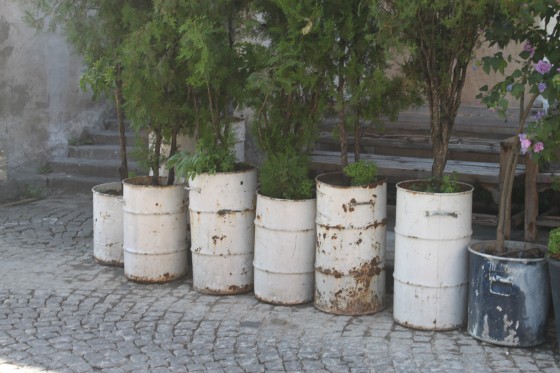
Other “trash” is also re-purposed. I saw plastic containers and old paint drums used as planters everywhere. Martha Stewart has nothing on these upcycling Turks.
So, yeah, maybe someone will pick up their camera to illustrate how unsustainable the country really is: expose me as being too dazzled by the beauty of this place to see it’s environmental warts.
But positive first impressions are potent. My family’s developed new “Turkey legs”: we will be back.