
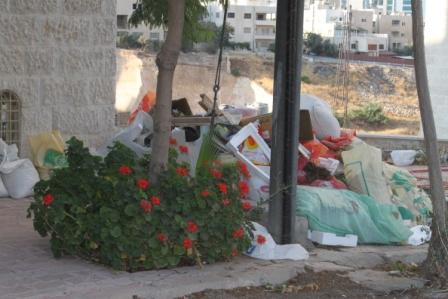

 Environmental campaign to rehabilitate litterbugs kicks off in Amman.
Plastic bags and cigarette butts are part of the natural landscape in contemporary Jordan. Bottles roll like tumbleweed across Amman’s early morning streets. Residents say the city’s sanitation services are deteriorating, according to The Jordan Times, but towering trash and burst garbage bags, overloaded waste bins and erratic municipal collection tell the story in more sensual way – the city stinks.
The problem doesn’t discriminate, residents in east and west Amman alike tell of smelly, rotting trash attracting flies, rats and feral cats, despite citizen’s paying regular sanitation fees as part of their monthly water bills.
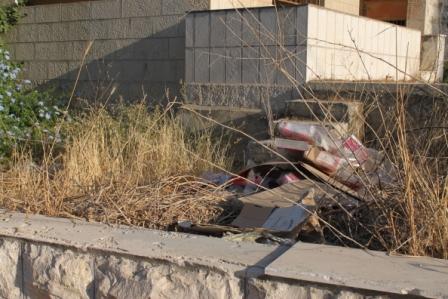 “Amman was never like this before. The piles of trash are so high that we can no longer walk in the streets”, said Bilal Abu Jaija, who lives in the Tlaa Al Ali neighborhood.
Osama Rabadi, visiting from the United Arab Emirates, found the litter condition shocking: “I would never imagine in a thousand years that Amman’s streets would be this dirty,” said the engineer, who was visiting his parents in Ashrafieh.
Parents are concerned about the health hazards of accumulated waste. Seham Obeidat said, “We wait for three days or so for the garbage collector to come. Flies are everywhere and the neighborhood stinks. We even stopped sitting on the balcony.” Obeidat lives near 7th Circle.
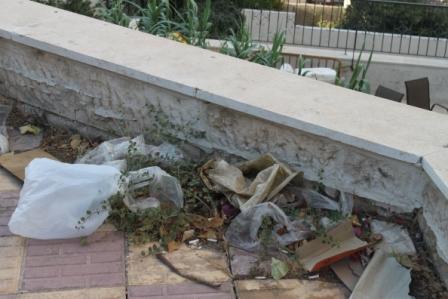 The fleet of municipal garbage trucks hasn’t been replaced or refurbished in five years, said Mohammad Amaireh, Director of the Greater Amman Municipality (GAM) waste department. And while GAM hasn’t hired new garbagemen nor purchased additional bins, they have launched a feel-good program to curb littering.
Sponsored by automotive service station conglomerate Total Jordan, GAM’s L’Amman Baitna’ (which translates to Amman, Our Home) encourages citizens to actively keep roads and byways clean.
Total, one of the largest oil and gas companies in the world, runs 21 service stations across the Kingdom. They’re handing out 10,000 waste bags at all their Amman stations, bags designed specifically for use in cars to help discourage roadway littering.
Mehmet Celepoglu, Total Jordan’s Managing Director, said, “In all our operations, Total Jordan strongly considers respect for the environment as one of our top priorities.” Their underwriting of the program is generous and well-intended. But why do I think the bags will be filled up and tossed out car windows?
Meanwhile, in Abu Dhabi, residents want city waste bins removed.
It’s a classic case of “you say toMAYto, I say toMAHto”.
While Ammanians are begging for more waste containers and better collection, people in Abu Dhabi are complaining because there are too many municipal garbage bins in their Al Saada Street neighborhood.
Residents told The National that the unsightly city bins block their car parking bays, and detract from “the area’s beauty,” imbuing the air with a foul smell of discarded food.
The Center of Waste Management (CWM) hired two companies to collect rubbish in Abu Dhabi city. The companies place large waste bins in populous neighborhoods and smaller ones elsewhere as needed. This particular part of the city is home to large villas, most of which have two or three containers along their frontage to support the high volume of waste that they generate.
The neighborhood is quiet in daytime, with plenty of parking. But in the evening, parking becomes problematic because bins block some spots. Some residents say the bins are frequently deposited on footpaths and in parking bays. CWM has requested inspectors to do an immediate site visit and come back with a full report in order for the management to take action.
Uthman Ahmed, a local, said: “These scattered bins generate a foul smell and it’s unhealthy. In the evening we can’t park as collection vans also come to collect the rubbish.”
Now, wait a minute. Garbage, not containers, generate bad smells. And the reason for dedicated trash drop-off points is so the trash can be systematically picked up. Maybe the containers aren’t closing properly or perhaps some training (as was done in Dubai) is needed for folks to learn to reseal lids after dropping in their junk.
Garbage trucks are loud and smelly. To avoid traffic problems, collection in New York City and Hoboken typically occur pre-dawn. I have the under-eye circles to prove this: but it’s the only way to sidestep conflict between car traffic and trucks.
Too few places to stow trash? Too many? In either case, the solutions are dependent on municipal assessment and action. Look to nations where garbage collection is a long-standing practice. Learn from their mistakes. Bottom line is waste management is a process dependent on regular action and quick response. Instead, there’s just a mountain of trash talk happening here.
Images taken today on my street in Jabal Amman


