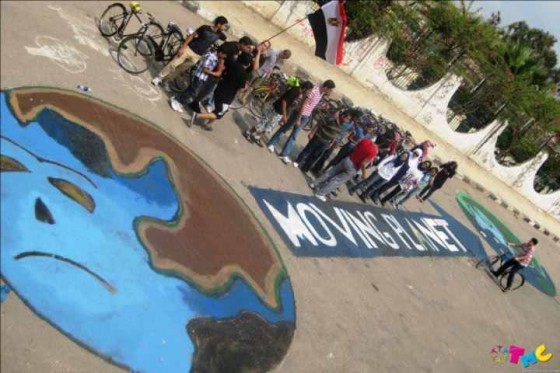

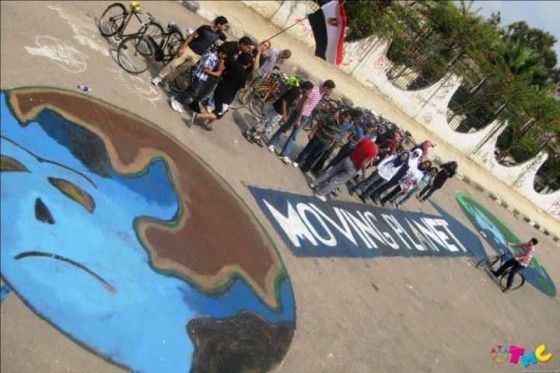
350.org proves that Egypt has an enormous reservoir of young and engaged people.
Scientists have determined that to keep the climate stable the average concentration of CO2 in the sky should be limited to 350 ppm, compared to the 400 ppm that was reached in 2012.
And while the science of climate change is solid, the efforts and initiatives to halt it remain defunct or insufficient. Nothing but a broad grassroots movement can change this, climate activists thought, and so they founded 350.org. Shortly after the main organisation was founded in theUSin 2008 Cairo joined in. During Climate Action Day in October 2009 fifty of them, packed with fancy bikes and a conscience, drove to the pyramids to organise a clandestine climate gathering and show the world they care.
And their madness didn’t stop. In November 2010 a thousand Cairenes gathered in Wadi Natrun to make a huge Scarabee visible from outer-space and promote the Global Climate Art Project that took place during the UN Climate talks.
And last month they organised their weekend-long Climate Leadership Workshop, to discuss techniques to gather people and search for ways to let Egypt benefit from their personal energy.
Climate Storytelling
It consisted of thirty young people with a proven interest in the environment, so it wasn’t a primer on climate change. No, instead it focused on how a movement is to be mobilised, using storytelling and other creative techniques.
The Green Arms’ Ahmed El-Dorghamy applied this, and showed off his storytelling skills to promote sustainable transportation to indicate the consequences our materialistic life-style and society have on the planet. He didn’t use statistics, or climate science to show this, but just showed how the car’s dominance deteriorates everyday life.
El-Dorghamy knows his priorities: He didn’t need to cite the amount of CO2, but instead used the ability of little boys to play football in the streets as the main elements in his discourse. And it is society that decides for us, Ahmed explained, if you want to marry a girl in your social circle, the first question your future father-in-law will ask is which automobile you have.
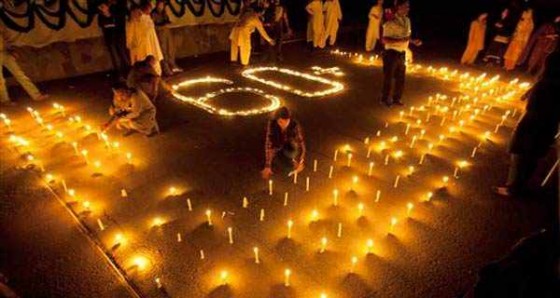
It goes even further, some of the participants explained me. While they’d rather be part of Cairo’s never-ending spectacle, society and state policy is designed in such a way that marrying means having to buy and relocate to one of the planned compounds in the desert.
Naivety and Naomi Klein
To me the workshop started to be a bit too introspective: could we just go on blaming ourselves, instead of focussing on the real pundits? Cairo might be very polluted, but you can’t really blame Egypt for climate change. If they were so naive to blame themselves more than the West, how could they ever stand up against the bad guys to force them to stop their bad practises?
So I asked them if crooks wouldn’t use climate change try to sell them technological solutions for the wrong problems. One of the attendees quickly replied that this isn’t a distant fear. Egyptians know well how the genetically modification lobby uses every reason possible to promote their crops, whether it’s fighting hunger or climate change.
Ahmed, another participant quickly responded that this is exactly how the system works: big corporations use disasters to change the system in their advantage, and he quoted Naomi Klein’s book “The Shock Doctrine”.
Sarah Rifaat, the Arab world coordinator, added that the Canadian Naomi Klein is actually part of 350.org’s Board of Directors. Naomi Klein is quite notorious, as her book No Logo played a big role in the anti-globalisation movement. Her recent joining of 350.org could mark a big trend. While environmentalism’s offspring and even recent history was mostly upper-class oriented it now seeks to reposition itself on the side of the weak, with a discourse similar to that of social and economic justice.
So what exactly is this environmental group? It tries to turn a wonky scientific target into a global movement, but consists of activists who care more about people than about nature. It’s simple: they don’t seem themselves as an organisation that is merely seeking to increase awareness but rather as a watchdog on environmental policy.
Naomi Klein explains that we need an organisation like 350.org because the way politicians an business people have used climate change and “made climate action look like just another opportunity for cronyism, helping to alienate a large sector of the public.”
Or as one of the participants said during the workshop, if Egyptian pressure groups can influence the government’s policy, the government won’t need to hire Japanese consultants to decide what is best for us.
In the US, 350.org’s actions got a tar-sands pipeline delayed that would have ruined all our present day climate change efforts.
They’ve also been fighting against fuel subsidies and the defunct mechanisms big business uses – such as cap and trade – to profit from climate change.
And how will 350 evolve in the Arab region? Sarah Rifaat explained me that their member group in Iraq, the Iraqi Civil Society Solidarity Initiative (ICSSI), is standing up against the Turks’ plan to build a dam on the Tigris river: this will destroy one of the oldest marshes in the world in the meantime.
They also groups in Oman and Egypt’s Mansoura, and launched programs promoting sustainable transportation and biking in the United Arab Emirates and Tunisia.
In Egypt, 350’s Cairo group is both cooperating with the Green Arm to set up biking initiatives, and Nawaya to promote permaculture, while people in the world’s most threatened metropolis, Alexandria, joined the popular protests against the Titat cement plant.
350.org once again proves that Egypt has an enormous reservoir of young, and engaged people.
Its strategic targets and campaigns have proved that they can make a difference on the American and on the international field, so it might be very interesting to see which direction 350 Egypt takes.
Will its activists focus on their city and try to shape it according to their vision? Will they act as the regional watchdogs for the greening of the economy? – like the Iraqi example suggests, or will they do the impossible and invent a movement that connects both the local cry for economic and social justice and a global care for the planet?
Check http://350.org/ for more information about 350.
Or their campaign http://www.climatedots.org/ to connect the dots on climate change and extreme weather.
350 Egypt’s Facebook Group; http://www.facebook.com/groups/160571285329/
An earlier interview with 350’s founder Bill McKibben http://www.greenprophet.com/2011/09/mckibben-protests-confrontational/