Plumbing the Mud in this Turkish Lake to Explain Climate Change

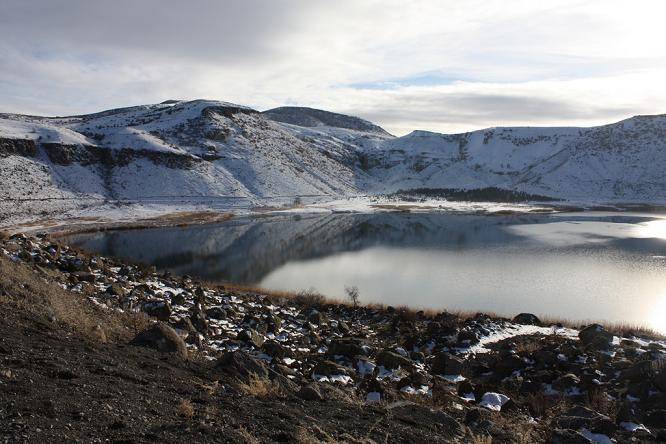
lake nar turkey, climate change mudLake Nar is in central Turkey, which was the epicenter of a disease that ravaged the Byzantine population 15 centuries ago. Climate change may have been a factor.

The Justinian Plague swept through the Eastern Mediterranean from 541 BCE to 750 BCE, killing approximately one quarter of the region’s inhabitants. Samples of sediment from the bottom of Lake Nar have shown that the outbreak occurred simultaneously with a shift in climate that could have tipped the disease into a full-blown pandemic.

Like Turkish falcılar, who tell fortunes from the sediment left in Turkish coffee cups, a team of scientists from Plymouth, Nottingham, and Birmingham Universities will conduct chemical studies on mud samples from Lake Nar to understand the history of climate change — and divine its future effects.

Their findings will be checked against historical texts that record the dates and locations of plague outbreaks.

The muds at the bottom of Lake Nar are “annually banded, similar to tree rings, and this enables us to reconstruct year-by-year variations in climate,” project leader and Plymouth University professor Neil Roberts said.

From sediment analysis, the team has learnt that the local climate became much wetter in the 6th century. This would have led to an increase in the number of flea-carrying rodents, which were the main agents of contagion.

Modeling future pandemics

Over the next 20 months, the scientists will also plumb the mud for answers to questions about how the plague affected local agriculture.

Better understanding the conditions that led to the Justinian Plague will enable scientists to model potential future pandemic scenarios under a changing climate, according to Roberts: “Many diseases like the bubonic plague, but also flu and malaria, are limited by environmental factors, including climate. If these natural controls alter in the future, then pandemics can become more likely. A warmer and wetter climate could lead to disease-carrying creatures which thrive in warm, moist environments spreading to new regions.”

The research is funded by the Natural Environmental Research Council (NERC) of the United Kingdom.

Read more about the environmental history of the Middle East:
Archeologists Discover Lost Language In Southeastern Turkey
Man Evolved When Elephant Meat Ran Out
Ancient Paw Print Found Near Roman Bath In Jerusalem

Image via NURETTIN MERT AYDIN

Julia Harte
Julia Hartehttp://www.greenprophet.com
Julia spent her childhood summers in a remote research station in the Rocky Mountains of Colorado, helping her father with a 25-year-old experiment in which he simulated global warming over a patch of alpine meadow. When not measuring plant species diversity or carbon flux in the soil, she could be found scampering around the forests and finding snowbanks to slide down. Now she is a freelance journalist living in Istanbul, where her passion for the environment intersects with her interest in Turkish politics and grassroots culture. She also writes about Turkish climate and energy policy for Solve Climate News.

Read More

LEAVE A REPLY

Please enter your comment!
Please enter your name here

TRENDING

5 projects to help kickstart your company’s sustainability journey 

True progress happens when environmental ambition meets action. Decarbonizing efficiently is possible for any business in any sector, but actually getting started can sometimes feel daunting.   The trick? It’s to start small and build momentum. Here are five potential projects to help you get started.  

Abortion Pills, Plan B and Mifepristone and what the new US mail ban means

Abortion pills, often confused with Plan B (the morning-after pill), and historically referred to as RU486 (mifepristone), are part of a broader category of reproductive health medications that women have been using for decades. But they are not the same thing.

Hormuz 2026 Conflict Poses an Energy and Food Security Dilemma in a Warming World

As tensions rise in one of the world’s most critical maritime chokepoints, the ripple effects go far beyond oil—touching food systems, climate pressures, and regional stability

Climate change traced in sea turtle shells

It's sea turtles which may in the end save islands in the Seychelles. They may also better help us understand climate change. Like rings on a tree, scientists have found a way to read sea turtle shells and how they are impacted by climate change tells a story. 

We’ve lived through the past 11 of the hottest years on record

Have we forgotten about global warming when the world...

How to quiet noise from construction in your office

Streets need to be resurfaced in New York but the humming and grinding noise is unsettling. Noise is environmental pollution. 

EarthX and a blueprint for sustainable investing

Trammell S. Crow, a Dallas-based businessman and father of four, is focusing his efforts on impact investing, and media that focuses on saving the planet through EarthX.

Mining Afghanistan’s Mineral Discoveries Similar to Avatar

Now that American forces in Afghanistan are commemorating the longest period of any war that America has been involved in, including the 1965-73 Vietnam War, the recent discoveries of large and extremely valuable mineral and metal deposits may finally bring to light a reason to continue the presence of US fighting forces in this war torn and backward country.

From Pilot Plant to Global Stage: How Aduro Clean Technologies’ 2026 Expansion Signals a Turning Point for Chemical Recycling Investors Like Yazan Al Homsi

The company's Next Generation Process (NGP) Pilot Plant in London, Ontario, has officially moved into initial operating campaigns, generating the kind of structured, repeatable data that separates laboratory promise from commercial viability.

Nobul’s Regan McGee on Shareholder Value: “Complacency Is the Silent Killer” 

Why the governance framework designed to protect shareholders so...

Should You Invest in the Private Market?

startustartup Unlike public stock exchanges, which offer daily trading, strict...

How to build a 100-year-company

Kongō Gumi is a Japanese construction company, purportedly founded in 578 A.D., making it the world's oldest documented company. What can we learn about building sustainable businesses from them?

How AI Helps SaaS Companies Reduce Repetitive Customer Support Work

SaaS products are designed for large numbers of users with different levels of experience, and also in renewable energy.

Popular Categories