
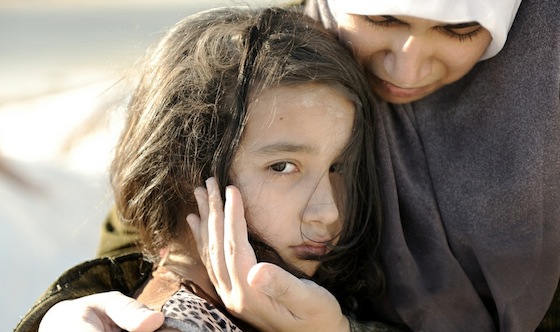
Refugees to Jordan Flow More Freely Than Water

arab refugees water jordanJordan’s hosting of forced migrants is overburdening already stressed water resources.

Humanitarianism has an unanticipated knock-on to fresh water supplies, as Jordan is starting to realize. Syrian refugees harbored in kingdom are draining the desert nation’s scarce water resources, reports Lebanon’s Daily Star. This presents a new setback for Jordan, one of the world’s most water-poor countries, where regional water shortfalls have been making alarming headlines.

Jordan’s average water consumption approximates 900 million cubic meters annually, with more than half consumed by agriculture. Annual per capita share is expected to fall to less than 500 cubic meters within three years: less than a tenth of the average world citizen’s share.  Annual per capita share below 500 m3 threatens human life.

This tiny kingdom has historically provided safe haven to refugees from neighboring Arab conflicts. Palestinians and Iraqis have emigrated for decades; more recently, Egyptians and Libyans sought entry.  It’s estimated that Syrian violence has resulted in over 120,000 new refugees, and inflow is steady.

“The majority of Syrian refugees are concentrated in the northern cities of Mafraq, Irbid, Ramtha, Jerash and Ajlun. All of these areas already suffer from water shortage,” said Fayez Bataineh, secretary general of the Water Authority.

“Each Syrian refugee needs at least 80 liters of water a day. The cost of this subsidized water supply is $18,000 a day, not to mention other related expenses,” said Adnan Zubi, assistant secretary general of the Ministry of Water and Irrigation. “The Syrians came from water-rich areas to almost parched parts in Jordan,” said Abdelrahman Sultan of the Jordanian-Israeli-Palestinian non-governmental group Friends of the Earth Middle East. “They consume water here the same way they used to consume water in their country.”

Cost is an issue, but supply is the more critical challenge.

“When my family fled to Ramtha from Homs several months ago, we could not find enough drinking water,” said Abu Eid, fther of six. “Sometimes, I avoided eating in order not to go to the toilet later because there was no water to wash.” Maher, a refugee now living in Ramtha, buys water every day. “We have water shortages all the time. I shower once every 10 days,” he added.

“This reliance on local services brings increasing pressure on the already vulnerable host populations of Jordan, as it is coupled with major water scarcity in the region, rising temperatures and a resulting negative impact on food production,” Aoife McDonnell of the U.N. refugee agency UNHCR Jordan said. UNHCR has been lobbying for international support of this looming crisis.

Jordan’s Ministry of Environment expects water demand to increase as refugees continue to pour in.  The country has been tackling chronic water shortage on several fronts.   A Red-Dead canal from the Red Sea to the Dead Sea vacillates between go and no-go. Expanded capacity in desalination is linked to the nation’s controversial nuclear development plans.  The ancient Disi ancient aquifer is being tapped into, as part of a water supply project exceeding $1 billion, despite concerns about high levels of radiation found in water samples. Grassroots public awareness campaigns aim increased conservation.

Jordan follows an open door policy, granting safe haven to Syrians who enter legally or illegally. More than 13,000 Syrians have been killed since the uprising against President Bashar Assad’s regime erupted in March 2011. “We did not wonder whether we would get enough water or not in Jordan. We just ran for our lives,” said Abu Eid.

Image of Arab refugees from Shutterstock

Read More

TRENDING

Hormuz 2026 Conflict Poses an Energy and Food Security Dilemma in a Warming World

As tensions rise in one of the world’s most critical maritime chokepoints, the ripple effects go far beyond oil—touching food systems, climate pressures, and regional stability

Dubai sets up smart feeding stations for abandoned cats

Dubai Municipality has set up 12 AI-powered "Ehsan Stations" to safely and officially feed strays. The city also officially supports Trap-Neuter-Return (TNR) programs. 

Eco organization offices destroyed by Iran missile

Tel Aviv's eco organization, the Heschel Center, was impacted by an Iranian missile.

What are AWG air-water generators, and why they aren’t a golden-bullet solution (yet)

Atmospheric water generators (AWGs) sound like magic: machines that can pull drinking water out of air. The idea is mentioned in the Bible, where the elders would pray for water collected as dew on plants and the catch on turning this into a machine is in the physics. To turn invisible vapor into liquid, you must remove heat, especially the latent heat of condensation.

Jordan’s $6 Billion Aqaba–Amman Desalination Project from the Red Sea Moves Forward

In 2025, the Jordanian government signed agreements with a consortium led by Meridiam and SUEZ, alongside VINCI Construction and Orascom Construction. Under a 30-year concession agreement, the consortium will design, build, finance, operate, and maintain the system before transferring it back to the Jordanian government. The total investment is estimated at approximately $6 billion USD.

Yerukim Forms a New Green Economy Where the Money is Really Green

The Yerukim members who pick up the recyclables get to keep the monetary reward, the public earns "green" bills that can be used in shops, and business owners get to be associated with environmentalism.

Choosing Riyadh over Dubai? What Investors Should Know

Saudi Arabia is deploying capital at unmatched scale to catalyze tourism and advanced industry while rewiring its power-and-water backbone. The investable frontier is widening—especially in renewables, grid storage, water efficiency/desal retrofits, and hospitality operating platforms. Prudent investors will insist on phased delivery, enforceable KPIs (energy, water, biodiversity), and RHQ/zone compliance—while pricing political-economy and reputational risks alongside growth upside.

Sell your cooking oil for biodiesel money

Want to make money on old french fry oil? Sell it.

Qatar Alternative Energy Summit Pairs Investors And Innovators

Alternative energy investors and innovators can meet n' greet in Doha, Qatar March 16 and 17.

Here’s How To Implement The Four Pillars Of Employee Engagement

If you throw a party for your work team and they are vegans, don't make it a barbecue. Know the sustainability values of your team to boost moral and retain good people.

Locals From Rishon Fight IKEA

Big Box stores are a pretty new concept in Israel, and thank God that not every Israeli city wants them in their backyard. A word from someone who has see the beautiful farmland around her hometown Newmarket, Ontario stripped and converted into vulgar strip malls of big box shops: they have no place in a healthy and sustainable town or city.

The Jewish National Fund Meets An Inconvenient Truth

According to the JNF, it has transformed thousands of acres of barren land into green forests in Israel. They state that each person emits about 23 tons of carbon per year, estimating that each tree planted can absorb one ton of carbon in its lifetime. That's a whole lot of trees you'd need to be planting. Could so many fit in Israel?

How to quiet noise from construction in your office

Streets need to be resurfaced in New York but the humming and grinding noise is unsettling. Noise is environmental pollution. 

Popular Categories