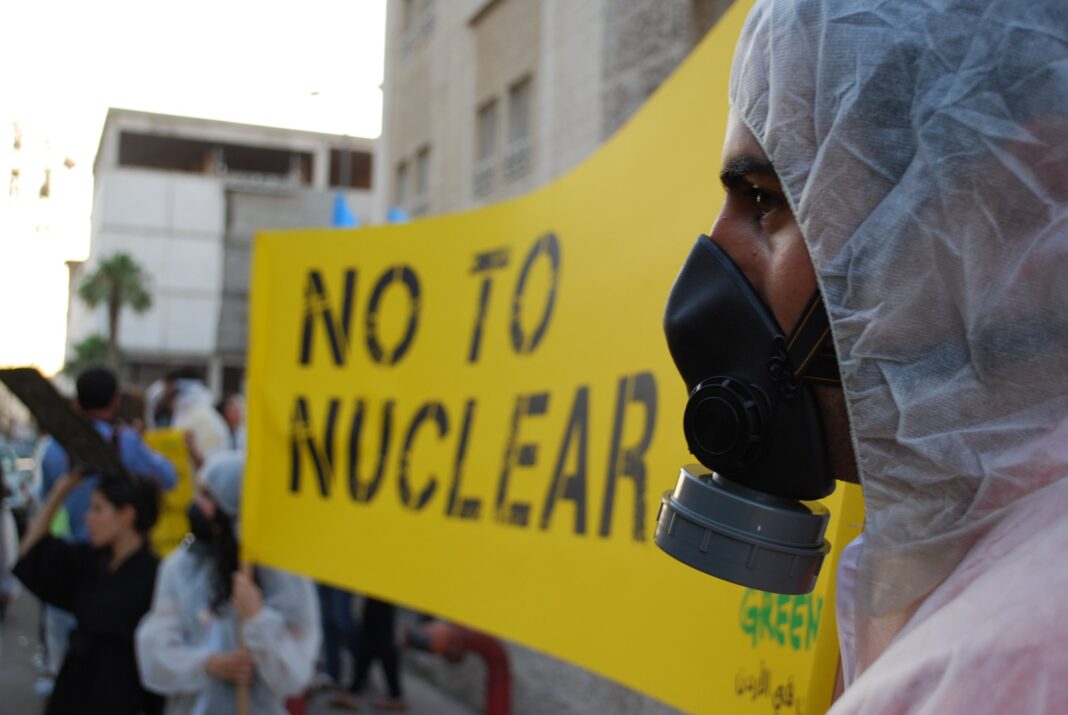
Jordan’s parliament voted last week to shelve the nation’s nuclear power program due to doubts over project financing. The action stopped this divisive project viewed by some as a solution to the country’s dependence on imported energy, and by others as a reckless use of resources with unacceptable risks. The vote suspended construction of Jordan’s first reactor and also the uranium mining agreement with French energy conglomerate AREVA. Both projects will remain inactive until new economic feasibility studies are completed.
A parliamentary report has alleged the $5 billion construction cost would likely triple when waste transport costs and decommissioning are factored in. The report also estimated Jordan’s uranium reserves at just 12,000 tons, less than 10 percent of the volume initially projected by pro-nuke analysis.
Environmental activists, including Dr. Ayoub Abu Dayyeh and Basel Burgan, have questioned the project’s burden on Jordan’s $4 billion USD budget deficit. Jordan’s water poverty requires increased desalination production or an environmentally dubious tap into the Red Sea to cool nuclear reactors: it’s uncertain if costs for either option are factored into the project price tag. Security is also a concern as a Generation III reactor could potentially place the Greater Mafraq area at risk of terrorism.
Nuclear proponents have championed the strategic importance of this 20-year master program to construct up to four reactors, emphasizing a need for energy security and protection from volatile fossil fuel pricing. Advocates also propose that nuclear development would position Jordan as an electricity exporter for the wider region.
Environmentalists say the kingdom can reliably provide domestic energy needs from renewable sources such as solar and wind, with equal exportation potential.
Despite the controversy, the program had been quietly moving forward. Last month, Jordan Atomic Energy Commission (JAEC) shortlisted Russia’s Atomstroyexport and a French-Japanese consortium consisting of AREVA and Mitsubishi Heavy Industries as project developers.
Donkeys and garbage collectors cause reaction against nuclear chief
At the same time, JAEC chief, Khalid Toukan, is being pressured to resign for alleged insults to local tribes residing in the vicinity of the proposed reactor site. Toukan, a former deputy prime minister, is accused of calling nuclear opponents “donkeys” and “garbage collectors.”
The remarks occurred in an audio recording believed to have been made last year but of unknown origin. He maintains that the tape, which is viral in local media, was fabricated as part of a nuclear smear campaign. His theory is that a cartel of 14 foreign governments and multinational companies has conspired to derail the Jordanian program.
Bassem Tweisi, political analyst and nuclear supporter, said in an interview with Haaretz that he also believes that there is an international agenda to strip the kingdom of its right to energy independence. “We cannot continue being dependent on foreign parties to support us with energy. We cannot have our electricity plugs switched off and on from abroad,” said Tweisi. “We do not have to put up with this pressure while knowing that the hazards of a third-generation nuclear reactor are less harmful than a soap factory.”
Would his sudsy comparison fly in Chernobyl, Fukushima, and Three Mile Island?
Dr. Abu Dayyeh, environmental activist, told The Media Line in a telephone interview, “We no longer have trust in the government and the commission over this project. The nuclear program must be terminated at any cost.”
JAEC’s $5 billion forecast for the 1,000-megawatt reactor is unsubstantiated by cost data relative to water cooling, the electricity demands, nuclear waste storage and ultimate system decommissioning.
Jordan bears a hefty foreign debt load, and like many of its regional neighbors, is experiencing rising unemployment and poverty. Parliament has accused Toukan of purposely misleading the public about the project’s feasibility in stressed economic times, understating costs to deter fiscal opposition. Jordan currently imports 98% of its energy at an annual cost approaching $6 billion. Just this week, the government enacted significant price hikes for fuel and electricity, an additional burden for the strained economy to bear.
Parliamentary voting on Toukan’s dismissal was planned for a special session to be held last week, but action was deferred, allegedly under pressure from the royal court. Against the backdrop of Jordan’s anti-corruption campaign, it’s unlikely that pressure on Toukan to resign will let up.
Jordan’s government is undergoing more change: another parliamentary poll will be held before the end of the year. The shifting economic and political sands make the winner of the nuclear debate difficult to call. Perhaps continued environmental activism will win the day. It’s a high stakes soap opera.
Image of nuclear suit from Shutterstock