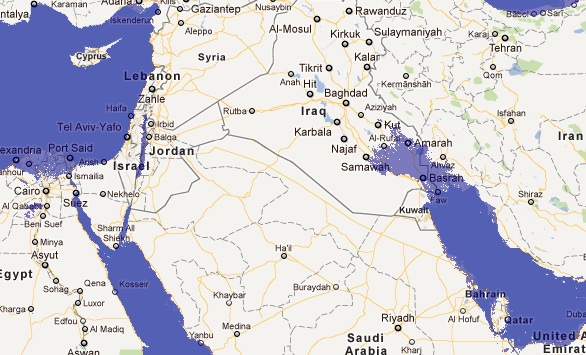
 What the Middle East will look like with a 9 meter raise. Play God with the online map to see what we’ll lose.
When you click around NASA’s online flood maps you can instantly view impacts on the world’s coastal communities. A single meter increase soaks Alexandria and Basra, and rattles the nerves of eastern Saudi shores. Jump sea levels 20 meters and Bahrain becomes an atoll, southern Iraq is submerged, and all of Cairo becomes beachfront property.
Primo guidance for dealing with a global warming apocalypse came in the 2nd best fortune cookie I ever opened: Hope for the Best, but Expect the Worst.
Water is the new frontier. We chart new territory determining how to preserve potable supplies and prevent catastrophies caused by severe weather and resultant flooding. As an architect, I’m drawn to the latter dilemma. I trainspot new schemes to protect our built environment.
Overpopulation in our cities means more building and paving. There’s less landscape to absorb rainfall, and poorly planned development can inadvertently channel water to drainage system pinch-points, causing localized flooding with unanticipated results.
I was sideline-involved in a brilliant project led by Dublin City Council (DCC): a 4-year pilot to render Dublin a “flood resistant city”. DCC partnered with local authorities in eight European cities, pooling talents to prevent both pluvial (rain) and fluvial (waterbody) flood events in urban settings. That EU-funded program focused on northwestern Europe, but their techniques are transferrable to coastal and urban places worldwide.
One specific concept was to capitalize on existing urban infrastructure. Instead of wrapping coastal dykes around town, integrate new protective barriers into what’s already built. Beef up street curbs and property walls; shore up the banks of local waterways. Expand on what exists so that, in a major flood event, roads would act as rivers and sidewalks as streams. These multi-functional hardscapes could channel flood waters to the city’s storm water drainage system, which would be adapted for higher capacity. A civil engineering version of the WWII credo “Make Do and Mend”. Good stuff.
Shortly after I left Ireland, a freak weather event teamed up with a storm surge to cause biblical flooding throughout Dublin. I figured friends’ stories were a bit of the Blarney until one sent me this link to amateur footage of city-wide effects.
[youtube]http://www.youtube.com/watch?v=HAozRKfTXjQ&feature=player_embedded[/youtube]
For obvious reasons, Irish and UK hydrogeologists and civil engineers are fronting some of the most innovative flood protection. UK flood specialists BACA Architects made a recent splash with their amphibious house.
An amphibious building follows the basic concept of a fixed dock. It’s tied to the ground via static structural foundations with sliding components. When tide movements or flooding occurs, the entire structure rises up along its fixed underpinning and floats in stable position, buoyed by the floodwater. It resumes normal setting when the waters recede.
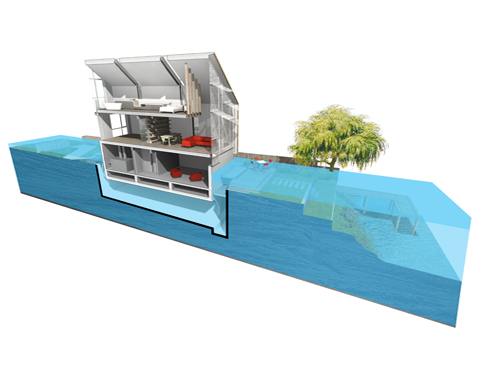
The house acts as a free-floating pontoon. The upper levels of the BACA house is constructed from lightweight timber. Its concrete basement sits inside a “wet dock”, essentially a pocket consisting of four retaining walls on a base slab.
The pocket acts as a bathtub, filling with water allowing the building to float like a child’s tub toy. A terraced garden ringing the property will help manage run-off when water levels start to subside.
The house, the UK’s first amphibious building, was recently awarded planning permission for construction on a island on the River Thames in Marlow, a tiny town about 35 miles west of London.
Maybe a bit goofball. Personally, I’d rather live in a houseboat than in a house that acts as a boat, but amphibious design can be a remedy for communities susceptible to radical rises in sea level and associated waterbodies: think monsoons, hurricanes, extremes in seasonal tides.
Rainsoaked northern nations are focused on flood-proofing their cities. Coastal communities in arid climates are more likely to be caught off guard by rising seas. Recall my stale cookie: make the message more relevant. Pray for the best, but be prepared for the worst.
Green Prophet will continue to report on a host of solutions that can enable us to adapt safely to the challenges of climate change.
Image of amphibious house by BACA Architects. Top image via flood maps.