
Will Ancient Mega Lake Bring Peace to Sudan?

darfur mega lake sudan

Can mega well bring peace to Sudan?

At least 300,000 people died and almost three million were displaced by the Darfur conflict in Sudan. Egyptian-American geologist Farouk El-Baz believes that limited access to water is one of the root causes of this conflict. Doctor El-Baz is director of Boston University’s center for remote sensing. He is known for his use of satellite images to search for water in the Mideast and North Africa. His work led to the discovery of a large underground water source in Egypt’s East Uweinat region near the borders with Libya, Chad and Sudan. This Nubian Sandstone Aquifer System (NSAS) contains over five million cubic feet of groundwater and is already bringing life and prosperity to a desolate part of the Eastern Sahara.
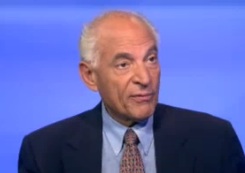
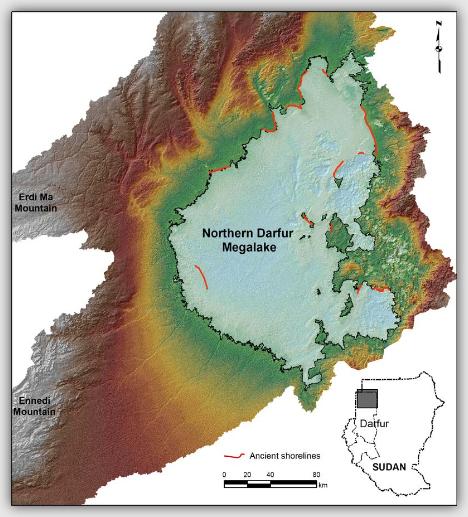
el baz mega lake waterIn 2007, Dr. El-Baz (left) used satellite-based ground penetrating radar to discover an ancient lake in the northern Darfur region of Sudan. At over 19,000 square miles this “Northern Darfur Mega-Lake” is vast– approximately the size of Lake Erie in North America.

Some time in recent geological history the lake slipped hundreds of meters beneath the desert sands and vanished from sight. Doctor El-Baz believes this underground lake can help restore peace to the Sudanese people so he proposed a 1000 wells project for Darfur.

[youtube]http://www.youtube.com/watch?v=d-XHFZyI9vs&feature=player_embedded[/youtube]

The discovery of this lake brings hope, but Sudan’s complex problems will not disappear overnight. El Baz says it took more than a decade to convince the Egyptian government to dig wells in the NSAS region. It will take time to access this newly discovered water beneath Darfur.

It is also true that unequal access to natural resources can fuel conflict. How will Sudan assure that access to this life-giving resource is shared fairly amongst the people who need it? The Nile waters agreement provides a template for a legalistic solution but what are practicalities of pumping this deep water and distributing it across such a large region? Hugon Kowalski of UGO Architecture & Design proposed an award-winning solution in the form of water tower skyscrapers. These multi-use buildings were inspired by baobab trees and would host a water-cooled hospital, school and offices along with the water pumps and treatment plant.

Mr. Kowalski’s dreams are large and bold as they must be for such forward- thinking designers. It is important to refine such ideas to best meet regional needs and to carefully consider the impact of mining fossil water in this part of the world. But the people of Sudan may not have the luxury of time to wait for a perfect solution.

Brian Nitz
Brian Nitzhttp://www.greenprophet.com
Brian remembers when a single tear dredged up a nation's guilt. The tear belonged to an Italian-American actor known as Iron-Eyes Cody, the guilt was displaced from centuries of Native American mistreatment and redirected into a new environmental awareness. A 10-year-old Brian wondered, 'What are they... No, what are we doing to this country?' From a family of engineers, farmers and tinkerers Brian's father was a physics teacher. He remembers the day his father drove up to watch a coal power plant's new scrubbers turn smoke from dirty grey-back to steamy white. Surely technology would solve every problem. But then he noticed that breathing was difficult when the wind blew a certain way. While sailing, he often saw a yellow-brown line on the horizon. The stars were beginning to disappear. Gas mileage peaked when Reagan was still president. Solar panels installed in the 1970s were torn from roofs as they were no longer cost-effective to maintain. Racism, public policy and low oil prices transformed suburban life and cities began to sprawl out and absorb farmland. Brian only began to understand the root causes of "doughnut cities" when he moved to Ireland in 2001 and watched history repeat itself. Brian doesn't think environmentalism is 'rocket science', but understanding how to apply it within a society requires wisdom and education. In his travels through Europe, North America, Asia and the Middle East, Brian has learned that great ideas come from everywhere and that sharing mistakes is just as important as sharing ideas.

Read More

3 COMMENTS

TRENDING

Can Scientists Predict Coral Bleaching Before It Happens?

Now researchers at the Woods Hole Oceanographic Institution (WHOI) in the US say they have developed a way to predict coral bleaching five to six months before it occurs, potentially giving reef managers enough time to intervene and save vulnerable corals.

AC Water Uses: How to Reuse Air Conditioner Condensate Water for Plants, Cleaning and Water Conservation

That means the water dripping from your air conditioner may already be usable for gardening, cleaning, flushing toilets, topping up humidifiers, or cooling systems — instead of disappearing into the sewer. A new study. Is it safe?

Hormuz 2026 Conflict Poses an Energy and Food Security Dilemma in a Warming World

As tensions rise in one of the world’s most critical maritime chokepoints, the ripple effects go far beyond oil—touching food systems, climate pressures, and regional stability

Baby teeth read like tree rings paint a picture of toxins in early life

A new study from the Icahn School of Medicine at Mount Sinai in New York offers a striking insight into how the environments we are born into can quietly shape our brains years later. By analyzing naturally shed baby teeth, the ones tucked under pillows for the tooth fairy, researchers have reconstructed a detailed timeline of exposure to environmental metals during pregnancy and early infancy.

Poop in the East River shows the city’s rat problem and what people like to eat

New York ecology and health can be monitored by a jug of water a week.

Yerukim Forms a New Green Economy Where the Money is Really Green

The Yerukim members who pick up the recyclables get to keep the monetary reward, the public earns "green" bills that can be used in shops, and business owners get to be associated with environmentalism.

Choosing Riyadh over Dubai? What Investors Should Know

Saudi Arabia is deploying capital at unmatched scale to catalyze tourism and advanced industry while rewiring its power-and-water backbone. The investable frontier is widening—especially in renewables, grid storage, water efficiency/desal retrofits, and hospitality operating platforms. Prudent investors will insist on phased delivery, enforceable KPIs (energy, water, biodiversity), and RHQ/zone compliance—while pricing political-economy and reputational risks alongside growth upside.

Sell your cooking oil for biodiesel money

Want to make money on old french fry oil? Sell it.

Qatar Alternative Energy Summit Pairs Investors And Innovators

Alternative energy investors and innovators can meet n' greet in Doha, Qatar March 16 and 17.

Here’s How To Implement The Four Pillars Of Employee Engagement

If you throw a party for your work team and they are vegans, don't make it a barbecue. Know the sustainability values of your team to boost moral and retain good people.

Locals From Rishon Fight IKEA

Big Box stores are a pretty new concept in Israel, and thank God that not every Israeli city wants them in their backyard. A word from someone who has see the beautiful farmland around her hometown Newmarket, Ontario stripped and converted into vulgar strip malls of big box shops: they have no place in a healthy and sustainable town or city.

The Jewish National Fund Meets An Inconvenient Truth

According to the JNF, it has transformed thousands of acres of barren land into green forests in Israel. They state that each person emits about 23 tons of carbon per year, estimating that each tree planted can absorb one ton of carbon in its lifetime. That's a whole lot of trees you'd need to be planting. Could so many fit in Israel?

How to quiet noise from construction in your office

Streets need to be resurfaced in New York but the humming and grinding noise is unsettling. Noise is environmental pollution. 

Popular Categories