

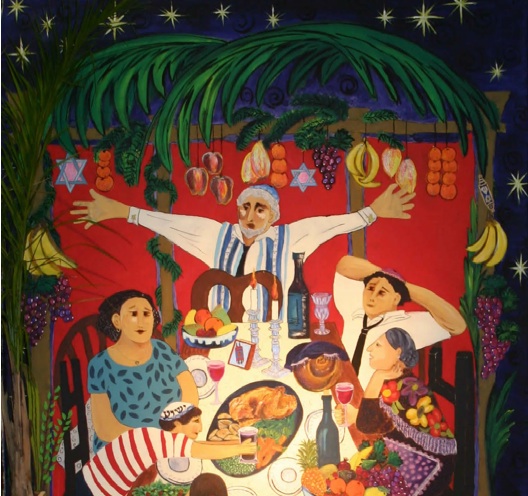
As the Jewish holiday of Sukkot approaches, it is only natural for us to reflect on the state of the planet’s health and well being. After all, it is harvest season in the Holy Land and Sukkot is a holiday that for some raises the consciousness about our environment. Jews live in huts thatched with bamboo, shake palm fronds, aravot, inhale the sweet scent of etrogs (yellow citron), devour seldom eaten fruits, and for the most part attempt try to be one with nature.
The Jewish people have a special connection with one of the essences of life. Water. While on Yom Kippur, we are judged for our sins (while staying away from water), biblical texts tell us that on Sukkot we are judged for water.
Water: such a basic thing. So needed. And unfortunately, needlessly wasted. Lack of it is known to be one of the leading causes of death in the world. Can we live without wine? Absolutely. Sad. But true. Yet we rarely see someone wasting wine because there is a price to pay – sometimes as much as $100 a bottle on the low end.
Drinkable water comes out of most faucets free of charge in the civilized world. If we pay for it like we do where I live in Israel, the cost is relatively minimal especially when considering it is an essence of life itself.
Over the years I have come to conserve water in simple yet effective ways, and while in the general scheme of things it contributes little, if everyone took these steps, it would mean a lot to our planet and human kind.
Indeed, there is a famous Talmudic principle, a central text to Jewish study, that translates to: “A person should not dump out water from his pit when others are in need [of the water].”
Dancing for water
During the intermediate days of the Sukkot holiday called Hol Hamoed, there are also would-be gatherings and festivals with music and dance known as Simchat Beit Hashoeiva. These gatherings commemorated the water libation ceremonies in which water was carried up the Jerusalem Pilgrim Road after departing from the Pool of Siloam and finally to the temple in Jerusalem.
A ritual known as the “Pouring of the Water” was held on all seven days of Sukkot. The person who did the pouring was told to raise his hands so everyone could see him pouring water on the altar. This came about because there was once a priest who spilled the water on his feet and was pelted by the crowd. Ouch. I wonder what they did to bad comedians.
Sukkot is definitely a time to reflect on how harvests in the future might be endangered by water shortages. If there is no water, there is no food. If there is no food, there is no life. So, let’s all try to be a bit more conscious about water conservation.
Here are a few tips that can help us conserve the most precious resource on earth. There are quite a few ways to conserve water, but the #1 way starts with you. You have to want it.
1. Don’t leave the water running when brushing your teeth or shaving
2. When doing the dishes, fill up one sink to rinse, so you do not leave the water running.
3. Ensure your sprinkler system is targeting the grass and plants and not the sidewalk, street or your car.
4. Run the washing machine and dishwasher when full. This can save up to 1,000 gallons a month.
We hope these tips can help start you on your way to a new year of peace, happiness and more water. Wishing Jewish readers a Shana Tova (A Good Year) and Chagim Smechim (Happy Holidays).
Note: Sukkot is also spelled Succoth, or Succot.
Image via eventsinbeithallel



I can assure you that water is far from free of charge in England and Wales. Where people have water meters individuals have an incentive to reduce the amount consumed by sensibly limiting the amount we use, but those with large families often avoid this by refusing a meter and paying a flat rate, which may be as much as £600 per year.