

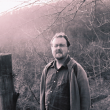

Ken Finn is a passionate man. Sitting with him in his Brighton kitchen (which he built himself), our conversation ranges from his book, ‘My Journey With a Remarkable Tree’, to the current state of the economy: “We’ve got to decouple the juggernaut [of economic meltdown] that is hurtling towards us” is a memorable quote from him: to the recent summer of unrest throughout the UK, and both the malaise and regeneration of human, tribal, society, to an exploration of the benefits of travel and our human stories.
I’m here to talk to him about the book, and to be interviewed for his radio show (more about this later), but mainly because since we met at the UKAware Festival 2 years ago in London, I’ve wanted to catch up and have a longer conversation with this deeply engaged individual. I find him warm, deeply articulate and insightful on what he sees around him.
Ken’s concerns start on a very local level, from the foxes and huge seagulls that seem to dominate Brighton, to the slowly building strength of the Green Party locally – they control the Local Council and Caroline Lucas (the GP Leader) is the local MP, both firsts in a stagnant British political system; through to deforestation and the ruination of the world’s natural resources, and particularly on to the human story of Sena, a key character in the book, whose life was threatened in Phnom Penh and who has recently fled to Holland.
 ‘My Journey’ is both a travelogue of Ken’s movement with a mission through Cambodia and Vietnam, and a tragic, dispiriting account of the impact human greed has upon the forest and those who have depended on it for their livelihood and well-being for centuries.
When I read of the corrupt rangers being bought by local province governors and politicians not to protect the forests but instead to allow them to be clear-felled and destroyed in the name of personal and corporate profit, I felt as sick as the author. He travelled with various guides (Sena being the most involved with the campaign against felling) and met Shamen and forest dwellers who revere their spirit trees.
Some of the book reads like a lulling motorbike read, bumping along forest tracks, immersed in sights and thoughts of food and the oddness of global travel, and then he is into an encounter and right into the experience, for good or ill – such as with the guards at a checkpoint who after consuming a crate of beer, suddenly seem to understand English, or the times he gets trapped into tourist nightmares and tries to wriggle out.
“I was ready to ask the questions I’d wanted to ask since I’d arrived. “So do you use any Cambodian timber?”
“No, nothing from Cambodia.”
I changed track, “My clients only want to buy environmentally sound products. What safeguards to you have in place to make sure that what you use is sustainable?”
“Everything is FSC certified, so you know it’s sustainable. See it’s here in our brochure.”
I could feel myself going red, ‘the fucking liar’ I said in my head but kept cool. “But that can’t be. Laos and Vietnam have no FSC accredited forests and there are only three small ones in the whole of Malaysia.”
Now he wasn’t sure, I’d set off alarm bells and definitely pissed him off.
“No, everything is sustainable.” He was closing the books and closing our meeting. He was avoiding eye contact too. He didn’t mean it of course but he didn’t know if I was trouble. I hoped I could be.
“Of course, I will be in touch.” I said, somehow wanting it to seem like a threat. It was over and Hai walked me out to the car. I let out a shout inside my head.”
All of us who’ve travelled and found ways to engage with communities will identify with this book. I understand when Ken tells me about the struggles to continue the campaign, and re-adapting afterwards to our Western lifestyle, where casual consumer use and throwaway culture still predominates. Garden furniture (and many other wood products) is everywhere in the UK and the Middle East, and much of it remains made out of illegal timber. Always look for the FSC logo I preach (Forestry Stewardship Council).
‘My Journey’ is also a book to invigorate anyone who believes in protecting something natural: a kind of manual for the journey. We will not win all our battles, much will be lost, but the journey itself is often remarkable. Thanks Ken for articulating that passion.
http://www.eye-books.com/remarkabletree/author.htm
Ken Finn also hosts a radio show, ‘Earth Boots’, on Brighton community Radio. Find podcasts from his shows, and one featuring our extended conversation, at: http://kenfinn.podomatic.com/entry/2011-10-03T16_45_21-07_00 his own website is at: http://www.ken-finn.com/
Read more Book Reviews on Green Prophet:
Book Review: Plastiki – Across the Pacific Ocean on Plastic



Thanks for the great review, will definitely buy Ken’s book. One thing, the reliance on FSC certified furniture to ensure sustainable raw materials could be ill-judged. I managed a furniture company in Vietnam for 2 years and my organization TFT, works there now to ensure traceability. There’s a LOT of cheating and FSC systems can’t detect illegal wood. FSC certified is not a solution.