
Book Review: Plastiki – Across The Pacific Ocean On Plastic

plastiki, graham hill, treehugger, pacific oceanA good friend of David de Rothschild’s, Treehugger founder Graham Hill takes the Plastiki helm

Theirs was one of 2010’s most talked-about, scoffed-about, and dreamed-about adventures: sailing across the Pacific Ocean in a boat made from plastic. Spontaneously envisioned to save our oceans from plastic pollution created by a now global society of waste, the Plastiki journey was rife with pitfalls. Delays. Storms. Politics. Graham Hill from Treehugger even lost the skin on his hands during part of the journey.

But in his new book Plastiki – Across The Pacific On Plastic: An Adventure to Save Our Oceans, David de Rothschild chronicles something even more important: the human spirit’s remarkable compass. Nine riveting chapters filled with anecdotes, diary entries from the crew, and op-eds from other eco-pioneers are imbued with the kind of tenacity that has plied oceans and crossed deserts for hundreds of years. David celebrates this. Indeed, his book is a kind of ouija board that evokes the best in humans, the qualities necessary to save the world.

plastiki, pacific ocean, plastic boat

One of the biggest challenges facing environmentalists, humanitarians, and scientists is this: how do we sound the numerous environmental and social alarms facing our civilization (and they are loud!) without boring people to tears, or without scaring them into apathy? Plastiki answers this question with adventure.
vertical garden, plastiki, david de rothschild

The word Plastiki is a marriage between Plastic and Kon-Tiki – the name of the raft used by Norwegian explorer Thor Heyerdahl in his 1947 expedition across the Pacific Ocean. (Thor’s grandson was one of the Plastiki crewmen for part of the time.)

What David and Thor have in common is the willingness to dream the undreamable, to do the undoable, to take extraordinary risks and live to tell the tale. The idea is that these adventures will inspire everyday people to take similar risks in their lives, which will in turn lead to a re-thinking of how we design and use material things. And it works.

Run by the amazing Jo Royle, the crew demonstrates that our current consumption patterns – based on extraordinary waste – can be overcome. With quite a bit of spit, ingenuity, gumption, and yes, tenacity, we can build boats that do not harm the environment. We can grow food in the middle of the Pacific ocean. And we can even charge our ipods and rock out to God of Thunder during a storm – if we want to. The point is, and Plastiki makes this clear, anything is possible.
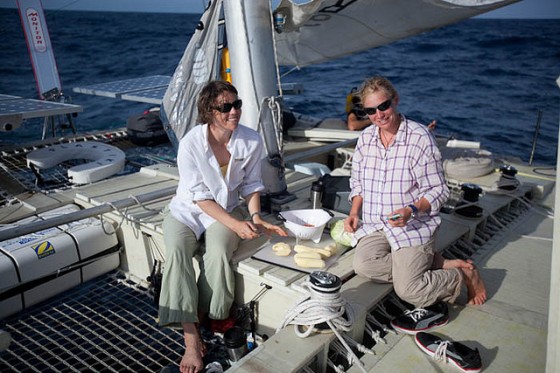
plastiki, jo royle, Singeli Agnew

That readers also walk away feeling informed without being beaten over the head may be the book’s most fundamental genius. All of the facts – which are more than dire – are presented with a “can do” attitude, with the sense that these are not insurmountable problems. David achieves this with the book’s colorful and playful visual presentation, and by making every chapter personal.

Our post-industrial consumption behavior has impacted our oceans in very destructive ways. Throughout the entire 8,000 mile ocean trek, the Plastiki crew saw only five marine mammals. Contrasted with the bountiful Kon-Tiki experience, this is as clear an indication of a sick ocean as we’ll ever get. It’s enough to sink anyone in despair.
boat made from plastic, plastiki

But David has braved these harsh realizations for us. In his book, he often reflects on his inner challenges. How people doubted him. The enormous technical task associated with making boats sustainably. His dreams. His dreads (such as returning to Los Angeles after spending several months out of the fray). At every turn, the Rothschild rebel child faces obstacles with courage and teamwork, all the while staying loyal to this fundamental premise: we can do better. And we will.

Plastiki comprises all the charm, wit, and good old-fashioned human grit necessary to move readers to take up the helm and steer our global civilization towards cleaner waters.

More Book Reviews on Green Prophet:
Book Review: A No-Nonsense Guide to Climate Change
Book Review: Animals in Islamic Tradition and Muslim Culture
Book Review: Strategy for Sustainability by Adam Werbach

all images taken from the Plastiki flickr photostream

Tafline Laylin
Tafline Laylinhttp://www.greenprophet.com
As a tour leader who led “eco-friendly” camping trips throughout North America, Tafline soon realized that she was instead leaving behind a trail of gas fumes, plastic bottles and Pringles. In fact, wherever she traveled – whether it was Viet Nam or South Africa or England – it became clear how inefficiently the mandate to re-think our consumer culture is reaching the general public. Born in Iran, raised in South Africa and the United States, she currently splits her time between Africa and the Middle East. Tafline can be reached at tafline (at) greenprophet (dot) com.

Read More

TRENDING

Are the Great Lakes polluted?

The Great Lakes may look pristine, but a new cleanup report reveals a growing tide of plastic pollution beneath the surface. From cigarette butts and food wrappers to tiny plastic fragments and discarded nicotine pouches, researchers are finding evidence that everyday consumer waste is making its way into North America's largest freshwater ecosystem. New technologies, including Canada's first BeBot beach-cleaning robot, are helping scientists understand how plastic travels through lakes, shorelines and stormwater systems before breaking down into microplastics.

Forever chemicals PFAS linger in German drinking water

Comprising more than 4,700 chemicals, perfluorinated and polyfluorinated alkyl substances (PFAS) are a group of widely used, man-made chemicals that accumulate over time in humans and in the environment. They are known as ‘forever chemicals’ as they are extremely persistent in our environment and bodies.

America makes new laws for slaughterhouse rules on wastewater

Building better environmental regulation in your country, province, state or city? Look to the EPA guide for starters. 

These worms eat plastic

Insect larvae are eating plastic. The secret is in their saliva. Try your own real experiments at home with plastics you find.

Recycle your contact lenses

New research presented by the American Chemical Society at their August meeting warned of the damage disposable contact lenses cause after they are flushed down our home plumbing, a daily habit of many of the 45 million Americans who wear them.

Yerukim Forms a New Green Economy Where the Money is Really Green

The Yerukim members who pick up the recyclables get to keep the monetary reward, the public earns "green" bills that can be used in shops, and business owners get to be associated with environmentalism.

Choosing Riyadh over Dubai? What Investors Should Know

Saudi Arabia is deploying capital at unmatched scale to catalyze tourism and advanced industry while rewiring its power-and-water backbone. The investable frontier is widening—especially in renewables, grid storage, water efficiency/desal retrofits, and hospitality operating platforms. Prudent investors will insist on phased delivery, enforceable KPIs (energy, water, biodiversity), and RHQ/zone compliance—while pricing political-economy and reputational risks alongside growth upside.

Sell your cooking oil for biodiesel money

Want to make money on old french fry oil? Sell it.

Qatar Alternative Energy Summit Pairs Investors And Innovators

Alternative energy investors and innovators can meet n' greet in Doha, Qatar March 16 and 17.

Here’s How To Implement The Four Pillars Of Employee Engagement

If you throw a party for your work team and they are vegans, don't make it a barbecue. Know the sustainability values of your team to boost moral and retain good people.

Locals From Rishon Fight IKEA

Big Box stores are a pretty new concept in Israel, and thank God that not every Israeli city wants them in their backyard. A word from someone who has see the beautiful farmland around her hometown Newmarket, Ontario stripped and converted into vulgar strip malls of big box shops: they have no place in a healthy and sustainable town or city.

The Jewish National Fund Meets An Inconvenient Truth

According to the JNF, it has transformed thousands of acres of barren land into green forests in Israel. They state that each person emits about 23 tons of carbon per year, estimating that each tree planted can absorb one ton of carbon in its lifetime. That's a whole lot of trees you'd need to be planting. Could so many fit in Israel?

How to quiet noise from construction in your office

Streets need to be resurfaced in New York but the humming and grinding noise is unsettling. Noise is environmental pollution. 

Popular Categories