

 Jordan is now months away from announcing the company they have selected to construct the country’s first nuclear reactor
Despite growing protests against the country’s nuclear plans from residents and environmentalists, the Jordanian government is pressing on with its nuclear programme. According to the local press, the government is expected to announce the name of the winning bid in November as the Jordan Atomic Energy Commission is currently assessing offers from three shortlisted companies. Here at Green Prophet, we have covered the mounting protests from the start and explored their concerns over safety and feasibility as well as the government’s justification of the nuclear reactor.
The Jordanian government wants to build a 1,000 megawatt nuclear reactor as part of its efforts to end its heavy dependence on energy imports. Raouf Dabbas, a senior advisor to the Ministry of Environment in Jordan told Green Prophet in a previous article that the country currently imports around 98% of its oil and energy from the outside, which is clearly problematic. The recent discovery of an estimated 100,000 tonnes of uranium reserves has meant that energy officials are now prioritising nuclear energy as key to achieving energy independence.
The nuclear plant will be located at Majdal, near Mafraq, which is some 40 kilometres northeast of Amman which is the capital of Jordan. However, residents from Mafraq and environmentalists have got together to form ‘Irhamouna’ (Have Mercy On Us in Arabic), a coalition to campaign against the nuclear plant and the dangers of nuclear power.
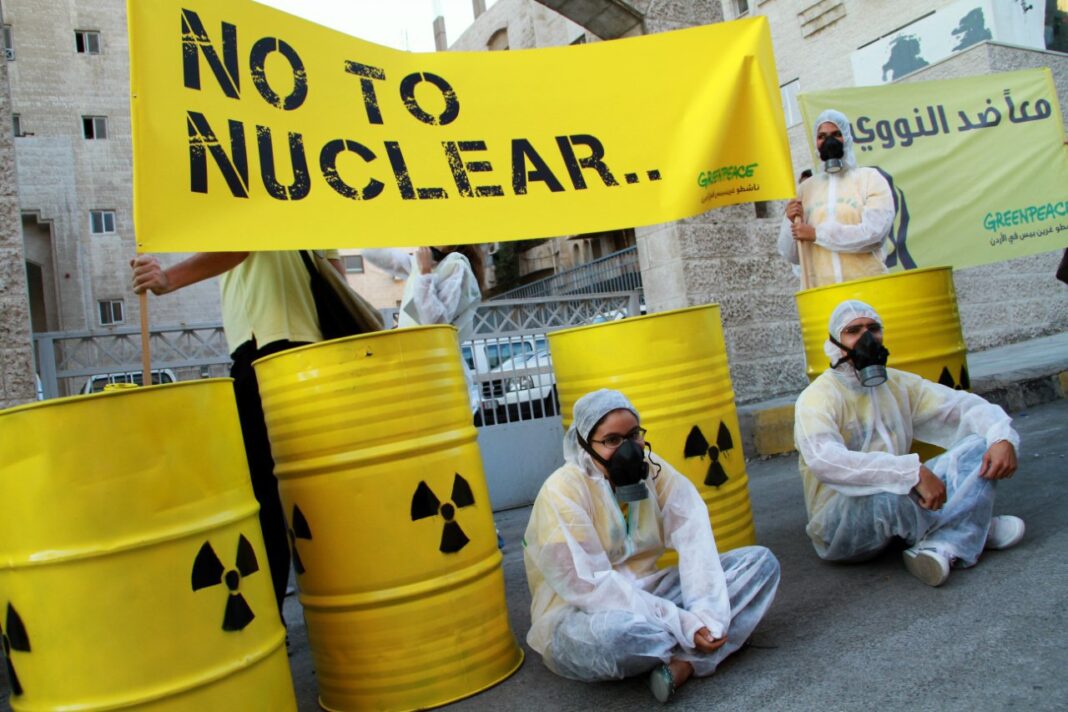
Around a month ago, Greenpeace Jordan staged a protest and remarked that the government needs to seriously reconsider renewable energy alternatives such as solar and wind power which provide clean and safe energy rather than relying on nuclear energy. Jordan has set itself the target of sourcing 20% of its energy mix from sustainable sources by 2020.
Nidal Hassan, organiser of Irhamouna told Jordan Times, that the residents will be putting up stiff resistance to the nuclear plans and added that “the people of Mafraq do not need and do not want nuclear power.” Protesters have remarked that nuclear power is dirty, expensive, uses up too much water for cooling (which Jordan can’t afford) and that there is still no solution for dealing with nuclear waste. Concerns have also been raised over safety as Jordan lies on a fault line with predications of a serious earthquake every 100 years.
The three shortlisted companies who have placed bids to build Jordan’s nuclear reactor are Canada’s AECL, a French-Japanese consortium comprising AREVA and Mitsubishi Heavy Industries, and Russian Atomstroy Export. Jordan’s nuclear power programme entails the construction of up to four plants to produce over half the country’s electricity needs
: Image via Mohammed Asfour/Greenpeace Jordan on Facebook.
:: Jordan Times
For more on Nuclear Power in Jordan see:
Jordanians Step Up Nuclear Protests
Canada, Japan, Russia and France Bid To Build Jordan’s First Reactor


I have heard ur coments guys and pity u, have u not heard of storing energy in molten salt, have u not heard that u have abundance of gas too, have u not heard that new techniques of extracting oil from shale produce less pollution than mining uranium…. Iam sad, u promised to fill me up with water from the Red Sea, what are u waiting for? I can give u electricity from hydro power, can desalinate water for u and stop the environmental and touristic degradation in the Dead Sea vicinity… Please don’t sell me for nuclear, Iam cleaner, safer, cheaper and more sustainable,
Kindly yours
Dead Sea
The pros outweigh the cons. The anti-nuclear lobby cannot come up w/any alternative but poorly produced arguments. For example, everybody knows that solar (CPV) only provides eight hours of electricity (micro-only) whereas CSP costs more than oil and gas to run per kWh! Wind only supplies eight hours (at best) and it is largely seasonal.
What’s the solution? Oil shale? That’s hypocritical considering it is more of a CO2 hazard than fuel oil.
Please check out “Pros and cons of nuclear power” (link below) and weigh the pros and cons for yourself… this really should be a no-brainer:
http://timeforchange.org/pros-and-cons-of-nuclear-power-and-sustainability
yes we need nuclear power
yes, Jordan do deserve a nuclear energy plant,and all others related facilities and products.
we can not as Jordanians trust any more our friends. neither Arabs, neither Jewish.
we have to built our own future.
Jordan is OK with agronomy,and now we must go on with industry which can not be don without strong energy, so let us go on
long live his Majesty king of Jordan.