
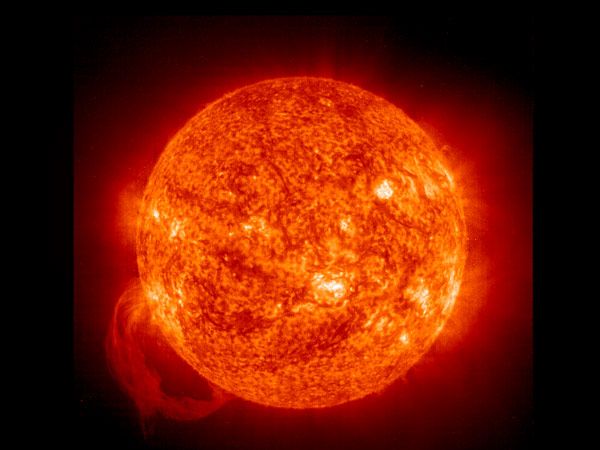

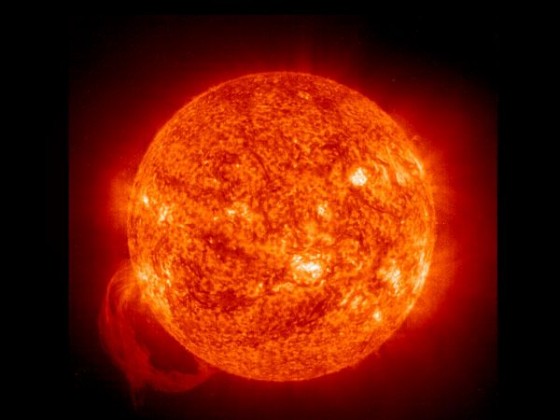
 A massive solar flare, like small one shown in this photo, could cause the world’s 440 commercial and 300 plus research nuclear reactors to melt down simultaneously.
The sun, that intensely hot ball of gases located 93 million miles from plant earth, has been the subject of numerous articles here, but mostly for good: for harnessing solar energy in an Israeli kibbutz for instance, as well as in other parts of the Middle East. A while back I speculated on the ideas of the electrical engineering genius Nikola Tesla, who believed it is possible to harness the radio magnetic waves generated by the sun to create “free electricity”.
But what would happen if things went terribly wrong in the event of a massive solar flare? According to a National Geographic report, a major solar flare known as the Carrington Event that was reported to have occurred in the year 1859 and recorded by a British astronomer Richard Carrington. It was so strong that people could read newspapers at night from its light. The latest report suggests if such a flare were to happen, the world’s power grids could fail. In long-reaching consequences, without power for days, or weeks catastrophes could happen.
 “Valentines Day” Auroa Borealis, Feb, 2011
Back then, the solar flare event was so unique that the auroras known as Northern Lights could be seen as far south as Cuba and “southern nights” from Antarctica as far north as Santiago Chile. Of course in that time, when the light bulb had not yet been invented, all that occurred were some temporary telegraph disruptions and the strange and even beautiful aurora phenomena.
But if such a solar flare were to occur today, the effect could disable and even destroy electricity and communication networks all over the world, causing massive power blackouts that might last for days or even weeks.
But the real danger we might all face from such an event could be the total meltdown of the reactors the world’s 440 nuclear power plants as well as another few hundred “research reactors” as some onlines sources point out. The two reactors in Israel alone are not in the best of shape as they were erected more than 40 years ago .
Damaged Fukushima reactors
The power grid destruction from a massive solar flare could disable the reactors and prevent their cooling systems from functioning, causing reactor meltdowns like those which recently occurred at the Fukushima Daiichi nuclear power plant in Japan.
The Fukushima reactor meltdowns, which released large amounts of radioactivity into both the atmosphere as well as the Pacific Ocean, is the worst nuclear plant accident since the 1986 Chernobyl one, according to anti-nuclear activist Dr. Helen Caldicott who Green Prophet interviewed.

Most people probably are not even aware of the more recent Valentine’s Day solar flare-up last February 2011, or the Halloween flare-up of 2003, which is said to have caused brief power outages in Sweden, interfered with satellite communications and created massive auroras that were seen as far south as Texas and southern France.
The effect of a massive meltdown of hundreds of nuclear reactors is something that might be reserved for late night horror movies. Its effect on human life, especially civilization as we are now accustomed to, would be devastating.
This scenario alone could well be a reason for countries to reconsider dependence on nuclear energy, especially large scale nuclear energy users like the USA (144 nuclear power plants), France (58 nuke plants) and Japan (49 nuke plants still operating). Not to mention the number of unstable Middle East countries like Jordan rallying to build their own reactors.
More articles about the sun, solar energy, and nuclear energy:
Arab Spring May Boost Chance for Desertec Solar Power
Dr. Helen Caldecott: Fukushima Nuclear Crises Much Worse Than Chernobyl
Were Tesla’s Solar Innovations Buried by Big Oil?
Japan Nuclear Meltdown Will Seriously Affect World Environment



The psalm of David and samuel 2 ;22, psalm; 18 look like ¨ The carrington event,looklike.
I don’t believe we will have a carrington event. I think the next solar flare will be so huge that it will cause immediate out of body experience.
In a dream I saw it after praying: Giant electric motors that draw kilowatts to operate are hooked directly to major power sources and are in direct danger of EMP damage. Giant electric motors operate to cool every nuclear in the world and any serious EMP event like the 1859 event will destroy these motors that can’t be replaced quickly. When the grid fails and these motors are down in a short time fires will erupt at overheated plants, smoke will spread fallout. These plants will become unapproachable and without the grid we face starvation, riots, fuel & water shortages and mass chaos. These motors are critical to keep reactors cool and without them backup generators are useless. The US government and others are not in the dark about this threat and yet they remain idle. Man is man’s biggest danger, Jesus saves and without him no flesh shall survive.
Jake, like the article says, there are now 440 commercial nuclear plants in the world, many of them using outdated technology. So, this could be the case with many of these plants – unless they have some type of back up power systems – and then what would power these systems in the event of a situation like a mega solar flare? Generators using diesel fuel perhaps
I can sum up this article in one word.
Facepalm.
I can’t speak for EVERY reactor on the planet. But the CANDU reactor would NOT melt down during a complete power loss. They are designed to use the natural covective circulation of coolant during a power loss to maintain safe core temperatures.
Thus, since I know not all reactors on earth will melt down, I find your article useless for any sort of argument you may have had.
I guess it’s no worse than the Armageddon movie with Bruce Willis when the giant asteroid is heading towards Earth.
I have been writing about this for a month or more,yes we could have a massive Magnetic flare,but what makes it worse,we are set-up from the Nuclear people,pushing the End of Earth with 440,reactors build in very dangerous locations all over the Earth.I believe this is a put up job,to maximize the Damage from a solar flare will cause Heavy,very heavy Radiation to kill Mankind on purpose!Your Time is running OUT!Do something to save the Earth.Close all reactors or face your own end.From a plan to exterminate Mankind for some reason.Maybe Alien directed,looks that way from my point of view.God,can not help us,if were all dead or dieing from radiation,we allowed this to happen.Now bite the bullet,they screwed us,building Death Reactors all over!!!
This sounds like crazy talk!