
Bonn: The Latest Climate Talks and the Middle East

bonn climate talks photoAn update on the latest climate negotiations in Bonn as well as Middle Eastern countries which made the headlines during the talks

Believe it or not, the latest climate negotiations at Bonn – which discussed the future of the Kyoto Protocol which ends in 2012 as well financing adaptation – have come and gone without making much of a stir. The lack of media attention is surprising, even if we take into consideration the total failure of Copenhagen and a growing realisation that climate summits are not where we are going to find solutions for climate change.

What isn’t so surprising is apparent failure of the talks to make any real progress towards setting legally binding targets to cut emissions or finance the developing countries so that they can move towards sustainability. It seems that after two weeks of negotiations, which ended on Friday 17th June, there is very little to show for it.

Saudi Arabia, Qatar, Kuwait and Oman

Whilst Middle East and North Africa nations were fairly absent from the talks, some countries did manage to make an impact. Unsurprisingly, Saudi Arabia made the headlines (again) for their attempts to delay the progress of the talks by insisting that agreement wasn’t necessary for another 18 months.

They were also keen to revive their demand that they should receive compensation for the loss of oil revenue in a post-oil future. Kuwait, Oman and Qatar were similarly criticized for holding up talks and were awarded the ‘Fossil of the Day’ by the Climate Action Network, which is an alliance of various green NGO’s.

Saving Kyoto Protocol

The rift between developing and developed countries seemed to grow as the G77 group (which consists of developing countries) pointed out that the money promised to them 18 months ago to allow them to adjust to climate change had not been delivered. They also demanded that developed nations commit to a 50 percent cut in emission below 1990 levels by 2020 under an extended Kyoto Protocol.

Egypt, speaking for the Arab Group, called the Kyoto Protocol the most important legal instrument addressing climate change and urged Annex I countries (developed nations) to respect their legal commitment to a second commitment period.  Apart from these brief mentions, the Middle East didn’t really get much of say in the talks.

The focus seemed to be more on the EU nations as they need to be working towards a new legally binding agreement to cut their emissions as well as providing adaptation funds for developing nations who will bear the burnt of climate-change induced disasters.

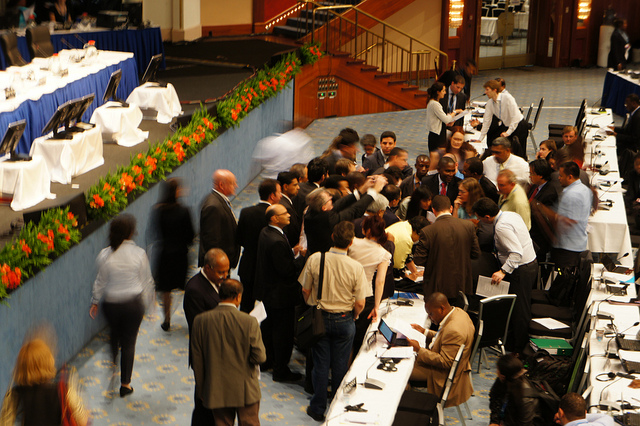
::Image via Adopt A Negotiator/flickr

Arwa Aburawa
Arwa Aburawahttp://www.greenprophet.com
Arwa is a Muslim freelance writer who is interested in everything climate change related and how Islam can inspire more people to care for their planet and take active steps to save it while we can. She is endlessly suspicious of all politicians and their ceaseless meetings, especially as they make normal people believe that they are not part of the solution when they are the ONLY solution. Her Indian auntie is her model eco-warrier, and when Arwa is not busy helping out in the neighborhood alleyway garden, swap shopping or attempting fusion vegetarian dishes- with mixed success, she’d like to add- she can be found sipping on foraged nettle tea.

Read More

TRENDING

Understanding Food Production: Karl Studer on the Urban-Rural Knowledge Gap

Karl Studer occupies an unusual position in American business. As President of Quanta Services, he oversees electrical infrastructure operations across the United States, Canada, and Australia, managing thousands of employees and multibillion-dollar projects.

Tigris River oil spill highlights Iraq’s environmental oversight and our addiction to oil

A fresh oil spill in the Tigris River, filmed by an Iraqi university student, has reignited concern over Iraq's polluted waterways. From ancient Mesopotamia to modern Basra, the country's dependence on oil has come at a steep environmental and human cost, with activists warning that unchecked contamination is putting ecosystems and public health at risk.

Wave wind energy for Nvidia’s next AI energy boom?

As AI factories consume unprecedented amounts of electricity, NVIDIA is looking beyond chips and data centers to the ocean. The company recently spotlighted Israel's Eco Wave Power and its wave energy projects in Jaffa and Los Angeles, highlighting how AI, digital twins and renewable energy can work together to meet future power demands. The collaboration reflects a growing realization that the future of artificial intelligence may depend as much on clean energy infrastructure as it does on computing power.

Weston Higginbotham found dead in a Kyoto forest: is climate anxiety part of the story?

In some ways, Weston has become a symbol of a generation wrestling with environmental and technological anxiety. Friends and family described him as deeply concerned about environmental issues. Reports also noted that he questioned the growing role of artificial intelligence in daily life, even reportedly disagreeing with his mother about her use of AI.

Billie Eilish’s Mom Takes the Stage at Hollywood Climate Summit — But Does Hollywood Still Care About Climate Change?

Hollywood once promised to help save the planet. Leonardo DiCaprio warned of climate catastrophe from awards stages. Celebrities flew to climate conferences. Studios pledged greener productions. Streaming platforms rushed to commission environmental documentaries. But in 2026, with the aftermath of wildfires, heatwaves and floods becoming routine, a question lingers: Does Hollywood still care about climate change?

Yerukim Forms a New Green Economy Where the Money is Really Green

The Yerukim members who pick up the recyclables get to keep the monetary reward, the public earns "green" bills that can be used in shops, and business owners get to be associated with environmentalism.

Choosing Riyadh over Dubai? What Investors Should Know

Saudi Arabia is deploying capital at unmatched scale to catalyze tourism and advanced industry while rewiring its power-and-water backbone. The investable frontier is widening—especially in renewables, grid storage, water efficiency/desal retrofits, and hospitality operating platforms. Prudent investors will insist on phased delivery, enforceable KPIs (energy, water, biodiversity), and RHQ/zone compliance—while pricing political-economy and reputational risks alongside growth upside.

Sell your cooking oil for biodiesel money

Want to make money on old french fry oil? Sell it.

Qatar Alternative Energy Summit Pairs Investors And Innovators

Alternative energy investors and innovators can meet n' greet in Doha, Qatar March 16 and 17.

Here’s How To Implement The Four Pillars Of Employee Engagement

If you throw a party for your work team and they are vegans, don't make it a barbecue. Know the sustainability values of your team to boost moral and retain good people.

Locals From Rishon Fight IKEA

Big Box stores are a pretty new concept in Israel, and thank God that not every Israeli city wants them in their backyard. A word from someone who has see the beautiful farmland around her hometown Newmarket, Ontario stripped and converted into vulgar strip malls of big box shops: they have no place in a healthy and sustainable town or city.

The Jewish National Fund Meets An Inconvenient Truth

According to the JNF, it has transformed thousands of acres of barren land into green forests in Israel. They state that each person emits about 23 tons of carbon per year, estimating that each tree planted can absorb one ton of carbon in its lifetime. That's a whole lot of trees you'd need to be planting. Could so many fit in Israel?

How to quiet noise from construction in your office

Streets need to be resurfaced in New York but the humming and grinding noise is unsettling. Noise is environmental pollution. 

Popular Categories