
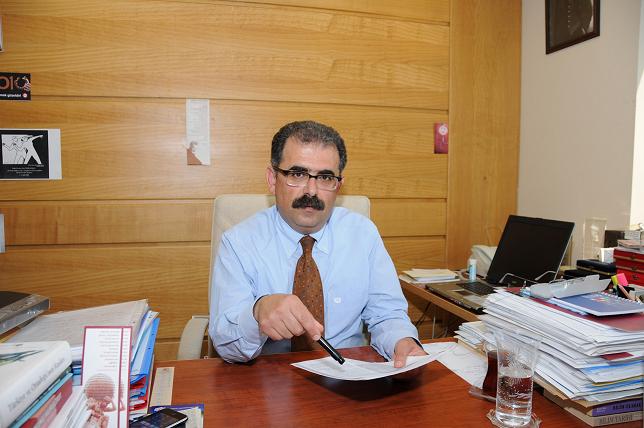

 The head of a Turkish university’s public health department was accused of “threatening to incite fear and panic” after he published a study showing high amounts of heavy metals in the local population.
After he found high levels of mercury and arsenic in mother’s milk and babies’ excrement from Dilovası, an industrial town in the northwestern Turkish province of Kocaeli, Professor Onur Hamzaoğlu published his preliminary findings in early January. At the end of last week, the town and regional mayors filed complaints against Hamzaoğlu with his university’s rector’s office, accusing him of willfully scaring the town’s residents with misinformation.
Hamzaoğlu, of Kocaeli University, could face two to four years in prison if the district court agrees with his accusers.
Kocaeli administrators and Turkey’s High Education Board will decide whether the case should go before the Kocaeli prosecutor’s office, in which case a full investigation will be opened into Hamzaoğlu’s research. If not, disciplinary actions may still be taken against him.
In the meantime, Hamzaoğlu is still preparing the rest of his report on toxic metal levels in the population. The final version will be released next month.
Hamzaoğlu began analyzing the population of Dilovası in 2005, at the behest of the Turkish Parliamentary Research Commission. Because of its proximity to sea, rail, and road transportation, the town has been the site of rapid industrial development over the past several decades. One hundred and ninety-three industrial organizations are active in the region, and about half the population of Dilovası is employed by an industrial operation.
As a result, Hamzaoğlu found, the rate of cancer fatalities in the town is three times the world average. The region is blighted with heavy pollution. But the number of industrial facilities in Dilovası continues to rise.
Hamzaoğlu has filed a counter-complaint against the mayors of Dilovası and Kocaeli, but there isn’t much else he can do besides wait and see if his university will stand by him or not. In Turkey, there is a long and dark history of environmental scientists and activists being sued into submission when they oppose large, lucrative enterprises such as fossil-fuel-fired power plants in their localities. Scientific ideas that are widely accepted elsewhere in the world, such as Darwinian evolution, are still controversial in this largely Muslim country; when the journal of Turkey’s science agency prepare to publish a front-page story on evolution in 2009, officials at the agency forced the editors to excise the entire article from the issue.
The Turkish government has also made a habit of pursuing economic progress at the expense of environmental and social welfare. When the prime minister recently visited the site of a spill that could turn into Turkey’s worst environmental crisis, he downplayed the risks, encouraging local residents to “not worry at all,” even as they were preparing to evacuate their homes. And even after the disastrous meltdown at Japan’s Fukushima reactor, the government went ahead with plans to build Turkey’s first nuclear plant on an earthquake fault.
Hopefully, Hamzaoğlu’s name will be cleared and his case will inspire other scientists to be upfront about scientific facts and environmental problems in Turkey.
Read more about Turkey’s environmental record:
Turkey Possibly Facing Its Worst Environmental Crisis Ever
Turkish Environmentalists, Architects Critical of Proposed Canal
Hydropower Could Meet More of Turkey’s Energy Demand – But At What Cost?
Image via Hurriyet Daily News


Well, this is bad, but I don’t know why such hatred in this article against Turkey or Turkish. Obama goes ahead with plans to pump more money into the nuclear sector as well, no matter Fukushima, and Creationism isn’t exclusive for Turkey as well. What did Turkish did to you, Julia?
@Karin: The good news is that for all the people who are sued and bullied into submission by companies, a few do manage to win court cases against their industrial foes. But that usually happens after a massive demonstration of public awareness and outrage. So in a very real sense, communicating these problems to the Turkish public is the best way to fix them!
@Tafline: I heard a similar story about China, but in the ’70s. Sad that countries are still resorting to these measures to avoid dealing with their environments! Great interview with the sheikh, by the way 🙂
Thanks for this. I heard a similar story in Dubai. A scientist (who I can’t name) was doing fish research and was essentially banned from Dubai for five years when he published his results. Publishing the facts appeared too much like a criticism of the regime. The King of Jordan recently published a memoir, employing total transparency, and the Green Sheikh believes in transparency too. Hopefully their example will eventually spread.
The fact that Jordan has an environmental journalist speaks volumes about transparency, even if she is politically motivated. How can we change the world without facts? Sounds like a frightening place to live.
At least in Turkey the media can write about it though. While you can’t mention even the name of the said scientist. Is she/he an expat or a local?
True, and Turkey is supposed to exist on the freer end of the continuum. My scientist friend is an expat, so maybe that is a factor?
This is crazy. Obviously scientists would be afraid to pursue the truth if this is what thanks they get. Julia – what do you think could be done to make sure the news gets out in a responsible way? Do local people just think it’s better to bury their heads in the sand? Or are the power companies just too powerful? Remember the movie Silkwood? Time to create a remake in Turkish!
http://www.imdb.com/title/tt0086312/