
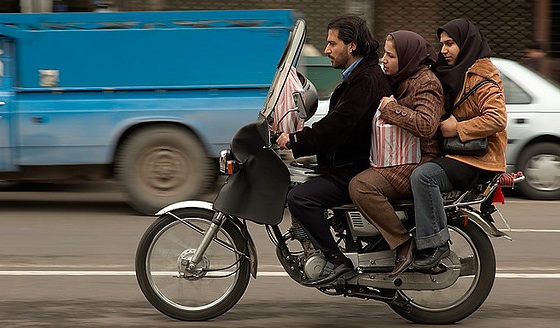
Motorbikes Produce Almost Half of Tehran’s Sound Pollution

iran tehran motorbikes imageYes, noise is a form of pollution from motorized vehicles that’s bad for your health.

Sound pollution in Iranian cities is hitting an all-time high. The large cities like Tehran are the worst. Sound pollution can be any unwanted or offensive sounds that unreasonably intrudes into our daily activities. When a person drives by open windows in a street, the sound is something like 70 decibels. A whisper is 35 decibels and a normal room has a sound intensity of 40 db. At 45 db a person cannot sleep. At 85, the ears are damaged, and at 120, it can hurt your ears.

The main reasons for sound pollution in Iranian cities are the sound of vehicles, airplanes, construction of buildings, small construction jobs and more. The most sound-polluted city in Iran is Tehran, which is now a city that draws the attention of the new comers by high amount of noise. This noise is much more felt in the central parts of the city.

The first reason for this pollution is the cars. Older cars usually produce more noise pollution. The second reason is the motorcycles. As Dr. Yousef Rashidi, the managing director of Tehran’s Air Quality Control Company says 49 percent of the sound pollution of Tehran is produced by motorcycles. These vehicles give out a 90 db sound. Airports and trains are other important contributors.

The statistics say that in most of the metropolitan areas of Iran the urban noise is 20 to 30 db higher than the allowed limits. But the government isn’t taking this problem seriously. Of course some partial steps have been taken during the last 10 to 15 years. Some sound walls on the two sides of noisy urban highways have been constructed, for when highways pass through the residential neighborhoods.

More severe actions are needed to combat sound pollution, an often overlooked form of pollution in the Middle East. The government and parliament of Iran should prepare strict laws like the Noise Control Act (NCA) of 1972 in the United States to save our health, and hearing.

Read more on Iran:

Traffic Fatalities in Iran: The Statics and Causes

Why 27 People Die from Air Pollution in Tehran

Lebanon’s Five Environmental Headaches

Image via Kamshots

Mehrdad Parsipour
Mehrdad Parsipourhttp://www.greenprophet.com
Mehrdad Parsipour is an urban researcher who is based in Germany. He is originally from Iran and is interested in the traditional urbanism and architecture of Iran and Middle East. Mehrdad’s other research interests are western traditional urban development trends, Islamic cities, and sustainable urban forms, and finally the environment. Since 1997 he has been working in the field of civil engineering, and also urban and regional planning.

Read More

2 COMMENTS

TRENDING

Dan Zaslavsky’s energy tower dream is rising again in Iran and China

The Energy Tower idea never made the leap from drawings and engineering studies to full-scale construction. But nearly two decades after most people stopped talking about it, the concept is quietly evolving in two unexpected places: China and Iran. The concept let dreamers dream and doers do - figuring out more pleasing designs and engineering.

Hormuz 2026 Conflict Poses an Energy and Food Security Dilemma in a Warming World

As tensions rise in one of the world’s most critical maritime chokepoints, the ripple effects go far beyond oil—touching food systems, climate pressures, and regional stability

A Fact-Based Reflection on Sustainability and Tourism in Hormuz

A Documented Response to the Article “The Aga Khan...

Dubai sets up smart feeding stations for abandoned cats

Dubai Municipality has set up 12 AI-powered "Ehsan Stations" to safely and officially feed strays. The city also officially supports Trap-Neuter-Return (TNR) programs. 

Yerukim Forms a New Green Economy Where the Money is Really Green

The Yerukim members who pick up the recyclables get to keep the monetary reward, the public earns "green" bills that can be used in shops, and business owners get to be associated with environmentalism.

Choosing Riyadh over Dubai? What Investors Should Know

Saudi Arabia is deploying capital at unmatched scale to catalyze tourism and advanced industry while rewiring its power-and-water backbone. The investable frontier is widening—especially in renewables, grid storage, water efficiency/desal retrofits, and hospitality operating platforms. Prudent investors will insist on phased delivery, enforceable KPIs (energy, water, biodiversity), and RHQ/zone compliance—while pricing political-economy and reputational risks alongside growth upside.

Sell your cooking oil for biodiesel money

Want to make money on old french fry oil? Sell it.

Qatar Alternative Energy Summit Pairs Investors And Innovators

Alternative energy investors and innovators can meet n' greet in Doha, Qatar March 16 and 17.

Here’s How To Implement The Four Pillars Of Employee Engagement

If you throw a party for your work team and they are vegans, don't make it a barbecue. Know the sustainability values of your team to boost moral and retain good people.

Locals From Rishon Fight IKEA

Big Box stores are a pretty new concept in Israel, and thank God that not every Israeli city wants them in their backyard. A word from someone who has see the beautiful farmland around her hometown Newmarket, Ontario stripped and converted into vulgar strip malls of big box shops: they have no place in a healthy and sustainable town or city.

The Jewish National Fund Meets An Inconvenient Truth

According to the JNF, it has transformed thousands of acres of barren land into green forests in Israel. They state that each person emits about 23 tons of carbon per year, estimating that each tree planted can absorb one ton of carbon in its lifetime. That's a whole lot of trees you'd need to be planting. Could so many fit in Israel?

How to quiet noise from construction in your office

Streets need to be resurfaced in New York but the humming and grinding noise is unsettling. Noise is environmental pollution. 

Popular Categories