

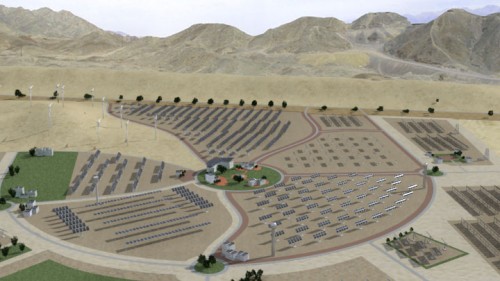
 A wind farm in Turkey. Should Turkey look east to oil-rich countries, or west to renewables?
Turkey seems to be becoming more interested in renewable energy these days, especially in the areas of solar, geothermal like that of Ormat, and wind energy.
But the future of this country, which straddles the link between east and west, appears to be centered around a proposed amendment to a renewable energy law (links to PDF) , which although passed back in May, 2005, has yet to really become the norm in a land that is trying to decide whether to align itself with the west, resulting in eventual EU membership, or renew its ties with the Islamic World. Recent measures to dissociate itself with its ally Israel in recent weeks illuminate this dilemma.
Turkey’s parliament passed a renewable energy law known as Law No. 5346 concerning the use of Renewable Energy Resources for the Generation of Electrical Energy, which went into effect on May 18, 2005.
This law, Turkey’s first in regards to renewable energy, authorized the Energy Market Regulatory Authority (EMRA) to “take the necessary measures to promote the utilization of renewable energy resources”.
The law provided that companies wishing to become involved in renewable energy projects could obtain a license from the EMRA to generate electricity from renewable sources and as a result only pay 1 % of the license acquisition fee; and be exempted from paying an annual license fee for a period of 8 years from the date of completion of their renewable electricity generating projects. A number of renewable energy sources are mentioned in the law, including solar, wind, geothermal, biogas, wave and tidal, and stream and river; including producing electricity from reservoirs of less then 15 sq kilometers.
The potential to produce large amounts of energy from renewable sources is very evident in Turkey, and at the time the above law went into effect, it was estimated that the potential of creating energy from biomass alone was more than 430,000 GWh or about 1% of total world energy production. Significant amounts of electricity from wind, solar and geothermal sources was also predicted.
So what happened in past 4 years that prompted Turkish lawmakers to propose an amendment to the original law in order to encourage more interest in renewable energy projects? It appears that although there was an existing law on the books, there was not being enough done by the government in order to make it worthwhile for the development of renewable energy projects, including offering an attractive “feed-in tariff” for renewable energy companies to receive from the Turkish government when these companies fed their electricity into the national grid.
In addition, the initial high costs of the renewable energy equipment discouraged individuals and companies from entering into such projects.
Those involved in renewable energy projects, including companies exhibiting renewable energy equipment at the Renex 2009 Renewable Fair, being held in Istanbul, are urging the government to pass an amendment to the existing law to allow a high enough feed-in tariff that will make renewable energy investments pay for themselves in 5 to 6 years, as in countries like Italy.
Solar energy in particular has been slow going in Turkey due to the high cost of the solar panels and other equipment. Foreign suppliers, including the Chinese company Yingli Solar, one of China’s leading manufacturers of photovoltaic solar panels, is very interested in helping Turkey develop its solar energy facilities. Mr. Seok-Jin Lee, Chief Operating Officer of Yingli Solar, noted that Turkey has very good “business potential,” and that due to the price of solar panels dropping as much as 40% they are now more reasonably priced. “We also hope to expand our markets into Europe, including Italy, Spain, Southeastern Europe, Slovakia and the Czech Republic”, Lee added.
German renewable energy companies are also interested in Turkey, especially in the field of geothermal energy: “Turkey is a key market for German renewable energy firms,” notes Professor Rolf Bracke, at the Geothermal Center of Germany’s Ruhr-University in Bochum.
As a Turkey-in-conflict stands between the east and the west, it will be interesting to see in which direction it ultimately takes. The side of the EU, or that of Iran and the east.
Photo via RenewableEnergyWorld.com



You’ve made some good points there. I looked on the internet to learn more about the issue and
found most individuals will go along with your views on this site.
[…] Egypt Restarts Peak Load Swap With Saudis Turkey Unsure to Look East or West for Renewable Energy Development Israeli Technology Harnesses Photosynthesis to Create Electricity AKPC_IDS += […]
[…] got some renewable energy projects brewing see our recent article on renewable energy prospects for Turkey. Competing with oil from the Middle East, it now appears that the Turkish government has decided to […]
[…] on Turkey and the environment: Turkey Lands World Bank Smart Grid Project Turkey Unsure to Look East or West for Renewable Energy Turkey Bans 74 Pesticides for the […]
Turkey becomes more interested to develope renewable energy but unsure whether to go east or west for it -http://is.gd/4QM7S
Turkey looking for direction in renewable energy expansion: http://bit.ly/1yvvzB
Turkey Unsure to Look East or West for Renewable Energy Development – Green Prophet (blog) http://bit.ly/vIOU4
Green Prophet » Turkey Unsure to Look East or West for Renewable … http://bit.ly/2d4x3C
Green Prophet » Turkey Unsure to Look East or West for Renewable … http://bit.ly/2YMN5L
Green Prophet » Turkey Unsure to Look East or West for Renewable … http://bit.ly/1lOqj
Green Prophet » Turkey Unsure to Look East or West for Renewable …: Solar energy in particular has been slow .. http://bit.ly/2Owp0L
Green Prophet » Turkey Unsure to Look East or West for Renewable …: Mr. Seok-Jin Lee, Chief Operating Officer.. http://bit.ly/7Meze
Green Prophet » Turkey Unsure to Look East or West for Renewable …: The law provided that companies wishing t.. http://bit.ly/EgQVf
Green Prophet » Turkey Unsure to Look East or West for Renewable … http://bit.ly/EgQVf