Gulf Countries Are Picking From Sudan’s Breadbasket

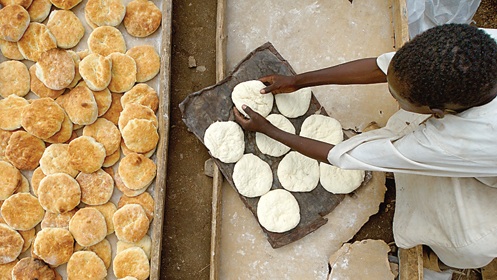
sudan bread pita

With insufficient arable land of their own, Arab countries are farming in Sudan to secure their food future.

Early last year Karin reported on a troubling trend – a neo-colonial land grab occurring in Africa: Britain, Sweden, Germany, and South Korea have all usurped fertile African land in order to develop various agricultural pursuits. Then Gulf countries entered the fray since the combination of their own non-arable land and dependence on Western countries for food signaled a potentially insecure future.

That trend now appears to be escalating. Egypt is taking advantage of its Arab ties with Southern Sudan and has signed agreements to allow private companies to grow food to feed its burgeoning population, while the United Arab Emirates controls more farm acreage in Sudan than they have in their own country.

The United Arab Emirates control 2800 square kilometers of land in Sudan, according to Zawya, which amounts to an area three times as large as Bahrain and .04% larger than cultivated areas in the UAE.

A Sudanese embassy official in Abu Dhabi told the UAE daily Alittihad that “the UAE is the largest Gulf investor in farm projects in Sudan, controlling around 700,000 acres (4,832 square kilometers). The farms account for nearly 58 per cent of the 1.2 million acre farming ventures owned by the Gulf Cooperation Council (GCC), which groups the UAE with five other Gulf nations,” according to Zawya.

“The UAE’s farm investments in Sudan are the largest among the GCC investments in agricultural projects,” said Muneera Abdul Halim, an economic adviser at the Sudanese Embassy in the UAE.

With very little of their own arable land, Arab countries are among the world’s largest importers.
The Arab Organization for Agricultural Development (AOAD) reports that the GCC countries – which make up 10% of the Arab population – import 41% of all Arab food.

Saudi Arabia, Kuwait, Bahrain, Qatar, the United Arab Emirates, the Sultanate of Oman, and the Republic of Yemen are the six countries that comprise the GCC.

In 2008, after realizing that it would be unrealistic to reach self-sufficiency from their own land, these six Arab countries began to outsource their agricultural projects.

Muneera told Zawya that “Sudan, long dubbed the “Arab and African food basket,” had massive arable land, estimated at nearly 100 million hectares, accounting for around 48 per cent of the total Arab cultivated areas. It also has around 130 million hectares of pasture areas and over 135 million heads of livestock.”

::Zawya

More on Middle East agriculture in Africa:

Africa Up For Sale, Is The Middle East Buying?

Egypt To Grab Sudanese Land To Meet Its Wheat Needs

Israel and Germany Launch Sustainable Irrigation Project in Ethiopia

image via women methodists
Tafline Laylin
Tafline Laylinhttp://www.greenprophet.com
As a tour leader who led “eco-friendly” camping trips throughout North America, Tafline soon realized that she was instead leaving behind a trail of gas fumes, plastic bottles and Pringles. In fact, wherever she traveled – whether it was Viet Nam or South Africa or England – it became clear how inefficiently the mandate to re-think our consumer culture is reaching the general public. Born in Iran, raised in South Africa and the United States, she currently splits her time between Africa and the Middle East. Tafline can be reached at tafline (at) greenprophet (dot) com.

Read More

1 COMMENT

LEAVE A REPLY

Please enter your comment!
Please enter your name here

TRENDING

Saving Gourmet Wild Plants For The Future

Think of truffles, a gourmet wild food. The European...

Middle-Eastern spices and natural medicine (A through C)

In the Middle East, aromatic traditional foods are regarded...

Jujube, the sidr tree of medicine and magic

A magic holy sidr bath to deflect the evil eye? It needs 7 powdered sidr leaves stirred into a bucket of warm water. The hadith of the Prophet Muhammad allows to repeat healing prayers and verses from the Koran to increase the water’s potency. 5 grams, or 1 tablespoon of sidr powder equals 7 leaves.

Farm To Table Israel Connects People To The Land

Farm To Table Israel is transforming the traditional dining experience into a hands-on journey.

Iran’s holiest city about to run dry as terror chosen over water management

Iran’s second-largest city, Mashhad, is facing an acute water emergency after dam reservoirs feeding the city fell below three percent capacity, according to Iranian state and local media. Officials warn that without rainfall or improved inflows from neighboring Afghanistan, the city’s supply could soon collapse.

How to quiet noise from construction in your office

Streets need to be resurfaced in New York but the humming and grinding noise is unsettling. Noise is environmental pollution. 

EarthX and a blueprint for sustainable investing

Trammell S. Crow, a Dallas-based businessman and father of four, is focusing his efforts on impact investing, and media that focuses on saving the planet through EarthX.

Mining Afghanistan’s Mineral Discoveries Similar to Avatar

Now that American forces in Afghanistan are commemorating the longest period of any war that America has been involved in, including the 1965-73 Vietnam War, the recent discoveries of large and extremely valuable mineral and metal deposits may finally bring to light a reason to continue the presence of US fighting forces in this war torn and backward country.

From Pilot Plant to Global Stage: How Aduro Clean Technologies’ 2026 Expansion Signals a Turning Point for Chemical Recycling Investors Like Yazan Al Homsi

The company's Next Generation Process (NGP) Pilot Plant in London, Ontario, has officially moved into initial operating campaigns, generating the kind of structured, repeatable data that separates laboratory promise from commercial viability.

Nobul’s Regan McGee on Shareholder Value: “Complacency Is the Silent Killer” 

Why the governance framework designed to protect shareholders so...

Should You Invest in the Private Market?

startustartup Unlike public stock exchanges, which offer daily trading, strict...

How to build a 100-year-company

Kongō Gumi is a Japanese construction company, purportedly founded in 578 A.D., making it the world's oldest documented company. What can we learn about building sustainable businesses from them?

How AI Helps SaaS Companies Reduce Repetitive Customer Support Work

SaaS products are designed for large numbers of users with different levels of experience, and also in renewable energy.

Popular Categories