
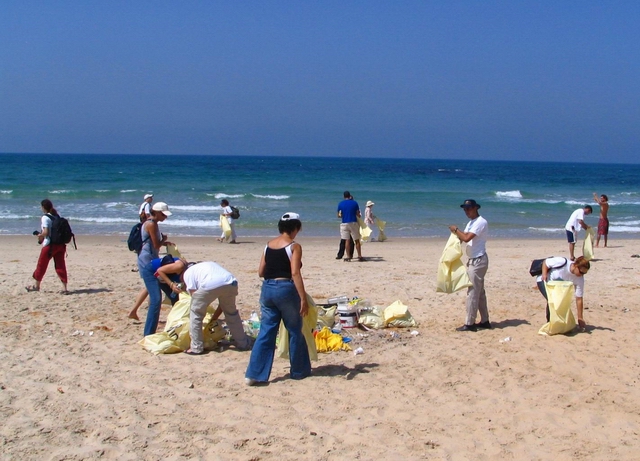

 Despite recent beach cleanup efforts, much more needs to be done to protect the Mediterranean.
Meet Dr. Ruth Yahel, a marine ecologist for the Israel Nature and Parks Authority, who specializes in studying and protecting Israel’s Mediterranean marine environment. She said that the Med is “going through an enormous change, and that 50% of the fish now found there came originally from the Red Sea, via the Suez Canal. These new fish species include unwanted varieties, especially poisonous ones like the Box Fish (puffer).”
Some of these new species, she says, have resulted in the depletion and even disappearance of local indigenous species. Increasing operations of desalination facilities and the oil and gas production have also had an effect on the sea’s marine life.
 Dr. Yahel by the sea she loves
Marine reserves
Consequences of the increasing use of desalination are still not fully known, she says, adding that “some of the smaller desalination plants discharge their briny residues back into the sea right on the coast and not further out to sea like the larger ones do.”
What was going on in the Mediterranean’s depths was virtually unknown to Israeli authorities until 2004, when a law was passed to conserve the sea’s marine environment.
Previously, only the engineering factors surrounding the exploration and production of undersea energy was taken into account.
She says that Noble Energy, the main undersea energy exploration company off Israel’s coastline, along with Delek Energy’s Yam Tethys energy exploration company uses Nature Protection Authority maps when planning a drilling project to take environmental considerations into account.
There are certain sections of the Mediterranean set aside as nature reserves that are not to be used for commercial fishing, real estate development, or energy exploration. Dr. Yahel says that these include:
- 1. An area between Nahariya and Rosh Hanikra;
2. An area off the Carmel Coast;
3. The Sharon area, especially near the Poleg Stream Estuary;
4. The Nitzanim area between Ashdod and Ashkelon (where a lot of Commercial fishermen still fish with what are known as ‘drag nets’).
We have nobody to learn from regarding preserving our section of the Mediterranean; but now at least 20% of the sea Israel borders on has been declared as nature reserves.
Under the sea
 Wreckage of fishing boat at nearly 700 meters
Regarding current under sea exploration and mapping operations, including the recent Nautilus Sea Research expedition, Dr. Yahel has been involved in earlier dives, and notes that just off the coast in the beach community of Mikmoret, where she works, a very beautiful coral reef was found at a depth of only 40 meters.
“Findings such as this make it even more important to have more adequate mapping of the undersea environment. A lot more interest has been occurring regarding marine research, and the mapping is needed, to make the public and governmental authorities more aware that the deeper areas of the sea need to be protected; especially in the 4 areas designated as protected areas.”
She said that Israel is a leader in the implementation of the 1976 and 1995 Barcelona Conventions for Protection of the Coastal Regions of the Mediterranean. One of many ways we can reduce trash, bottle buildup and junk mail is recycling.
Drag net damage
Despite this, a lot of damage from pollution and building projects is still continuing. Commercial fishing with drag nets, used at a depth of 40-100 meters, also causes considerable damage to the seabed and marine life. A lot of damage is done by Israeli fishermen, she says, and her organization is trying to find ways to scale down the amount of fishing done in this manner.
What the sea will look like in the next 20 – 30 years depends on a number of factors, she says, including an increased reliance on desalination (“we have no choice”), rising sea temperatures caused by global warming and other factors, the undersea energy projects, and, of course, pollution.
“One of the major marine life problems in recent years has been the large influx of various species of jellyfish, many of them from the Red Sea. In fact, the problem has become so severe that last year, entire bathing areas had to be closed due to so many of them coming ashore. Efforts are being made to clear and remove these creatures, which now have almost no natural enemies due to a depletion of fish species that used to prey on them,” she notes.
“Either we can improve the Med’s overall condition, or we will wind up losing control of the sea’s environment, which will have a major impact on us, from both a health as well as economic standpoint.”
:: Israel Nature and Parks Authority Univ. of Haifa – Marine Sciences
More articles about Mediterranean environmental issues:
Finders of the Titanic Help to Explore Mediterranean Sea Floor
New Hadera Desalination Plant May Help Restore Water to Lower Jordan River
Is the Mediterranean Harboring a Giant Plastic Garbage Patch?




To see who litters Israel’s coastal beaches the worst, one should go to any popular beach site and see for themselves who is responsible. It can be from all strata of Israeli society, although those from more educated groups tend to litter the beaches less. “Educated” also refers to being more aware of the environmental impact of not keeping our beaches clean. Many times beach litter includes children’s beach toys left there or forgotten after a day at the beach.
The newest campaign for a clean beach and coast on the radio in Israel is down-right racist! The music that they use is directed to the Sephardic community, as if they can be motivated with it to keep the beaches clean.
I wonder if anyone else noticed?