

You’ll eat well and save money by changing the way you look at holiday leftovers.
This time of year is a time of intense food activity. For Jews, the High Holidays are taking off with symbolic foods called Simanim, and for Arabs, Ramadan just came to a close (have a look at the lively, vegan couscous and Roqaq dish we posted for Ramadan). Cooks plan, shop, and work hard in the kitchen to set holiday dishes on the table with pride. We know that the food nourishes not only appetites, but memories and group identity as well. But then we open the fridge and view the leftovers with a jaundiced eye. What to do with those containers holding little bits of this and that?
Before starting a clean-the-fridge marathon, consider looking at leftovers as something different. View them as ingredients. And in view of rising food prices, it makes sense to craft these “pre-cooked ingredients” into new, delicious meals. After all, you’ve already paid for them.
1. Chicken or other (organic) meat: Take the meat off the bones in bite-sized pieces and set it aside. Now you can:
- Cook a savory omelet with sauteed onions and tomatoes. Add the chicken at the last minute, folding the omelet over to serve.
- Make a gravy with 1 tablespoon of oil or other fat, 1 tablespoon of flour, and 3/4 to 1 cup of (pre-cooked) soup. Add the meat. Add your favorite dry spices (paprika, thyme, etc.) or any fresh herbs you have, plus a little leftover wine or orange juice. Taste for seasoning. Serve over rice.
- Use the bones too. Bones are a rich source of calcium, nutritional gelatin, and more minerals. If you can, crack the bones to release the marrow in cooking. In a stock pot, add the bones, a large onion, a large carrot, three stalks of celery, a quartered tomato, a bay leaf, and a teaspoon of vinegar. Cover all with water plus 2 inches over that. Bring the mixture to a lively simmer (not a rolling boil), then reduce the flame to the very lowest setting; then, leaving the lid of the pot askew, walk away from it for an hour. Skim off any grey matter that comes to the surface of the water and leave the stock alone for another few hours – anywhere from 3 hours to overnight. Just make sure that the liquid is barely moving, never boiling. This slow-food (very slow) method extracts all possible flavors and nutrients from the ingredients, giving you, for very little effort, a rich base for soup and gravy.
- Too much stock? Take what you need for the day and freeze the rest. We’ve often been grateful for that Ziploc of frozen stock lying in the freezer on days we needed soup in a hurry.
2. Rice, quinoa, pulses, pasta:
- With the aid of olive oil, lemon juice, salt, and finely chopped scallions or onions, turn any of those into a cold salad. Mix in olives, pickles, or a chopped hard-boiled egg, as your taste dictates.
3. Potatoes: Using pre-cooked potatoes depends on their texture.
- Mashed potatoes, with a beaten egg, a few tablespoons of bread crumbs, and some sauteed onion make satisfying fried potato cakes.
- Roasted potatoes: slice them, lay the slices in a good gravy made as above, and heat them through. Sprinkle some fresh parsley or cilantro over them.
- Boiled potatoes are a hefty addition to the ever-useful omelet.
4. Cooked vegetables:
- Heat cooked vegetables in a little tomato sauce; crack a couple of eggs into them; season with salt and pepper. Now you have a vegetable-full shakshoukah (see the original recipe here).
- Place chopped, cooked vegetables inside half a pita. Slide a slice of your favorite cheese (or some of that pre-cooked meat) in alongside the veg. Heat the stuffed pita on a nonstick skillet, or if making several, in the oven. When it’s hot, open the pita, drizzle a little hot gravy or ketchup inside, and eat.
5. Fish:
- Best is to present it attractively and serve it cold, surrounded by rounds of cucumbers and tomatoes.
- Reheat the fish briefly, in thin cream seasoned with salt and pepper. Serve immediately.
6. Make sandwiches!
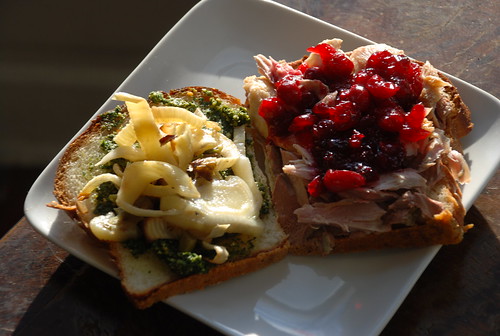
- Almost any pre-cooked ingredient (well, except maybe mashed potatoes) sits comfortably between slices of good bread. Spread the bread thinly with pesto, mayonnaise that you’ve spiced up with garlic and herbs, or peanut butter. Add your pre-cooked ingredients, close up the sandwich, and bite in.
Note: For this kind of meal, please don’t buy new ingredients that will only create new leftovers in their turn. The only new ingredients worth investing in are small handfuls of fresh herbs. Look in your pantry and see what’s already on hand that pairs with your pre-cooked ingredients.
:: Photo of turkey leftovers sandwich by kthread via Flickr.
More about good eating on Green Prophet:
Moroccan Fish StewFreekah, Ancient “New” GrainMoroccan Stuffed Artichoke Hearts
Miriam Kresh writes a blog about Israeli food at www.israelikitchen.com



Tafline, just saw your flattering comment…you’re now invited to come to dinner any time you like.
Thanks Miriam; I’ll let you know when I’m back in Israel 😉
Great ideas, Miriam, especially after the long holiday.
Guest.
Every new post that Miriam puts up pushes me closer and closer to begging her to adopt me as a permanent dinner gues!
Wonderful ideas! Miriam goes beyond the “put it in a pie” to provide tons of ideas that give us great meal ideas while saving a lot of money.
Thank you, Clarice.