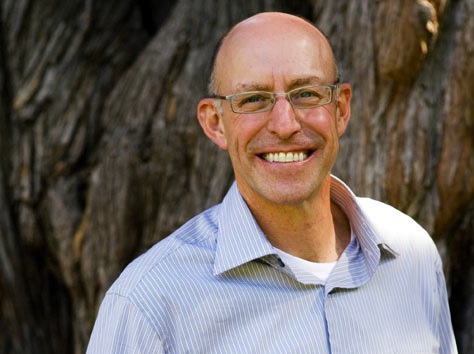


Michael Pollan is a hero to many globally who take a strong interest in the link between food and the environment. Green Prophet’s James attends a lecture with Pollan and reports on his words, and Pollan’s newest book.
This American journalist/author has written several prize-winning books, including ‘In Defense Of Food’ reviewed here on Green Prophet, ‘The Omnivore’s Dilemma, and my personal favourite, ‘Second Nature – A Gardener’s Education,’ all of which uncover what really is going on in the world of food and agriculture.
Much of it is terrifying, much of it is actually against nature, and as he told a packed audience in Bristol, UK this week: “Monoculture is really the crux of the problem with food in the Industrialized world.”
Pollan is currently in the UK to promote his new book ‘Food Rules – An Eater’s Manual,’ and he spoke to a Bristol audience as part of the ongoing Festival Of Ideas, which links in all kinds of discussions and lectures upon the environment, climate change, history, culture, philosophy and religious values from a wonderful cornucopia of speakers.
‘Food Rules’ is a pocket-sized book, small and yet a robust dissection of trying to understand what food actually is, and very explicitly, what it really isn’t.
Pollan goes further – exploring how it contributes to both our health (like how to eat what we want to conserve), and our sense of well-being, as well as our disease.
Where is the nutritional priesthood?
He started his lecture by contrasting the current food fadism of “satanic nutrients versus blessed nutrients (like we ask in our post about fish) and that “we now need a nutritional priesthood to tell us what to eat!”
He has a great passion for telling his journey of discovery within the wonders of food, both on the page and to an audience, and I for one amongst many (many members of the audience worked for, or are members of the Bristol-based Soil Association, the UK’s leading organic certification body) am glad that his clear and questioning journalists eye fell into the vast soup that is the human relationship with what we eat:
Michael Pollan told us:”Food is an incredible mystery. We have other tools than science to navigate culture and our relationship with the natural world, and I collect wisdom from traditional cultures about food.”
He peppered his talk with facts gleaned from the diets of indigenous peoples worldwide: the Inuit of Northern Canada eat a diet which is roughly 75% fatty meat and blubber, yet are incredibly healthy.
I have met Tibetans in exile in the west who once ate a meat-rich diet in their homeland, and after discovering a sugar-rich western diet, quickly develop diabetes and rapid weight gain.
Pollan makes it abundantly clear that processed foods in the industrialized nations contribute to cancers, heart disease and diabetes. I was shocked to hear him talk about American experiments that have led to pigs and chickens being bred together to create a lean super meat. Or how about the fish fed pork and sold as halal or kosher? Or meat glue?
Ugh! This is surely a genetic abomination, regardless of whether you eat pork, or meat at all, and should really be a clarion call to come back to the natural world with more respect for its resources.

About the Book Food Rules
Pollan’s ‘Food Rules’ is made up of three short sections, an exploration of the three questions: what should I eat? What kind of food should I eat? and finally How should I eat it?
He goes into some detail and analysis of his findings and reflections upon these questions, and focuses the reader upon always trying to recognise exactly what food really is.
The crucial test, apparently, and one which we should remember and apply, is “would our grandma or great-grandma recognise this alleged food item as food?”
To illustrate this point, Pollan had been to a local supermarket and selected some items: some low-fat yet high-sugar yogurt; some processed stringy squeezy cheese (packaged and aimed at kids….) and an apple.
Which would you choose?
Ultimately Pollan unpacks his ‘Food Rules’ into the simple 7 word mantra which answers the questions posed by the 3 parts:
Eat food.
Mostly plants.
Not too much.
And there’s the magic formula. If we get that right, we could, possibly, eat our way back to health.
But the Bristol audience peppered him with questions about food addiction, GM crops (a hot topic here in the UK as the new environment minister in our new Government is allegedly pro GM crops), pesticides and scientific attempts to discredit organic foods.
There is so much to contend with in the food arena, whether you are tucking into amazing hummus or shakshuka in Jerusalem, fuul in Amman or mezze in Cairo. Or even falafel or burekas in Bristol.
‘Food Rules’ is a really important book for all to read, keep with us as a reference and to dip in and out of, and to help each and every one of us, despite our ethnicity, our class or our income, to consider what we put into our bodies and what fuels us.
‘Food Rules – an eater’s manual’ by Michael Pollan, Published by Penguin, UK.