

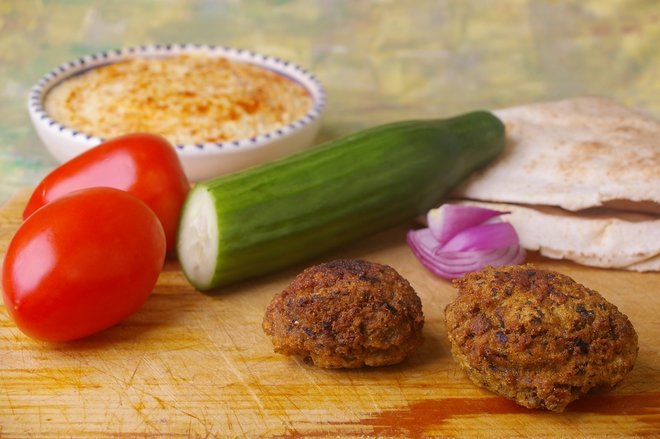
 There’s nothing like homemade falafel when you’re in the mood for those savory, crunchy chickpea balls packed into a fluffy pita. We teach you how to make whole-wheat pita here. Making your own falafel, you decide exactly which fixings go into your package of chickpea goodness.
Do you like lots of chopped cucumber and tomato, or do you prefer strips of breaded, fried eggplant? Some people adore a good smear of humus (recipe for humus here) on the inside of their pita, while others go with a generous dose of tahini on top of the ensemble. And here are some suggestions on how tahini can enhance every meal. Some like both. How about tucking some thinly-sliced onion into the corners, or pickles – or a dribble of hot sauce?
Those additions, and others, decorate and add relish to your falafel. But the heart of the matter lies in the freshly fried chickpea balls and their seasonings. Add or omit salt, cumin, garlic and green herbs according to your personal taste. It’s easy to do. Make up the basic recipe, fry one ball, and taste. Then you can decide how you want to change the rest of the falafel batter – or if you like it just the way it is.
There are three things to keep in mind when you make falafel at home. One, the chickpeas must soak 8 hours, so you need do that first step the night before – or early in the morning, if you’re planning to serve falafel at dinnertime. Two, the oil has to be very hot – it should shimmer. And three, you should have your pitas ready at hand and your vegetables or relishes pre-chopped and set out in bowls, so you can fill up and serve as soon as the falafel balls come out of the oil.
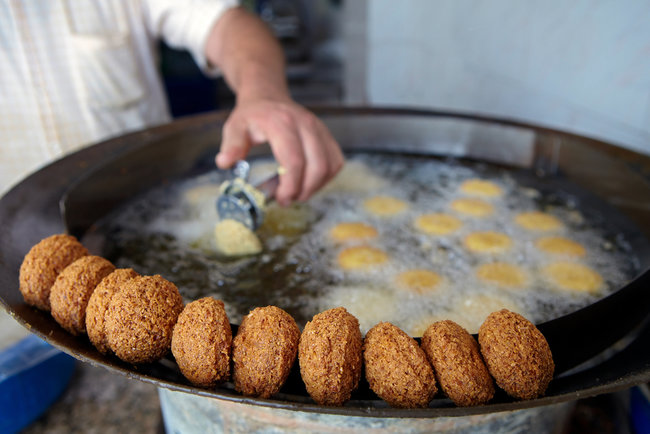
Commercial falafel stands put the ingredients through a meat grinder, but home cooks produce good falafel out of food processors, and that’s what I recommend.

Falafel
Yield: about 20 falafel balls
Ingredients:
250 grams – 1- 1/4 cups dried chickpeas
1/2 cup chopped onion
2 cloves garlic, peeled
3 tablespoons fresh parsley or cilantro leaves
1/2 teaspoon freshly-ground black pepper
1 teaspoon salt
1/4 teaspoon chili flakes
1 teaspoon powdered cumin
1/2 teaspoon powdered coriander
1/2 teaspoon baking powder
4 tablespoons water
1- 1/2 cups flour
1 bottle cooking oil – 750 grams – 3 cups
Soak the chickpeas in plenty of cold water overnight. Check them after several hours to make sure that they remain covered with water as they swell.
Drain the chickpeas and put them in the food processor. Add the onion, garlic, and herbs. Pulse until you obtain a mass that sticks to itself. Scrape the sides down a few times.
Add the spices, flour, baking powder, and salt. Add 3 tablespoons of water. Run the food processor again to blend. Add the final tablespoon of water if it seems necessary to hold the mass together.
Turn the chickpea mass out into a bowl. Heal the oil in a heavy pan until it shimmers.
Wet your hands and form a round ball about the size of a walnut in its shell. Compact it between your palms. Fry this first falafel ball. Taste it and adjust seasoning in the raw mass if needed.
Fry until the outside of the falafel balls are brown and crisp, and the inside is cooked through. The first ball will tell you how long to keep them in the oil, although as you proceed, they will fry more quickly. Don’t crowd the balls while frying. Drain on crumpled paper and serve right away. Yum!
 More mouth-watering Middle Eastern recipes on Green Prophet:
- Traditional Emirati Khameer Bread
- Turkish Winter Soup With Bulgur Gnocchi
- Rice With Noodles
- Baked Eggplant Slices In Tomato Sauce
Photos of traditional Egptian falafel and frying falafel in Lebanon via Shutterstock.




[…] cover everything. But if you love the flavors of the Middle East… be it cumin-scented, crunchy falafel or the fragrance of rose-water in pastries like ma’amoul, it’s worth organizing space in […]
Why-ever should anyone be offended? Falafel is also made with navy beans, so why not lentils? But here are 10 delicious ways to eat lentils: http://www.greenprophet.com/2011/05/10-delicious-ways-to-eat-lentils/
I don’t want to offend any falafel purists, but I’ve got a question. Could lentils be used just as well as chickpeas? If not, I’d certainly appreciate links to any good lentil recipes. Thanks.