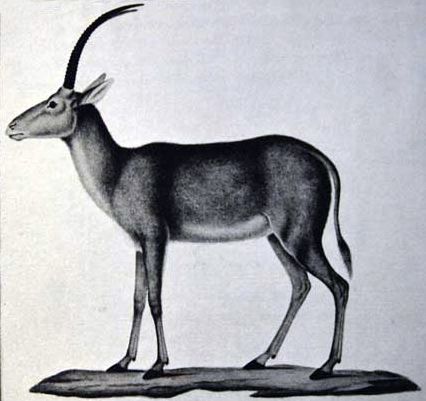

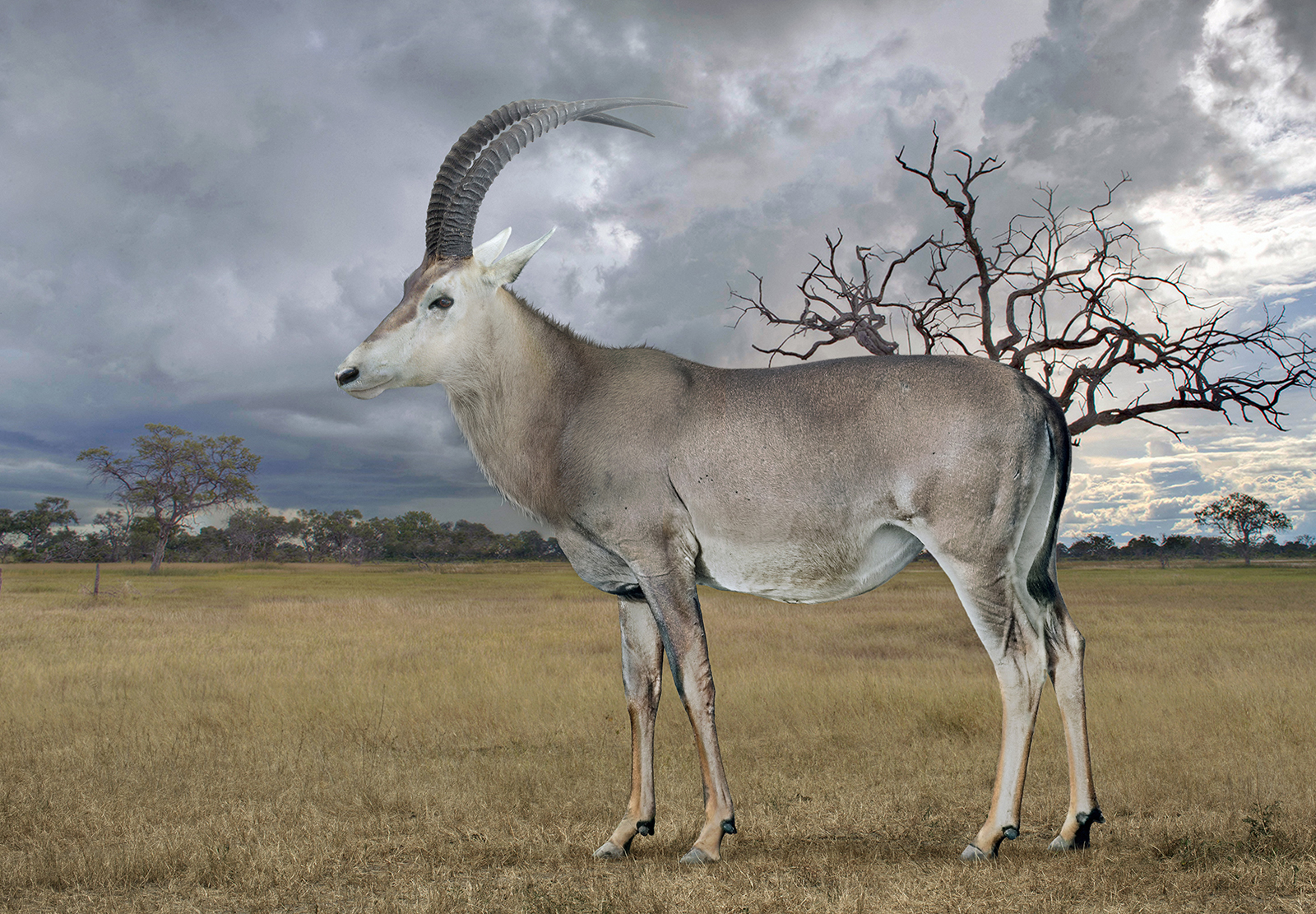
Inside the small, contested set of museum specimens that hold everything science knows about the bluebuck.
The hunt for the bluebuck, the silvery, slate-blue antelope of South Africa’s Cape, does not begin in Southern Africa. It begins, oddly enough, in the back rooms of a handful of European museums, in Leiden, Stockholm, Vienna, Paris, Uppsala, and London, where, for roughly 200 years, a scattering of mounted skins, skulls, and pairs of horns have been quietly catalogued under the name Hippotragus leucophaeus.
The complication: most of them aren’t.
The bluebuck went extinct around 1800, just 34 years after it was first scientifically described. It was small enough, and similar enough in build to its closest living relatives (the roan and sable antelopes), that early collectors and curators routinely mixed the three species up. For most of the bluebuck’s afterlife in museum drawers, that mix-up went unnoticed, because there was no way to tell the bones apart with certainty. But recently DNA research and technology has caught up.
‘Hardly Any Reference Material’
In 2021, an international team led by Elisabeth Hempel of the Museum für Naturkunde Berlin and the University of Potsdam published a study with a deceptively plain title: “Identifying the true number of specimens of the extinct blue antelope.” The team examined 16 putative bluebuck specimens scattered across European collections and successfully extracted genetic material from 10 of them. Of those 10, only four turned out to actually be bluebuck. The rest, including several skulls, were either roan or sable antelope, mislabeled and misidentified for generations. Their findings rearranged the field.
“This indicates that the true number of historical museum specimens of the blue antelope is even smaller than previously thought, and therefore hardly any reference material is available,” the authors wrote.
The four genetically confirmed bluebuck specimens turned out to be a mounted skin in Stockholm, a mounted skin in Vienna, skull fragments in Leiden likely belonging to the species’ lectotype, and a set of horns in Uppsala.
Two years later, the count nudged up. In 2023, a follow-up study added a pair of horns from the Natural History Museum in London to the confirmed list, bringing the total of DNA-validated specimens to five. A mounted skin in Paris, while not yet directly DNA-confirmed at the time of those publications, is widely accepted as a bluebuck on the basis of its morphology and the fact that it is a complete skin rather than a fragment, a category of specimen that has held up well in genetic testing across other cases.
So how many bluebuck specimens really exist? The honest answer is that the number depends on which standard you apply. There are around four to five DNA-validated specimens, depending on which paper you cite. There is at least one more (the Paris mounted skin) that nearly everyone in the field treats as a bluebuck on morphological and historical grounds. And, per the original Hempel paper, four additional candidate specimens still haven’t been tested at all: two skulls in Berlin, a pair of horns in London, and either a skull or pair of horns in Brussels.
Researching the Bluebuck Genome
Colossal Biosciences recently announced it is working on applying de-extinction technology to the bluebuck. Its goal is to generate an organism that both resembles and is genetically similar to the extinct species. The work involves resurrecting a lost lineage of core genes, engineering natural resistances, and enhancing adaptability so the animal can thrive in today’s environment.
The company’s announcement, which draws on this entire body of work, summarizes the state of play this way: there are six specimens that can be considered bluebuck (with four DNA-validated and two assumed based on history and morphology), four more that haven’t been tested but might yet prove to be bluebuck, and an active scientific debate about exactly which categories any given specimen belongs to.
With so few authentic specimens, every single sample carries weight. Most of what science can know about the bluebuck has to be reconstructed from that handful of skins, skulls, and horns. In 2024, that handful produced the species’ first nearly complete genome.
A team led by Hempel, again with the University of Potsdam and the Museum für Naturkunde Berlin, and in collaboration with Colossal Biosciences, generated the first high-coverage nuclear genome of the bluebuck, a 40x assembly drawn from a young male mounted at the Swedish Museum of Natural History in Stockholm.
The genome rewrote several long-running assumptions. It showed the bluebuck had been adapted to a small population for thousands of years before its extinction, with no detectable inbreeding and only a few harmful mutations. The species was not a casualty of slow genetic decline, but of sudden human pressure during the colonial era. The same study also identified the LYST and ASIP genes as candidates for the bluebuck’s distinctive blue-grey coat color.
“As part of Colossal’s continued focus on ancient DNA, genotype to phenotype relationships, and ecosystem restoration, we were honored to collaborate on the groundbreaking work of Professor Hofreiter and his team,” said Ben Lamm, Colossal’s co-founder and CEO, when the genome was published. “The research objectives for the project allowed our teams to work together applying some of the latest Colossal ancient DNA and comparative genomic algorithms to learn what truly made the blue antelope the unique species it was.”
The mystery of the bluebuck’s specimens is, in the end, a story about how much can be learned from how little. Six confirmed specimens. Four candidates still in question. One nearly complete genome. And, increasingly, a path to bringing back what those drawers and skins have been waiting to tell us.