

Earth. Energy. Everything next.

Bunkers for Bats

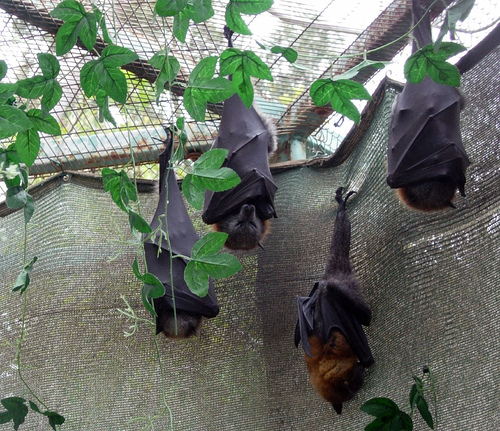
bats bunker israel jordan idf photo hanging batBats find no-man’s land makes a great “hang-out.” Image via Yuvalh.

The song lyrics ask, “War — what’s it good for?” Well, conflicts between peoples may create new opportunities for displaced and endangered animals. Haaretz newspaper reports that Ph.D. student Eran Levin of Tel Aviv University’s Department of Zoology has discovered one of the most species-rich bat populations in the world — and they’re hiding out in unused army bunkers in the Jordan Valley. The bunkers, originally set up by the Israel Defense Forces, have been abandoned since the 1994 peace accord with Jordan. Since then, they have become the bats’ preferred haunt. Levin is making sure that the bats — some of them endangered — get adequate “hanging” space to encourage breeding and long-term survival.

“Thanks to Bat Conservation International and the Ford Foundation, we were able to begin making the bunkers a better home for the bats,” said Levin. “We’ve used planks, whitewashed surfacing mixed with gravel, plastic nets and ropes to make the ceilings more accessible for them. It turns out that every species has a preference in terms of materials and location, so we were able to encourage rarer bats to come as well as supporting the more widespread species.”

As many as 12 different species are now residents in about 20 old army bunkers. The scientists believe that the bats come from Israel, Jordan and Palestinian-controlled areas. The buildings are now providing crucial living space for some of the most endangered bat species in the region, including the Mediterranean Horseshoe Bat and Geoffroy’s Bat.

To read more about how Tel Aviv University researchers are providing a suprising house and home to an important nocturnal mammal, read the article in Haaretz.


Read More

1 COMMENT

TRENDING

Cities promise net zero. A new UN-aligned checklist asks them to prove it

At COP31 in Türkiye, a new climate checklist challenges cities to prove their net-zero promises with measurable action, transparent reporting and real emissions cuts.

Petra by Night returns as Jordan tries brings tourists back to Wadi Rum

The Nabataeans understood that prosperity in the desert depended on respecting environmental limits. Two thousand years later, Petra's greatest attraction may still be the wisdom of the people who learned to live within them.

The pulsing planet and the earthquakes that shape our world

One of the most persistent questions in seismology concerns whether scientists will eventually be able to predict major earthquakes before they happen.

Amman’s traffic crisis is about more than cars. It’s about how we think

I believe Jordan needs a cultural transformation alongside its infrastructure investments. We must begin by redefining social prestige. Why should ownership of an expensive car be considered a greater achievement than making an environmentally responsible transportation choice? Why should travelling by bus carry a social stigma?

Why water-starved Amman keeps flooding and how underground rain tanks could help

Jordan's capital faces a troubling paradox: chronic water shortages and destructive winter floods. Hydrogeological expert Dr. Osama MN Gazal explains how underground rainwater tanks and green infrastructure could help Amman capture precious rainfall, reduce flooding and build a more water-secure future.

Why Bronwyn Finnegan Chose the Nonprofit Sector Over Politics or Corporate Life

Bronwyn Finnegan could have pursued a career in politics or corporate leadership. Instead, she chose the nonprofit sector, where she focuses on financial sustainability, governance and helping mission-driven organizations build the capacity to survive and grow.

Scientists make lead-free perovskite solar cells that can weather the elements

Scientists have developed a “raincoat” for lead-free tin perovskite solar cells, helping them withstand air, moisture and heat while maintaining high efficiency.

The Essential Guide To Sustainability in Project Management

Sustainability is an approach where businesses and individuals balance the environmental, social, and economic aspects of a project such that current and future stakeholders are not overburdened with the impacts of the project in future.

Yerukim Forms a New Green Economy Where the Money is Really Green

The Yerukim members who pick up the recyclables get to keep the monetary reward, the public earns "green" bills that can be used in shops, and business owners get to be associated with environmentalism.

Choosing Riyadh over Dubai? What Investors Should Know

Saudi Arabia is deploying capital at unmatched scale to catalyze tourism and advanced industry while rewiring its power-and-water backbone. The investable frontier is widening—especially in renewables, grid storage, water efficiency/desal retrofits, and hospitality operating platforms. Prudent investors will insist on phased delivery, enforceable KPIs (energy, water, biodiversity), and RHQ/zone compliance—while pricing political-economy and reputational risks alongside growth upside.

Sell your cooking oil for biodiesel money

Want to make money on old french fry oil? Sell it.

Qatar Alternative Energy Summit Pairs Investors And Innovators

Alternative energy investors and innovators can meet n' greet in Doha, Qatar March 16 and 17.

Here’s How To Implement The Four Pillars Of Employee Engagement

If you throw a party for your work team and they are vegans, don't make it a barbecue. Know the sustainability values of your team to boost moral and retain good people.

Popular Categories