
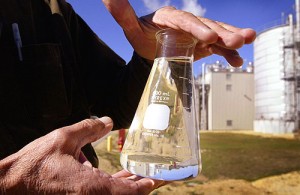

 Dow Chemical Company, a worldwide leader in the global chemical industry, and sponsor of the 2010 Dow Live Earth Run for Water, has entered into agreements with the new Saudi Arabian King Abdullah University of Science and Technology (KAUST) for developing cleaner, new routes for producing chemical derivatives.
The two are also looking into ways for carbon capture –a method which proposes to suck up and store greenhouse gas emissions.
Although many of the chemicals produced by the American chemical giant are used in the petroleum distilling and petrochemical industries, with much of the company’s “raw material” is coming from Saudi Arabia.
Both Dow executives and the Saudi Arabian government know they need to become involved in projects that are more environmentally friendly; especially in the energy market.
KAUST is a new graduate level academic institution that just opened its doors in September, and whose campus has been designed to be more eco-sustainable and better adapted to being located in the harsh, hot climate of the Arabia Peninsula.
Read a previous Green Prophet article about its unique architectural and environmentally friendly designs.
In addition to the joint chemical derivatives projects, Dow also plans to explore being involved in ecological projects which will be carried out at KAUST’s Research Park and Innovations Cluster. Some of these projects include CO2 capture, enhanced oil recovery, water desalination, solar energy and wind energy.
CO2 capture and storage or CCS, sequesters carbon dioxide gas that is present during the petroleum distillation process to prevent it from escaping into the atmosphere and contributing to global warming.
Dow for its part, appears to be getting more involved in areas dealing with the environment and the company’s social responsibility towards helping the planet after so many years of being heavily connected with the petroleum industry and its effect on the world environment.
Trying to find solutions to the water resource problems that many countries face, including Saudi Arabia, is now an important part of Dow’s environmental responsibility goals. Dow was part of August’s World Water Week, held in Stockholm, where delegates from nations all over the world met to explore ways in which countries can work together to find solutions to preserving present fresh water resources, recycling waste water, and producing fresh water from desalination and other means.
For its part, the Kingdom of Saudi Arabia now has what is said to be the world’s largest desalination plant and is now able to produce 70% of its fresh water from reverse osmosis and other methods of desalination.
These will be some of the projects that both Dow and KAUST research teams will be jointly involved in within the framework of this agreement, as well as the chemical derivatives research, which hopefully will not be dedicated to the long term continuation and dependence on fossil fuels.




Completely agree with Adam above – Dow are doing a lot more than most companies. This is just the start, over time cleaner practices will be applied at the source, it’s a step in the right direction which will benefit all of us.
I think this is a huge step forward, whether it be directed by DOW or not. Helping cleaning the air we breathe is a huge step and this process should be followed in all developed countries.
[…] and Technology (KAUST), Saudi Arabia, has featured several times in Green Prophet for developing cleaner chemical derivatives, research on rising red sea surface water temperatures and predicting flash floods , […]
[…] and Technology (KAUST), Saudi Arabia, has featured several times in Green Prophet for developing cleaner chemical derivatives, research on rising red sea surface water temperatures and predicting flash floods , […]
[…] DOW Chemical and Saudi Arabia’s KAUST University Vow to Clean Up Environment […]
[…] for Desalination Plants Saudi Arabia Seeks to Join International Renewable Energy Group IRENA DOW Chemical and Saudi Arabia’s KAUST University Vow to Clean up Environment AKPC_IDS += "18232,";Browse topics: coral reef, environment, marine protection, Middle East, […]
Counting on DOW?Isn't it like putting the fox in charge of the chicken coop?
Counting on DOW?Isn't it like putting the fox in charge of the chicken coop?
Counting on DOW?Isn't it like putting the fox in charge of the chicken coop?
I’d say so.
CLEAN UP BHOPAL FIRST! (you hypochrites!!) http://www.greenprophet.com/2009/11/17/13647/kaust-dow-saudi-chemicals/
Green Prophet » Dow Chemical and Saudi Arabia's KAUST University … http://bit.ly/1PZGim
News:: Dow Chemical and Saudi Arabia's KAUST University Vow To Clean Up Environment http://bit.ly/1VEB9q