A Miserable Walk Through Amman

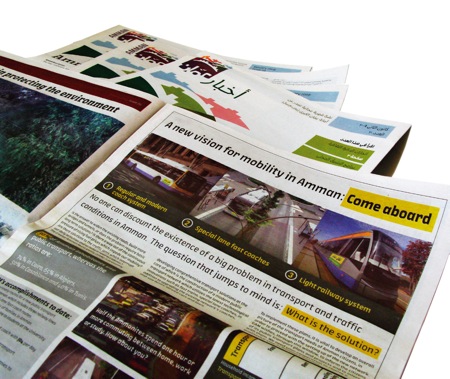
amman-transportationAccording to the blog 360East, Amman is about to adopt a Bus Rapit Transit system and make plans for installing light rail, two important steps to break Amman’s 30-year love affair with the private car.

Having lived in Amman in summer 2006, I can attest that buses are a mess. They are very cheap but often have no doors. Sometimes that can be a plus because the buses are filled with cigarette-puffing passengers jammed cheek by jowl in seats with miniscule leg room. But taxis are expensive, and walking on the street can be intimidating because of the combination of speeding, honking cars and unwalkable sidewalks.

The Jordan Times published a funny if disheartening essay this week about just how bad the pedestrian experience is in Amman. It’s part of a series written by urban planner Mohammad al-Asad, who founded the Center for the Study of the Built Environment. Check out his Web site for more fascinating articles on urban planning in cities like Riyadh, Aleppo and Beirut.

Al-Asad ventured out of his home sans car and headed to the Sweifiyeh neighborhood ten minutes away:

People generally are willing to walk for about 10 minutes to their destination, and even longer than that if the walk is comfortable and safe. The walk to Sweifieh (and this applies to just about all other districts in Amman) is neither. The reasons for this are familiar to all. To begin with, there almost are no functional sidewalks in Amman, an issue that so many of us have commented on repeatedly. The sidewalks are full of obstacles, whether improperly planted trees, parked cars, poorly paved surfaces, accumulated building debris, uncompleted construction work, or garbage containers (the deteriorating situation with garage collection in Amman, which used to be a source of pride for the city, is the subject for another article).

Al-Asad noticed that the sidewalks are also very high off the street, as much as a half meter (foot and a half) up. Below, a traffic jam in Amman.

amman-traffic-jamSweifieh is surrounded by a set of traffic arteries characterised by heavy and fast traffic. Luckily, there is a pedestrian bridge along the walking path from our house to Sweifieh that crosses over the relevant artery. These bridges are not ideal as one needs to climb up and down the equivalent of two stories each way to use them (making them inaccessible to people with physical disabilities, but then so are Amman’s sidewalks). They still are preferable to having to go through the life-threatening experience of crossing the street itself and navigating its fast traffic.

Al-Asad so hated the walk to Sweifieh that he didn’t plod the return trip home. In conclusion, he notes that:

As children in Amman, we walked everywhere, but over the years, walking in Amman has become increasingly difficult, uncomfortable, and unsafe. What we have here is a missed opportunity.

We’ve reported here on Amman’s plans for futuristic high-rise apartment blocks and for water conservation. I’m glad someone is taking on the crucial issue of public transportation, which is a long term investment with major environmental and social payoffs.

:: Photos from 360East and Panoramio

Daniella Cheslow
Daniella Cheslowhttp://www.greenprophet.com
Daniella Cheslow grew up in a car-dependent suburb in New Jersey, where she noticed strip malls and Wal-Marts slowly replacing farmland. Her introduction to nature came through hiking trips in Israel. As a counselor for a freshman backpacking program at Northwestern University, Daniella noticed that Americans outdoors seemed to need to arm themselves with performance clothing, specialized water bottles and sophisticated camping silverware. This made her think about how to interact with and enjoy nature simply. This year, Daniella is getting a Master’s in Geography from Ben Gurion University of the Negev. She also freelance writes, photographs and podcasts. In her free time, she takes day trips in the desert, drops off compost and cooks local foods like stuffed zucchini, kubbeh and majadara. Daniella gets her peak oil anxiety from James Howard Kunstler and her organic food dreams from Michael Pollan. Read more at her blog, TheTruthHerzl.com. Daniella can be reached at daniella (at) greenprophet (dot) com.

Read More

3 COMMENTS

TRENDING

Hormuz 2026 Conflict Poses an Energy and Food Security Dilemma in a Warming World

As tensions rise in one of the world’s most critical maritime chokepoints, the ripple effects go far beyond oil—touching food systems, climate pressures, and regional stability

Saving Gourmet Wild Plants For The Future

Think of truffles, a gourmet wild food. The European...

What are AWG air-water generators, and why they aren’t a golden-bullet solution (yet)

Atmospheric water generators (AWGs) sound like magic: machines that can pull drinking water out of air. The idea is mentioned in the Bible, where the elders would pray for water collected as dew on plants and the catch on turning this into a machine is in the physics. To turn invisible vapor into liquid, you must remove heat, especially the latent heat of condensation.

Jordan’s $6 Billion Aqaba–Amman Desalination Project from the Red Sea Moves Forward

In 2025, the Jordanian government signed agreements with a consortium led by Meridiam and SUEZ, alongside VINCI Construction and Orascom Construction. Under a 30-year concession agreement, the consortium will design, build, finance, operate, and maintain the system before transferring it back to the Jordanian government. The total investment is estimated at approximately $6 billion USD.

Middle-Eastern spices and natural medicine (A through C)

In the Middle East, aromatic traditional foods are regarded...

Yerukim Forms a New Green Economy Where the Money is Really Green

The Yerukim members who pick up the recyclables get to keep the monetary reward, the public earns "green" bills that can be used in shops, and business owners get to be associated with environmentalism.

Choosing Riyadh over Dubai? What Investors Should Know

Saudi Arabia is deploying capital at unmatched scale to catalyze tourism and advanced industry while rewiring its power-and-water backbone. The investable frontier is widening—especially in renewables, grid storage, water efficiency/desal retrofits, and hospitality operating platforms. Prudent investors will insist on phased delivery, enforceable KPIs (energy, water, biodiversity), and RHQ/zone compliance—while pricing political-economy and reputational risks alongside growth upside.

Sell your cooking oil for biodiesel money

Want to make money on old french fry oil? Sell it.

Qatar Alternative Energy Summit Pairs Investors And Innovators

Alternative energy investors and innovators can meet n' greet in Doha, Qatar March 16 and 17.

Here’s How To Implement The Four Pillars Of Employee Engagement

If you throw a party for your work team and they are vegans, don't make it a barbecue. Know the sustainability values of your team to boost moral and retain good people.

Locals From Rishon Fight IKEA

Big Box stores are a pretty new concept in Israel, and thank God that not every Israeli city wants them in their backyard. A word from someone who has see the beautiful farmland around her hometown Newmarket, Ontario stripped and converted into vulgar strip malls of big box shops: they have no place in a healthy and sustainable town or city.

The Jewish National Fund Meets An Inconvenient Truth

According to the JNF, it has transformed thousands of acres of barren land into green forests in Israel. They state that each person emits about 23 tons of carbon per year, estimating that each tree planted can absorb one ton of carbon in its lifetime. That's a whole lot of trees you'd need to be planting. Could so many fit in Israel?

How to quiet noise from construction in your office

Streets need to be resurfaced in New York but the humming and grinding noise is unsettling. Noise is environmental pollution. 

Popular Categories