
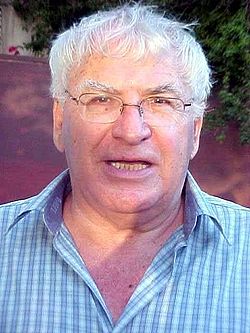

 For readers who have driven or hiked past unmarked, run-down old stone buildings in Israel, former Jerusalem Deputy Mayor Meron Benvenisti’s Sacred Landscape (University of California, 2000) will reveal a layer of Arab ghosts inside Israeli towns, cities and the countryside.
Born in 1934, Benvenisti spent his childhood accompanying his father on geographical tours of Mandatory Palestine. The elder Benvenisti traveled in order to rename the Arab features of the map with Hebrew monikers, but his son saw an enchanting world of Palestinian villages. Meticulously researched with zealous attention to detail, Sacred Landscape asks the question of how the rural Palestinian fabric within Israel’s 1948 borders ceased to exist both on land and in the minds of the Israelis who replaced it.
The first step, according to Benvenisti, was a cadre of Jewish geographers, including his father, who collected the names of towns, rivers, hills and springs and painstakingly redubbed them. Drawing from the minutes of naming committee meetings, Benvenisti reports that some names were Hebrew versions of the Arabic, some were taken from the Bible, others were named for Zionist leaders. For Benvenisti, the loss of the Arab map was tragic.
“The wealth of Arabic toponymy [place names] is astounding in its beauty, its sensitivity to the landscape, its delicacy of observation and its choice of images … The people who chose these names had no need to articulate their love for their land in vast lyrical creations or to sing songs of longing from a distant Diaspora. They expressed it by naming a piece of land the Setting of the Moon; a spring of pure water, the Blue Spring; and a picturesque village, the Charming Village.”
The new Hebrew names, however, still referred to a primarily Arab landscape until the 1948 war, during which nearly 400 villages were depopulated. Benvenisti equivocally points out the Israeli and Palestinian claims as to who began the war, and then explores its consequences. The first three villages destroyed in the war were Qastal, Talunya and Saris on the road to Jerusalem. Their residents had either helped the Arab troops who laid siege to Jerusalem, or the villagers abandoned their homes, and the Arab Legion used them as bases. Benvenisti writes up the pre-war history of Qastal, population 150:
“They inhabited about twenty-five stone houses and cultivated some 100 dunams of fruit trees, fifty dunams of olive groves, a few score dunams of vegetables and additional plots of field crops. There was no school in the village. Its single shop and coffee-house sat beside the main road to Jerusalem and were the property of an Armenian named Abu George. Most of the younger villagers had taken an active part in the Arab Revolt of 1936-39 under the command of ‘Abd al-Qadir al-Husseini and remained loyal to him in the 1948 war as well.”
The refugees left behind them intact villages, sometimes with food still in the cabinets and animals in their pens. While some Israeli leaders planned to settle immigrants in these abandoned homes, the houses often were not heated or connected to a water supply, and made for an uncomfortable first home for the thousands of immigrants from the Arab world who were settled there by the government and moved out as quickly as possible. In time, the empty houses became an uncomfortable reminder that the refugees might come home. During the 1950s and early 1960s, Jewish Agency head Yosef Weitz spearheaded an effort to demolish most of the village remains. The Arab presence was thus wiped out of Caesaria, the Achziv beach, and hundreds of other places on the Israeli map. Israeli history taught about the Crusader origins of the buildings that remained, ignoring the more recent Arab past.
Finally, Benvenisti explores what became of mosques, churches and graveyards, which were spared the devastation visited upon village houses. Most of the village cemeteries became straggly untended fields strewn with garbage. Mosques are used today as anything from stables to synagogues. Saint’s sites have been Hebraicized and appropriated.
Benvenisti is 75 and lived through the rapid Judaization of the Israeli/Palestinian geography. Although he participated in building kibbutzim on the sites of destroyed villages and served in the Israeli army, the experience of watching his neighbors disappear marked him permanently with a sense of guilt.
Although Benvenisti deals in loaded terms of ethnic cleansing that may turn off some Israel sympathizers, he also catalogs the Arab aggression towards the establishment of the Jewish state, and the ongoing tension between Arabs and Jews that simmers around the fateful events of 1948. He plumbs national documents to see what motivated the Jewish leadership to eradicate the villages, and sifts through the literature of Israel’s greatest writers to see how they handle the moral weight of the process. While he takes Palestinian geographers to task for expecting a return to individual villages long obliterated from the landscape, his largest critique is reserved for the country in which he was born:
“It is ironic that the Israelis – who have managed to thwart every attempt in the past fifty years to bring back the refugees, who altered the physical reality in a manner that ruled out any possibility of restoring the Palestinian landscape, and who have perhaps even compelled the Palestinian leadership to acquiesce to the status quo – are still hounded by the nightmare of ‘the return.’”
Readers looking for an account of why the Palestinian leadership failed in protecting the countryside will not find a total recount here. But Benvenisti offers an eye-opening look at the step-by-step process of Israel’s renaming and transforming the Palestinian landscape, colored by his own experiences as a child and later as a researcher in the villages. He portrays little-known aspects of pre-State Palestinian life, such as the Bedouins who raised water buffalo and lived in reed huts in the North. His lucid and flowing writing makes the factual historical reference read like a gripping novel. Sacred Landscape will change the way you read the Israeli landscape. It is a masterpiece that sensitively mourns a rural life forever disappeared.
(Photo from http://www.radioopensource.org)



I am astonished that Benvenisti can wring his hands about a few hundred villages whose inhabitants fled in a war started by their side when 850,000 Jews were driven out of every town in the Middle East and N. Africa and their property stolen – and they were not even on the battlefield.