
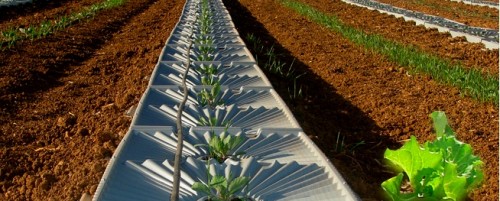


(Tal Ya Water technologies, featured at the Agritech expo in Tel Aviv next week, could provide the world’s best – possibly first – effective dew drop collector for watering crops.)
Growing tomatoes and raising dairy cows in 113 degrees Fahrenheit is no easy feat, but over the last 30 years or so, Israeli agriculture technologies have been made to cope with whatever Mother Nature throws at them.
It’s taken special fans, software, innovative dew collectors, drip irrigation, integrated pest control tactics, and state of the art greenhouses along with some “mother of invention.”
Old Macdonald would be proud: mainly as a means to survive in the hostile desert climate, Israeli agronomists, entrepreneurs, academics, and government agencies, started focusing on agriculture.
The fruits of their labor will be on show next week at Israel’s international agriculture exhibition Agritech, from May 5 to 7 in Tel Aviv.
Over the years, Israel married pure science with know how and technology, and today the country exports more agriculture technologies than the fresh produce which inspired the innovations in the first place.
Three thousand international guests are expected to take part in next week’s exhibition — including 25 ministerial and 80 commercial delegations from around the world, as well as up to 15,000 Israelis.
This year, as attendees pour over the 200 plus Israeli companies being showcased, they will also be able to take part in a world-class conference — Feeding the Future.
“First of all this conference is aimed at a foreign audience and visitors,” says Agritech co-chair Arie Regev, who is also the director of foreign relations for Israel’s Ministry of Agriculture and Rural Development.
With the first Agritech exhibition in 2003, followed by another in 2006, this will be the third, and despite the slumping economy, Regev expects the same turn out as the last event which included visitors from over 100 countries.
Distinct advances based on its specific challenges
Israeli technologies cover just about “whatever you may think of,” Regev tells ISRAEL21c. “There will be irrigation technology, monitor control equipment, milking parlor equipment, assisting equipment, computers, monitors and software.”
Among them, the main sub sections of the exhibition will be companies working in crops or with livestock. And while advanced agritech products no doubt come from other Western countries like Holland, Israel has a distinct advantage, says Regev.
“Israel is having, keeping and maintaining modern advanced agriculture in arid and semiarid conditions where water constraints are very imminent and strong, and where temperature and humidity is high,” he says. “Many of our solutions for crops or for livestock provide solutions to alleviate this problem, making growing crops and raising livestock, easier, better and more efficient. And, yes, more humane concerning animal husbandry.”
While he doesn’t want to pinpoint any particular “stars of the show,” what he can tell ISRAEL21c is that “for decades the Israeli agriculture industry has served as a laboratory for all these new technologies. Israel exports about $2 billion per annum on agritech products, almost double its fresh produce exports,” Regev says.
Space age and tested on Mars
Exhibitors are all listed on the Agritech website and include well-known and lesser known names. Those featured are not only Israeli innovators, but also include solutions that Israelis have had a hand in distributing around the world, such as a new ground humidity-monitoring sensor developed for NASA’s spaceship Phoenix. The Israeli company Agrolan is distributing this particular product for use in agriculture.
On Mars the sensors were attached to robotic arms so the spacecraft could identify water. On Earth, Agrolan’s technology can measure soil humidity for farmers over large swathes of land. The collected data is transmitted to a specific website so that the software can control in real time the timing and the quantity of the irrigation, says Dan Meiri, the general manger of Agritech.
Agrolan, he tells ISRAEL21c, has been working on its own innovation as well. At the last Agritech conference, the company unveiled its dial-in weather stations to get reports of weather conditions back at the ranch, real time.
Innovative solutions visitors will see include those launched by Shelef Laboratories, which has built a mobile lab for monitoring pests and pesticides applied to large commercial scale farms; or how about colored canvases developed by Israel’s Volcani Institute to cover your crops, filtering out certain kinds of light to disorient pests?
“Tal Ya Water technologies, a semi-startup, is still having money invested in it, but according to what I know, it’s a very nice company,” Meiri tells ISRAEL21c.
“They are collecting dew in a nice and simple way —like from the time of the Nabateans — but their secret is the shape of sheets they are using and materials. They’ve waited a long time before they released their method.”
The small company based in Emek Hefer will be featured at Agritech.
“There is another unique company- a new system developed by Auto Agronom that is detecting each parameter on the leaves of plants. Not just how much water or fertilizer is there, but oxygen and carbon dioxide too,” adds Meiri.
Putting the globe’s minds together to feed the world
Israelis like deal making, so Agritech will be a two for one event. Along with the expo, there will be a conference that brings together some of the world’s best minds in a bid to help tackle food shortage. The conference, says organizers, will be a unique and unprecedented occasion in which experts from Israel and worldwide, will join efforts to provide analyses for creating a more even equilibrium between supply and demand of quality food for all.
During the conference, registrants will see how Israel and its guests address feeding the world’s hungry.
Among those offering their expertise will be Gilbert Houngbo, the Prime Minister of Togo, who is the former United Nations Development Program director for Africa, Dr. Tefera Deribew, Minister of Agriculture and Rural Development of the Federal Democratic Republic of Ethiopia, Israel’s Chief Scientist of the Ministry of Agriculture – Dr. Yuval Eshdat, as well as Dr. Will Martin, a research manager for The World Bank.
Israel is active and well known for its work in agriculture and humanitarian affairs, and its agricultural technology transfer is important in developing countries. Some successes are Israel’s low-pressure irrigation systems in South Africa, a unique aquaculture enterprise in Uganda, an Israeli-made rural development project in Angola, or dairy farms that it has helped established in Eastern Europe.
In a press release announcing his visit to a Canadian university in Edmonton recently, Hebrew University of Jerusalem’s Prof. Ayal Kimhi, who will be a speaking at the conference, said that in Angola, an Israeli company is building villages as a means of production for farmers and a cooperative system. The project has been so successful that the region has experienced a boom in growth.
“In Israel, we have a foreign ministry and a ministry of agriculture working to specifically find ways for Israeli technology to help other countries,” said Kimhi, who is also Israel’s director of research, at the Center for Agricultural Economic Research.
“Doing this kind of work helps to broaden people’s perception of Israel, seeing that it’s a superpower in technology, not just a land from the bible or what you see on CNN,” said Kimhi.
For more on the conference, visit the Agritech website.
::Agritech
(This story is reprinted with permission by ISRAEL21c – www.israel21c.org)




[…] partner, Jain Irrigation Systems Ltd. Representatives from both groups met in Tel Aviv for the Agritech 2012 Conference and Exhibition in Israel. The joint company currently employs 120 workers at […]
[…] farmers in one region in Israel, microclimates can be a headache. Little hills and valleys at differing […]
Agritech 2009 Expo In Tel Aviv Aims To Help Feed the World | Green Prophet http://bit.ly/8YW1s
Agritech 2009 Expo In Tel Aviv Aims To Help Feed the World http://ow.ly/4Gjk
Agritech 2009 Expo In Tel Aviv Aims To Help Feed the World http://ow.ly/4Gjj
Agritech 2009 Expo In Tel Aviv Aims To Help Feed the World http://ow.ly/4Gji
Agritech 2009 Expo In Tel Aviv Aims To Help Feed the World http://tinyurl.com/cmb44z