Go Green Quickly to Avert Energy Crises, Say US-Israeli Economists

picture21.gifAnalysts from Tel Aviv University and San Francisco offer sound solutions for looming energy crises:

With electricity rates soaring as much as 150% since 2001, and predictions of severe and regular blackouts in states such as Washington and Virginia, there’s a clear need for new thinking about electricity.

A recipe for preventing a dark future comes by way of an Israeli and American team, who suggest effective and environmentally friendly ways to generate “healthy electricity” markets in the United States.

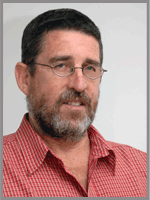
“There are no easy answers for solving America’s energy demands,” says Prof. Asher Tishler, Dean of the Faculty of Management at Tel Aviv University, and his American partner, Chi-Keung Woo of the San Francisco consulting firm Energy and Environmental Economics.

“But a smart formula for easing into the next decade would include a slower evolution towards deregulation of the electricity market, along with an aggressive investment in clean technology,” they say. The two researchers have co-authored a number of economics papers in this field, most recently in the International Journal of Energy Sector Management and Utilities Policy.

Deregulate Slowly, Go Green Quickly

Tishler and Woo recommend that Americans “think greener” by channelling billions of investment dollars into research and development dedicated to creating sustainable and alternative energy solutions during a slow and steady transition to deregulation. “With aggressive R&D, in 10 to 15 years green technology will be a reality,” says Tishler, “and we’ll find that it is not more expensive than traditional sources of energy.”

But what happens to rising electricity costs in the interim? Among the 20 American states that have deregulated utilities, prices for electricity remain higher than the ones that did not. Hang in there, say the researchers.

“Prices in a private market will fluctuate like crazy,” says Prof. Tishler, but “competition over time will reduce this volatility.” He stresses that unlike other traditional commodities, electricity is not easy to control. Rechargeable batteries cannot store electricity when demand is low, no major advances in technology to improve efficiency have been made recently, and labor costs remain high.

Social Costs a Factor

Easing consumers through the deregulation transition may not be easy on their pocketbooks. Tishler and Woo suggest, however, that if consumers are willing to fork out more for their electricity bills in the near future, it will encourage lower usage, thereby conserving power, helping to prevent blackouts, and benefiting the environment.

As the wealth of America’s middle class grows, so does the demand for big screen TVs and all manner of power-hungry electronics and so do greenhouse gas-causing CO2 emissions, taxing the environment further. “Energy consumption is a social issue, not just an economic one,” says Tishler.

An immediate way to cut down on use is by raising power prices even more, and by urging consumers to switch to clean energy. Alternatives such as solar power may be more costly in the short term, but the social benefits, though difficult to calculate, “are huge,” conclude the researchers.

Prof. Asher Tishler holds a Ph.D. in Economics from the University of Pennsylvania, and has been a faculty member at Tel Aviv University since 1976. He was recently appointed dean of the Faculty of Management. Over the last two decades, his research has focused on the defense sector and on optimizing electricity markets.


::American Friends of Tel Aviv University

Karin Kloosterman
Karin Kloostermanhttp://www.greenprophet.com
Karin Kloosterman is an award-winning journalist, innovation strategist, and founder of Green Prophet, one of the Middle East’s pioneering sustainability platforms. She has ranked in the Top 10 of Verizon innovation competitions, participated in NASA-linked challenges, and spoken worldwide on climate, food security, and future resilience. With an IoT technology patent, features in Canada’s National Post, and leadership inside teams building next-generation agricultural and planetary systems — including Mars-farming concepts — Karin operates at the intersection of storytelling, science, and systems change. She doesn’t report on the future – she helps design it. Reach out directly to [email protected]

Read More

TRENDING

Black fathers live longer than non-fathers, new study

Researchers found that fatherhood was associated with lower rates of early death among Black men, while early fatherhood was linked to poorer long-term health outcomes.

Can Scientists Predict Coral Bleaching Before It Happens?

Now researchers at the Woods Hole Oceanographic Institution (WHOI) in the US say they have developed a way to predict coral bleaching five to six months before it occurs, potentially giving reef managers enough time to intervene and save vulnerable corals.

AI data centers are triggering panic, instead of cleantech opportunities

AI may unintentionally become the economic engine that finally modernizes America’s aging grid. California is experiencing a massive AI data center boom, ranking 3rd in the U.S. with 227 operating centers and 54 more in development as of April 2026, according to Stanford.

Abortion Pills, Plan B and Mifepristone and what the new US mail ban means

Abortion pills, often confused with Plan B (the morning-after pill), and historically referred to as RU486 (mifepristone), are part of a broader category of reproductive health medications that women have been using for decades. But they are not the same thing.

SunZia comes online and America’s 11B, and largest renewable project begins wind power

The impact is already being felt. California has broken its wind generation record multiple times in recent weeks as SunZia begins feeding electricity into the grid. It’s a glimpse of what a renewable-powered future could look like when large-scale infrastructure finally comes online. Can we start saying goodbye to Saudi Aramco and Arabian Gulf oil? 

Locals From Rishon Fight IKEA

Big Box stores are a pretty new concept in Israel, and thank God that not every Israeli city wants them in their backyard. A word from someone who has see the beautiful farmland around her hometown Newmarket, Ontario stripped and converted into vulgar strip malls of big box shops: they have no place in a healthy and sustainable town or city.

The Jewish National Fund Meets An Inconvenient Truth

According to the JNF, it has transformed thousands of acres of barren land into green forests in Israel. They state that each person emits about 23 tons of carbon per year, estimating that each tree planted can absorb one ton of carbon in its lifetime. That's a whole lot of trees you'd need to be planting. Could so many fit in Israel?

How to quiet noise from construction in your office

Streets need to be resurfaced in New York but the humming and grinding noise is unsettling. Noise is environmental pollution. 

EarthX and a blueprint for sustainable investing

Trammell S. Crow, a Dallas-based businessman and father of four, is focusing his efforts on impact investing, and media that focuses on saving the planet through EarthX.

Mining Afghanistan’s Mineral Discoveries Similar to Avatar

Now that American forces in Afghanistan are commemorating the longest period of any war that America has been involved in, including the 1965-73 Vietnam War, the recent discoveries of large and extremely valuable mineral and metal deposits may finally bring to light a reason to continue the presence of US fighting forces in this war torn and backward country.

From Pilot Plant to Global Stage: How Aduro Clean Technologies’ 2026 Expansion Signals a Turning Point for Chemical Recycling Investors Like Yazan Al Homsi

The company's Next Generation Process (NGP) Pilot Plant in London, Ontario, has officially moved into initial operating campaigns, generating the kind of structured, repeatable data that separates laboratory promise from commercial viability.

Nobul’s Regan McGee on Shareholder Value: “Complacency Is the Silent Killer” 

Why the governance framework designed to protect shareholders so...

Should You Invest in the Private Market?

startustartup Unlike public stock exchanges, which offer daily trading, strict...

Popular Categories