
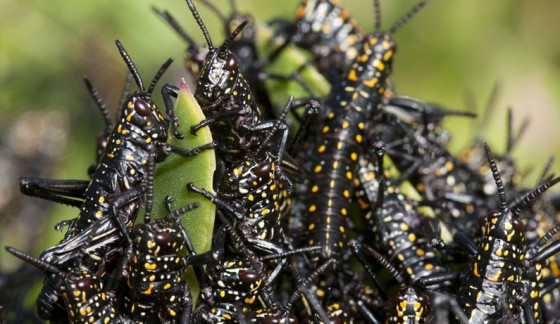

 Like in biblical times locust swarms threaten Egyptian crops.
Scattered pockets of locusts in southern Egypt and northern Sudan are a threat to agricultural land, warns the UN Food and Agriculture Organization (FAO). Countries along the Red Sea should remain on “high alert and make every effort to find and treat all infestations”, it says. During January, immature locusts known as “hoppers” formed bands and swarms along the coastal plains of the Red Sea, increasing locust numbers significantly in southeastern Egypt, northeastern Sudan, Eritrea and Saudi Arabia, FAO said in its January bulletin.
Despite “substantial” ground control operations in these countries, “more swarms are expected to form in northeast Sudan and southeast Egypt in the coming weeks,” it added in a 17 February update on its website.
“The desert locust is a difficult pest to control,” said Mamoon AlAlawi, secretary of FAO’s Commission for Controlling the Desert Locust in the Central Region, which includes Egypt, Sudan, Saudi Arabia, Eritrea, Ethiopia, Oman and Yemen. “Limited resources for locust monitoring and control, and political turmoil within and between affected countries further reduce the capacity of a country to undertake the necessary monitoring and control activities.”
AlAlawi said this threat was unlikely to turn into a humanitarian crisis, with the winter breeding period coming to a close and the current number of swarms relatively limited. Still, if the rains are strong in the coming weeks, increased breeding could lead to more swarms. “The situation is potentially dangerous,” he said, if swarms reach the interior of Saudi Arabia, a breeding area during the spring.
So far, a small number of locust swarms have appeared in areas near Egyptian tourist resorts in Marsa Allam and in the partially desert area of the New Valley, according to local media reports. Numerous high-density groups of mature adult locusts also laid eggs in the Abraaq area of the southern Red Sea coast in Egypt, and by the end of January, immature adults were also forming groups there, FAO said. In northern Sudan, swarms have invaded cropping areas in the interior in recent days, attacking winter crops and fruit orchards.
Late last year the Ministry of Agriculture sent 14 combat squads to the south, having learned a lesson from tardy action against the 2004 locust invasion, (Arabic). Nearly 11,000 hectares were cleared of locusts in January, with the support of the FAO Commission for Controlling the Desert Locust in the Central Region, which strives to minimize the use of pesticides, through its EMPRES programme.
But despite these efforts, locust numbers increased significantly in January, especially along the Red Sea coast between Egypt and Sudan, FAO said.
AlAlawi said the first warning about the current situation of desert locusts in Egypt was issued at the end of last summer, “so sufficiently in advance”. The control operations were successful in minimizing the threat, but some swarms survived and headed to the Red Sea, where weather conditions were warmer. This encouraged breeding and they were able to lay eggs in December and January.
“As Desert Locusts are always on the move, it is difficult to totally control them in one time,” AlAlawi said.
Others are more critical of the eradication efforts.
“The fact is that locusts had already managed to cross the border into Egypt and this means that they will threaten our fields,” said Ahmed Amr, a professor of agriculture from Zagazig University. “This shows that the government did not do its job of combating these insects at the border well. Once these locusts are in, you cannot stop them from ravaging the crops.”
Meanwhile, experts like Saeed Al Zeiny, a professor of entomology from Ain Shams University, pin their hopes on the weather. He says if the direction of the wind changes, locusts might be forced to change their course.
“It is not easy to control locust hordes on the move,” Al Zeiny said. “Everybody must also know that these locusts keep changing every now and then. This means that the pesticides that proved efficient last year can be inefficient this year.”
Egypt is Africa’s biggest wheat grower, with expected output of 8.5 million tons in 2012-2013, according to the International Grains Council. With around 3.6 million hectares of agricultural land in Egypt, there is a lot at stake in the case of a major locust invasion.
The country’s worst locust invasion since the 1950s was in November 2004, when millions of the red desert insects swept into Cairo and the Nile Delta. At the time, the Land Centre for Human Rights, a local NGO devoted to agriculture issues, reported that 38 percent (Arabic) of Egypt’s crops had been damaged as a result of the invasion.
Abdurrahman Afifi, a farmer from the town of Al Ayat south of Cairo who lost all his five acres of crops in the 2004 locust invasion, has already started warning neighbours and relatives to scatter poison bait or dust in their fields to combat the insects. “The problem is that most of these people earn their living solely from agriculture. This means that they will lose everything if they lose their crops,” he said.
This is reprinted from IRIN; Image of locust swarm from Shutterstock


Might be good to check to see if any of these species are considered to be Halal according to Islamic dietary laws. Some Jewish groups, particularly Yemenites, consider locusts as being kosher if they have the Hebrew letter Chet on their underside.
No worse than what the Chinese eat, I reckon.