IKEA’s Blue and Yellow Also Has a Green Face

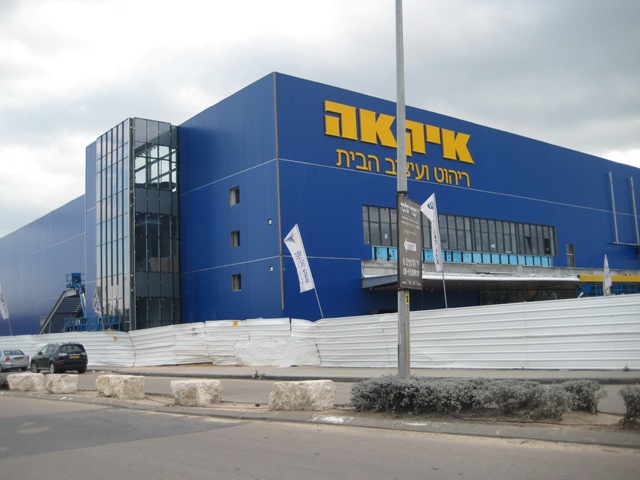
ikea building exterior IKEA Israel’s Blue-Yellow buildings also have a green policy

IKEA’s blue and yellow store motifs have become familiar to households all over the world, including the Middle East with stores in Israel, Kuwait, Saudi Arabia and the UAE. IKEA’s Israel stores have been serving the public since 2001, and have introduced environmental policies into both the products it sells there, such as ceasing to sell incandescent light bulbs. These environmental friendly policies also hold true in regards to the bags used to carry purchased items home as IKEA stores in many countries, including Israel, now do not give plastic bags to customers in a policy to not only save money but be more green as well.

Shlomi Gabby, IKEA Israel General Mgr.

Until February 2011, IKEA’s Israel branch had two stores: the original or flagship store in the city of Netanya, and a second larger store near the city of Rishon Lezion, just south of Tel Aviv.

Aside from discontinuing the sale of the Thomas Edison (or Nikola Tesla) type of light bulbs, which are more energy inefficient than the new LED and florescent ones, IKEA’s new policies regarding plastic shopping bags in itself is a very “green” policy.


As stated by Israel General Manager Shlomi Gabbay:

“For the past two years the IKEA home office has been encouraging stores to stop using plastic furnishing bags, and has been selling reusable “blue bags” made from nylon, a more environmentally friendly material. To encourage customer use of these bags, it has reduced prices and provided a lifetime guarantee for these bags”.

known to both IKEA employees and to customers as the “blue bags”  both stores in the Israel chain purchased about 250,000 blue bags in 2010, an increase of approximately 25%. They say customers have been reusing them more, resulting in expense reductions of 90 percent for plastic bags provided to customers at check-out. This is coupled with environmental savings of thousands of tons of environmentally non-friendly plastic waste.

IKEA wood and plastic furniture and accessory items are being made more and more from

recycled materials such as wood and fabrics left over from production that are considered by many to be waste products.

The stores also have bins for collection of recyclable items such as plastics, wood and metals. Energy saving lighting is also becoming standard for IKEA branch stores.

While some IKEA product items are perhaps not as environmentally sustainable as some environmentalists might want them to be, compared to many other large retail chains, IKEA is making great efforts to be as environmentally friendly as possible.

Not bad for a network of 331 stores in 38 countries, including at least 6 in the Middle East.

Shlomi Gabby photo: IKEA Israel:


More about IKEA green policies and recycling :

Recycled Furniture from Middle East Rugs and Doors

IKEA Israel Stops Selling Incandescent Light Bulbs

IKEA Increases Design Awareness, But What About Sustainable Design

Maurice Picow
Maurice Picowhttps://www.greenprophet.com/
Maurice Picow grew up in Oklahoma City, U.S.A., where he received a B.S. Degree in Business Administration. Following graduation, Maurice embarked on a career as a real estate broker before making the decision to move to Israel. After arriving in Israel, he came involved in the insurance agency business and later in the moving and international relocation fields. Maurice became interested in writing news and commentary articles in the late 1990’s, and now writes feature articles for the The Jerusalem Post as well as being a regular contributor to Green Prophet. He has also written a non-fiction study on Islam, a two volume adventure novel, and is completing a romance novel about a forbidden love affair. Writing topics of particular interest for Green Prophet are those dealing with global warming and climate change, as well as clean technology - particularly electric cars.

Read More

5 COMMENTS
  1. It’s not a perfect world we live in, Mark. If it was, we wouldn’t have so many environmental problems as we have now. I’m sure IKEA does have some issues that one might consider to be green washing; but most big companies do.

    One thing I notice id that their restaurant menus (except for fast food items) are reasonably priced and generally wholesome. I understand the company founder himself, Ingvar Kamprad, eats there.

    Call it what you want, but at least the company is trying to improve its environmental image. Ill give them credit for that.

  2. Isn’t this a bit too much greenwashing? Several benchmarks have in fact shown that Ikea is the least sustainable furniture maker. Personally, I have awful experiences working together with these charlatans. It’s a shame that so many people fall into the trap.

  3. Israel prices on virtually everything are much higher than in Europe.

    We have a 3 tiered tax system here:

    Customs duties

    Purchase taxes

    VAT

    In addition, stores often charge much more afterwards.

    That’s the reality of life here – has nothing to do with IKEA.

TRENDING

From Pilot Plant to Global Stage: How Aduro Clean Technologies’ 2026 Expansion Signals a Turning Point for Chemical Recycling Investors Like Yazan Al Homsi

The company's Next Generation Process (NGP) Pilot Plant in London, Ontario, has officially moved into initial operating campaigns, generating the kind of structured, repeatable data that separates laboratory promise from commercial viability.

Urban miner Sortera raises $45 million USD to pull aluminum from the scrap pile

Sortera Technologies, founded in 2020 by Nalin Kumar and Manuel Garcia, is emerging as a major U.S. circular-industry player. Led by CEO Michael Siemer, the company uses AI and advanced sensors to turn scrap metal into high-value aluminum alloys. Its new ~$45 million funding round signals investor appetite for industrial decarbonisation—where emissions cuts come not from PR-friendly solar installs, but from upgrading the materials that power EVs, solar frames, and construction.

Waste Reform from the Ground Up: How Trash Balers Are Helping Cities Rethink Sustainability

If you’ve ever watched a recycling truck weaving through city streets, you’ve seen the problem firsthand. Most of what we call “recycling” still depends on long-distance transportation and centralized sorting facilities. Those systems are energy-intensive and prone to contamination — the dreaded mix of wet food, plastic wrap, and paper that renders recyclables useless.

Scientists Crack the Code for Low-Cost, Low-Carbon Plastic Recycling

While enzymatic recycling offers hope for managing existing plastic waste, scientists and environmental advocates agree it must be paired with the development of bio-based plastics—materials made from renewable biological sources like corn starch, sugarcane, or algae. Unlike conventional plastics derived from fossil fuels, bio-based alternatives can dramatically reduce carbon emissions at the production stage and are often compatible with closed-loop recycling.

Regenx builds urban mines for the rarest of metals

Regenx from Canada has evolved the concept of mining: they are urban mining in the classic sense and pointing the way to cleaner and more sustainable ways of recovering minerals from industry.

Here’s How To Implement The Four Pillars Of Employee Engagement

If you throw a party for your work team and they are vegans, don't make it a barbecue. Know the sustainability values of your team to boost moral and retain good people.

Locals From Rishon Fight IKEA

Big Box stores are a pretty new concept in Israel, and thank God that not every Israeli city wants them in their backyard. A word from someone who has see the beautiful farmland around her hometown Newmarket, Ontario stripped and converted into vulgar strip malls of big box shops: they have no place in a healthy and sustainable town or city.

The Jewish National Fund Meets An Inconvenient Truth

According to the JNF, it has transformed thousands of acres of barren land into green forests in Israel. They state that each person emits about 23 tons of carbon per year, estimating that each tree planted can absorb one ton of carbon in its lifetime. That's a whole lot of trees you'd need to be planting. Could so many fit in Israel?

How to quiet noise from construction in your office

Streets need to be resurfaced in New York but the humming and grinding noise is unsettling. Noise is environmental pollution. 

EarthX and a blueprint for sustainable investing

Trammell S. Crow, a Dallas-based businessman and father of four, is focusing his efforts on impact investing, and media that focuses on saving the planet through EarthX.

Mining Afghanistan’s Mineral Discoveries Similar to Avatar

Now that American forces in Afghanistan are commemorating the longest period of any war that America has been involved in, including the 1965-73 Vietnam War, the recent discoveries of large and extremely valuable mineral and metal deposits may finally bring to light a reason to continue the presence of US fighting forces in this war torn and backward country.

From Pilot Plant to Global Stage: How Aduro Clean Technologies’ 2026 Expansion Signals a Turning Point for Chemical Recycling Investors Like Yazan Al Homsi

The company's Next Generation Process (NGP) Pilot Plant in London, Ontario, has officially moved into initial operating campaigns, generating the kind of structured, repeatable data that separates laboratory promise from commercial viability.

Nobul’s Regan McGee on Shareholder Value: “Complacency Is the Silent Killer” 

Why the governance framework designed to protect shareholders so...

Popular Categories