Yemen Running Dry As Water Shortage Reaches Extreme Levels in Africa and the Middle East

For years now, Green Prophet has been reporting on the growing water shortage situation in Africa and the Middle East and its economic and geopolitical implications. However, the scale of the problem and the need for urgent international coordination to secure this basic commodity is becoming more urgent today as stories and pictures from Yemen warn of an inevitable social collapse in the middle of political uncertainty.

According to a recent report from Maplecroft, the Gulf nations are among the countries with the least available water per capita. The “water stress index identifies areas of water stress by calculating the ratio of domestic, industrial and agricultural water consumption, against renewable supplies of water from precipitation, rivers and groundwater.

In a new ranking of 186 countries, the water stress index rates 17 countries as ‘extreme risk,’ with the Middle East and North African (MENA) nations of Bahrain (1), Qatar (2), Kuwait (3) Saudi Arabia (4) Libya (5), the disputed territory of Western Sahara (6), Yemen (7), Israel (8), Djibouti (9) and Jordan (10) topping the ranking.

Meanwhile, the population of the Middle East is expected to double to over 600 million in the next four decades. Add to that the changing climate change patterns expected to cause increased drought and flooding, and the water shortage situation is predicted to become more intense and permanent than past water shortages.

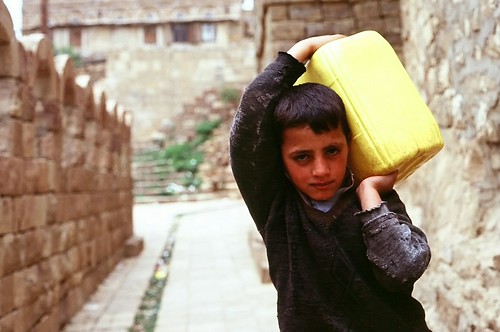
But of all counties in the region, the one coming closest to running dry is Yemen. As reported by Green Prophet recently, the food situation has been exacerbated by months of fighting to overthrow the current president Ali Abdullah Saleh. Directly linked with the food insecurity is the water shortage as agriculture is the primary use of water.  Past predictions that Yemen may be the first country to run out of water are no longer implausible. According to a report drawn up by the Washington Centre for Strategic and International Studies, within six years the city of Sana’a will have run out of water completely.

Other recent reports confirm that 19 out of the nations 21 aquifers are no longer being replenished. Consumption in the Yemeni capital exceeds by a factor of four the amount of water fed back into the underground reserves by local rainfall. Tap water is available only once every four days in Sanaa, a capital of 2 million people, while in Taiz, a southern city, tap water is available only every 20 days. Meanwhile nearly half of all Yemenis live under the poverty line set by the World Bank at $2 per day and don’t have access to proper sanitation, with more than 50 percent of children said to be malnourished.

The crisis is blamed on a number of factors, including inefficient irrigation techniques, increase in domestic consumption (the population of the region is set to double, from 24 to 48 million, over the next 17 years), corruption and poor resource management policies.

The problems created by the shortage of food and water in Yemen are exacerbated by the population’s dependence on qat, an extremely profitable crop which requires extensive irrigation and is so widespread that it takes up some 40 % of the country’s water resources.

While other “ water-deficit” counties like the UAE and Saudi Arabia can afford to invest in desalination plants, build underwater reservoirs, or buy land from other countries to secure food for their own people, in the long run these countries are as sensitive to the effects of depleting aquifers and declining home grown food production as Yemen. But time is running out faster for Yemen.


image: Flikr

Related Stories:

Syria Suffers Water Shortage- More News on Middle East Drought

In the face of “Nile-lessness” Egyptians Protest Water Shortages


Rola Tassabehji
Rola Tassabehjihttp://www.grenea.com
A global citizen, of Lebanese origin, Rola began her career in Unilever Arabia and from there moved into several roles in the marketing/communication function in Unilever, including: Brand Manager Skin Care, Unilever Arabia; Brand Development Manager, Dove, Unilever Africa, Middle East, and Turkey; and Communication Manager for Unilever North Africa and Middle East. After ten years with Unilever, she relocated to Abu Dhabi with her family and joined the team that launched INSEAD Middle East. She is currently working as Marketing Director of a new start-up, Grenea (www.grenea.com), focusing on building sustainable real estate development projects in emerging markets. After working with multi-nationals on skin care and business education, she has found a new interest in the convergence of environmental and social justice and is passionate about the possibilities that a restorative resource-based economy can bring to the people of the Middle East. Email [email protected]

Read More

TRENDING

Can Scientists Predict Coral Bleaching Before It Happens?

Now researchers at the Woods Hole Oceanographic Institution (WHOI) in the US say they have developed a way to predict coral bleaching five to six months before it occurs, potentially giving reef managers enough time to intervene and save vulnerable corals.

AC Water Uses: How to Reuse Air Conditioner Condensate Water for Plants, Cleaning and Water Conservation

That means the water dripping from your air conditioner may already be usable for gardening, cleaning, flushing toilets, topping up humidifiers, or cooling systems — instead of disappearing into the sewer. A new study. Is it safe?

Hormuz 2026 Conflict Poses an Energy and Food Security Dilemma in a Warming World

As tensions rise in one of the world’s most critical maritime chokepoints, the ripple effects go far beyond oil—touching food systems, climate pressures, and regional stability

Baby teeth read like tree rings paint a picture of toxins in early life

A new study from the Icahn School of Medicine at Mount Sinai in New York offers a striking insight into how the environments we are born into can quietly shape our brains years later. By analyzing naturally shed baby teeth, the ones tucked under pillows for the tooth fairy, researchers have reconstructed a detailed timeline of exposure to environmental metals during pregnancy and early infancy.

Poop in the East River shows the city’s rat problem and what people like to eat

New York ecology and health can be monitored by a jug of water a week.

Yerukim Forms a New Green Economy Where the Money is Really Green

The Yerukim members who pick up the recyclables get to keep the monetary reward, the public earns "green" bills that can be used in shops, and business owners get to be associated with environmentalism.

Choosing Riyadh over Dubai? What Investors Should Know

Saudi Arabia is deploying capital at unmatched scale to catalyze tourism and advanced industry while rewiring its power-and-water backbone. The investable frontier is widening—especially in renewables, grid storage, water efficiency/desal retrofits, and hospitality operating platforms. Prudent investors will insist on phased delivery, enforceable KPIs (energy, water, biodiversity), and RHQ/zone compliance—while pricing political-economy and reputational risks alongside growth upside.

Sell your cooking oil for biodiesel money

Want to make money on old french fry oil? Sell it.

Qatar Alternative Energy Summit Pairs Investors And Innovators

Alternative energy investors and innovators can meet n' greet in Doha, Qatar March 16 and 17.

Here’s How To Implement The Four Pillars Of Employee Engagement

If you throw a party for your work team and they are vegans, don't make it a barbecue. Know the sustainability values of your team to boost moral and retain good people.

Locals From Rishon Fight IKEA

Big Box stores are a pretty new concept in Israel, and thank God that not every Israeli city wants them in their backyard. A word from someone who has see the beautiful farmland around her hometown Newmarket, Ontario stripped and converted into vulgar strip malls of big box shops: they have no place in a healthy and sustainable town or city.

The Jewish National Fund Meets An Inconvenient Truth

According to the JNF, it has transformed thousands of acres of barren land into green forests in Israel. They state that each person emits about 23 tons of carbon per year, estimating that each tree planted can absorb one ton of carbon in its lifetime. That's a whole lot of trees you'd need to be planting. Could so many fit in Israel?

How to quiet noise from construction in your office

Streets need to be resurfaced in New York but the humming and grinding noise is unsettling. Noise is environmental pollution. 

Popular Categories