Why Masdar’s Personal Rapid Transport Would Have Been Great

Masdar PRT Cancelled

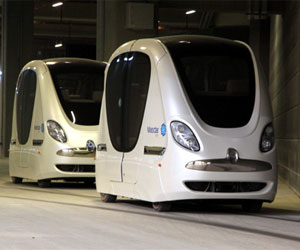
When the PRT plan at Masdar was scrapped, what exactly did we lose?

The folks at Singularity Hub offer an interesting analysis of Masdar’s PRT failure. Why is it, David Hill wonders out loud, that we have made massive advancements in telecommunications but precious few in transportation

Masdar gave us the perfect opportunity to take the next giant leap but we slipped and fell, our Fifth Element fantasies dashed in the process. Alas, the tiny self-navigating pods were simply too expensive. Or at least, the infrastructure necessary to lift them off the ground would have broken an already strained budget. What exactly have we lost?

First of all, there would have been a heavenly six square kilometer car-free zone; the little pod cars designed by Zagato and developed by the Dutch firm 2getthere wouldn’t have created any pollution at all. And yet the efficient fleet might have  made up to 135,000 trips every day, allowing people a more private, comfortable public transportation experience.

This elevated system would have done away with taxis (which would have been great for those of us who use them, but not so great on the job-creation front.)

Lithium-phosphate batteries that could have kept the cars going for 60km on a mere 1.5 hour charge would have allowed each vehicle to take 40 trips without recharging.  And the same infrastructure would have enabled Freight Rapid Transport – up to 5,000 trips a day.

Fortunately, we still have an underground metro and light rail transit system which will ultimately link Masdar with the rest of Abu Dhabi. There’s that. But if the emirate’s wealthand political will isn’t strong enough for radical advances in public transportation, then we might be stuck with the sluggish Fords and Hondas of old.

:: Singularity Hub

More On Masdar City:

Reassessing Masdar City

Masdar City: Small Hiccups Or Total System Failure

NY Times: Masdar City Just A Futuristic Playground For The Rich
Tafline Laylin
Tafline Laylinhttp://www.greenprophet.com
As a tour leader who led “eco-friendly” camping trips throughout North America, Tafline soon realized that she was instead leaving behind a trail of gas fumes, plastic bottles and Pringles. In fact, wherever she traveled – whether it was Viet Nam or South Africa or England – it became clear how inefficiently the mandate to re-think our consumer culture is reaching the general public. Born in Iran, raised in South Africa and the United States, she currently splits her time between Africa and the Middle East. Tafline can be reached at tafline (at) greenprophet (dot) com.

Read More

2 COMMENTS
  1. No one really knows why the PRT system has been abandoned for sure.
    That system is not all that expensive, but the undercroft that was required very likely was. The design called for constructing the entire city on a platform (the undercroft) so that the PRT vehicles could be operated without any interference from conventional traffic or pedestrians. It’s very likely that the cost of this undercroft was the main factor that has caused the Masdar developers to want to consider other solutions. Unfortunately, abandoning the undercroft might well require a complete redesign of the city as the next level up does not have wide streets, ample parking, good connectivity, spaces for charging EV’s, good access to goods movement locations and waste disposal locations. It remains to be seen if this redesign has been ordered and, if so, how what it will cost. Light rail and/or subway will simply serve a few locations in Masdar, mostly for outside
    commuters. Internal circulation services will still be required as will services to and from the parking garages located outside of the Masdar wall. It’s a mess to be sure. There is also some concern about how much electricity the PodCars would need in relation to the estimated capacity of the solar and other sources that are planned. It has been said that they, so far, have been found to be insufficient and that outside power will probably be required. If so, the demands of the PodCars for recharing may also be a factor. Finally, people used to various MASS TRANSIT systems often view PodCars as having insufficient capacity in urban settings. This perception is also likely to be a factor that was considered.

TRENDING

Anthropic, Google and Stripe put nearly $1 Billion on carbon removal

A coalition led by Frontier, backed by Stripe, Google, Salesforce and newly joined AI company Anthropic, has committed an additional $915 million to remove carbon dioxide from the atmosphere. The pledge adds to a previous $1 billion commitment and brings Frontier's total buying power to nearly $2 billion.

What Makes Artificial Turf Like AstroTurf Safe? University Research and Independent Testing Reveal Key Factors

A comprehensive analysis published by AstroTurf experts on turf field safety identifies several critical factors that separate premium synthetic surfaces from standard installations.

Endangered sperm whale washes ashore in southern Israel

A large sperm whale has washed ashore on Zikim Beach in southern Israel, marking only the eighth documented case of its kind along the country’s Mediterranean coast since monitoring began.

Luxury meets the textile waste stream with Coach – Bank & Vogue

A new collaboration between luxury brand Coach and textile reuse pioneer Bank & Vogue attempts to stitch those two worlds together: high fashion and the global textile waste stream.

Fishermen sue tire manufacturers on behalf of the salmon

A federal trial in San Francisco has brought US tire manufacturers, fishing groups, and environmental scientists into court over a chemical most drivers have never heard of — but which scientists say may be silently reshaping aquatic ecosystems.

Yerukim Forms a New Green Economy Where the Money is Really Green

The Yerukim members who pick up the recyclables get to keep the monetary reward, the public earns "green" bills that can be used in shops, and business owners get to be associated with environmentalism.

Choosing Riyadh over Dubai? What Investors Should Know

Saudi Arabia is deploying capital at unmatched scale to catalyze tourism and advanced industry while rewiring its power-and-water backbone. The investable frontier is widening—especially in renewables, grid storage, water efficiency/desal retrofits, and hospitality operating platforms. Prudent investors will insist on phased delivery, enforceable KPIs (energy, water, biodiversity), and RHQ/zone compliance—while pricing political-economy and reputational risks alongside growth upside.

Sell your cooking oil for biodiesel money

Want to make money on old french fry oil? Sell it.

Qatar Alternative Energy Summit Pairs Investors And Innovators

Alternative energy investors and innovators can meet n' greet in Doha, Qatar March 16 and 17.

Here’s How To Implement The Four Pillars Of Employee Engagement

If you throw a party for your work team and they are vegans, don't make it a barbecue. Know the sustainability values of your team to boost moral and retain good people.

Locals From Rishon Fight IKEA

Big Box stores are a pretty new concept in Israel, and thank God that not every Israeli city wants them in their backyard. A word from someone who has see the beautiful farmland around her hometown Newmarket, Ontario stripped and converted into vulgar strip malls of big box shops: they have no place in a healthy and sustainable town or city.

The Jewish National Fund Meets An Inconvenient Truth

According to the JNF, it has transformed thousands of acres of barren land into green forests in Israel. They state that each person emits about 23 tons of carbon per year, estimating that each tree planted can absorb one ton of carbon in its lifetime. That's a whole lot of trees you'd need to be planting. Could so many fit in Israel?

How to quiet noise from construction in your office

Streets need to be resurfaced in New York but the humming and grinding noise is unsettling. Noise is environmental pollution. 

Popular Categories