Aqaba’s Got Norwegian Wood — Isn’t it Good?

sahara forest projectGreenhouses will sprout in Aqaba’s desert under a pilot called The Sahara Forest Project – led by Norway. 

The ambitious Sahara Forest Project (SFP) aims to revegetate areas of desert and create green jobs through production of high-value crops and biomass. And, in the process, generate clean energy and fresh water. Farming the Jordan’s deserts as it’s to be done in Qatar sounds like a fantastical solution for Jordan’s resource problems.

“We aim to use what we have enough or too much of — saltwater, sun, arid land, and carbon dioxide — to make what we need more of — clean energy, fresh water and food,” Sahara Forest Project CEO Joakim Hauge told the Jordan Times.
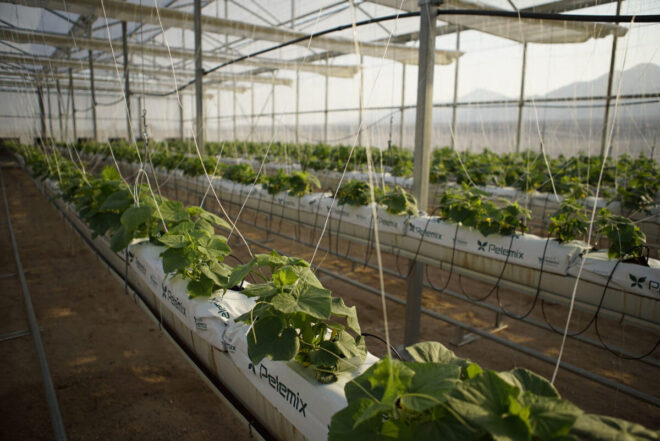
Sahara Forest Project

How do you build a biomachine?

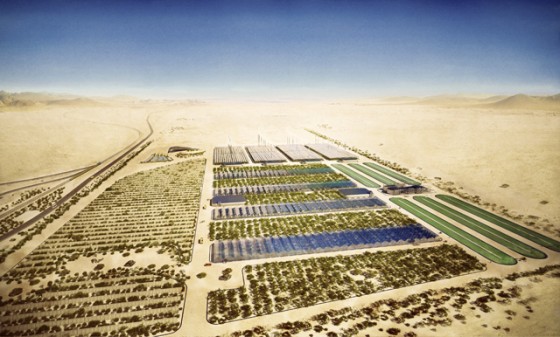
The Norway-based company operates on a threefold premise: construct saltwater-cooled greenhouses, generate electricity from concentrated solar power (CSP), and reintroduce desert flora. The technologies are complementary, and integrated to work as a holistic “biomachine”.

The first concept study of SFP was launched in 2009 at the United Nations climate negotiations in Copenhagen. The developers boldly assert that their engineered oasis has potential to produce enough energy for the Middle East – North Africa region and all of Europe.

Saltwater will be used to provide evaporative cooling and humidification within the greenhouses. Seawater will also be tapped as interstitial coolant within the walls, producing distilled water as a byproduct. Potable water requirements are thus minimized, while maximizing crop yields.
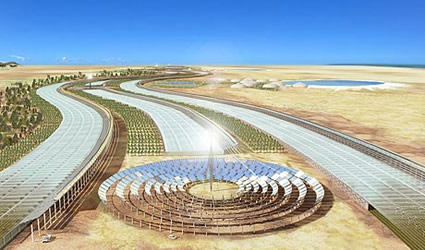
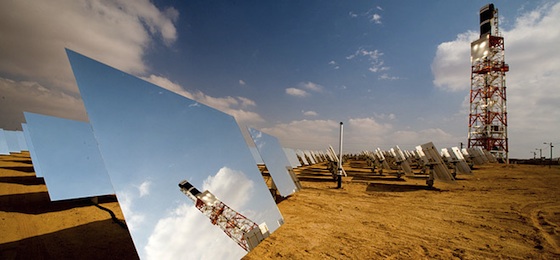
sahara desert project with solar panels
Sahara Desert Project

The Aqaba Special Economic Zone Authority and SFP signed a memorandum of understanding kicking off three feasibility studies for the project, which were financed by the Norwegian Ministry of Foreign Affairs.

The results of the studies were announced last week at a seminar that Hauge says, “…marks the start of a dialogue between international and Jordanian experts and policy makers, which we believe will establish the necessary framework for establishing a test and demonstration center in Jordan.”

That proposed center will serve as a testing ground, and as the project’s educational and innovation epicenter. This micro-Masdar will be sited at an unspecified Aqaba location, approximately 15 km inland and 40 m above sea level.  The 20 hectare pilot center will be designed to allow easy expansion to a 200 hectare commercial facility.

Support for the Jordan project will be via private and public funding: total price tag is estimated at $105 million. A pilot project is also underway in Qatar.

Downsides to the Sahara Desert Project

The project sounds logical. Seawater greenhouses and CSP (concentrated solar photovoltaic) technologies are well-suited to work in hot, dry climates.

It’s also impractical. Generating energy so far from end-users will never be a winning cost model: that’s one of the biggest challenges facing wind and wave technologies. Same argument works against commercial crops: these ultra-organic and carbon neutral veggies will be priced out of most Jordanians reach.  Shipping produce to urban centers will raise its carbon footprint up a few shoe sizes.
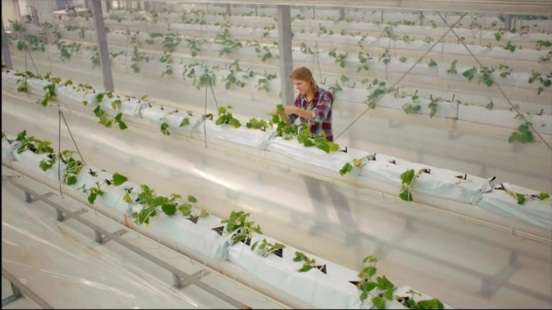
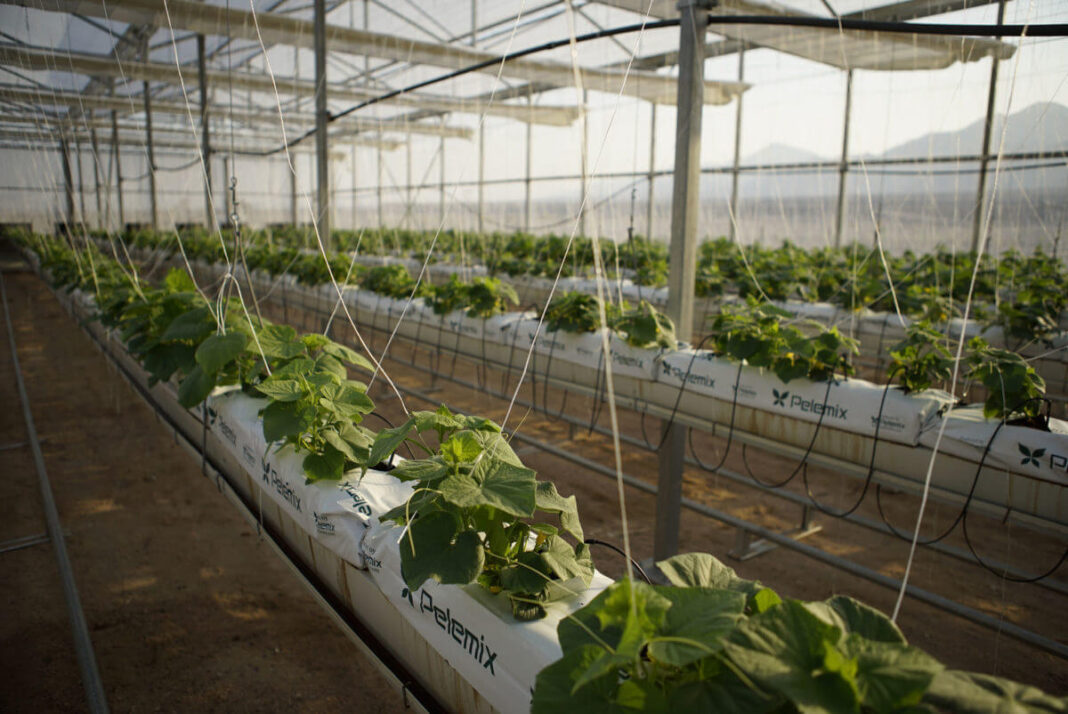
sahara forest project cucumbers desalination solar

And as for assisting local populations with green jobs? Consider instead training local farmers how to preserve and store water and employ efficient irrigation. Enact a program of biochar soil enhancement: desert land that’s useless for farming can be converted to rich agricultural land over time through this technique.  Commence  reforestation even on the smallest scale, efforts, irrigation infrastructures and micro-manage erosion.

Greening up the world’s deserts is simply fantastic – in the most literal sense.

::Sahara Forest Project

Hot this week

How Renewable Energy is Revolutionizing the Way We Power Our World

Solar has become the star of the transition thanks to modular hardware and straightforward installation. It fits dense cities and remote towns alike. Many companies are turning to rooftop arrays and carport systems - and exploring commercial solar installation as a practical way to lock in future savings.

How does one start prepping?

Faced with an extreme winter storm this year, Americans wonder how to be prepared for catastrophe. Miriam has lived through wars in the Middle East - so she's prepared on giving you a guide to prepping.

Fishermen sue tire manufacturers on behalf of the salmon

A federal trial in San Francisco has brought US tire manufacturers, fishing groups, and environmental scientists into court over a chemical most drivers have never heard of — but which scientists say may be silently reshaping aquatic ecosystems.

Listening to Water: Tarek Atoui’s Next Work for Tate Modern

Born in Beirut, Lebanon in 1980 and now living in Paris, Atoui has spent years building instruments that don’t sit comfortably in concert halls. Many of them involve water, glass, and ceramics — materials that react to sound instead of simply producing it.

Leading Through a Dual-Energy Transition: Balancing Decarbonisation with Energy Security

Experience in one area of the energy industry isn't enough to guarantee readiness across all the others. That's where a structured program like an MBA in energy can come in. Today's advanced curricula explore energy economics, finance, policy, and strategic management alongside the technical subjects. And when pursuing an energy MBA online, professionals can skill up and retrain without having to step out of the labor market -- an important perk at a time when skilled professionals are already in short supply.

Topics

How Renewable Energy is Revolutionizing the Way We Power Our World

Solar has become the star of the transition thanks to modular hardware and straightforward installation. It fits dense cities and remote towns alike. Many companies are turning to rooftop arrays and carport systems - and exploring commercial solar installation as a practical way to lock in future savings.

How does one start prepping?

Faced with an extreme winter storm this year, Americans wonder how to be prepared for catastrophe. Miriam has lived through wars in the Middle East - so she's prepared on giving you a guide to prepping.

Fishermen sue tire manufacturers on behalf of the salmon

A federal trial in San Francisco has brought US tire manufacturers, fishing groups, and environmental scientists into court over a chemical most drivers have never heard of — but which scientists say may be silently reshaping aquatic ecosystems.

Listening to Water: Tarek Atoui’s Next Work for Tate Modern

Born in Beirut, Lebanon in 1980 and now living in Paris, Atoui has spent years building instruments that don’t sit comfortably in concert halls. Many of them involve water, glass, and ceramics — materials that react to sound instead of simply producing it.

Leading Through a Dual-Energy Transition: Balancing Decarbonisation with Energy Security

Experience in one area of the energy industry isn't enough to guarantee readiness across all the others. That's where a structured program like an MBA in energy can come in. Today's advanced curricula explore energy economics, finance, policy, and strategic management alongside the technical subjects. And when pursuing an energy MBA online, professionals can skill up and retrain without having to step out of the labor market -- an important perk at a time when skilled professionals are already in short supply.

From Green Energy to Healthy Societies: Why old systems thinking is becoming relevant again

Across the Middle East and North Africa, large investments are being made in green hydrogen, renewable energy, water infrastructure and sustainability. Most of these efforts are discussed in the context of climate change, decarbonization and economic diversification. That framing is important, but it may not capture their full value.

We saw peace – an interreligious encounter deep in our eyes

They came from Israel, Palestine, Jordan, Iraq, Yemen, Morocco, Tunisia, Lebanon, Egypt… There are Sunni Muslims, Shiite Muslims, Jews (Orthodox and Reform), Orthodox Christians, Coptic Christians, Protestant Christians, Druze, Baha'is, a Scientologist.

Can biochar reduce ‘Forever Chemicals’ in food if it’s used in farms?

Biochar is produced by heating organic material in a low-oxygen environment so it does not burn. This process, known as pyrolysis, transforms plant matter into a stable, carbon-rich material.

Related Articles

Popular Categories