Earth. Energy. Everything next.

Aqaba’s Got Norwegian Wood — Isn’t it Good?

sahara forest projectGreenhouses will sprout in Aqaba’s desert under a pilot called The Sahara Forest Project – led by Norway. 

The ambitious Sahara Forest Project (SFP) aims to revegetate areas of desert and create green jobs through production of high-value crops and biomass. And, in the process, generate clean energy and fresh water. Farming the Jordan’s deserts as it’s to be done in Qatar sounds like a fantastical solution for Jordan’s resource problems.

“We aim to use what we have enough or too much of — saltwater, sun, arid land, and carbon dioxide — to make what we need more of — clean energy, fresh water and food,” Sahara Forest Project CEO Joakim Hauge told the Jordan Times.
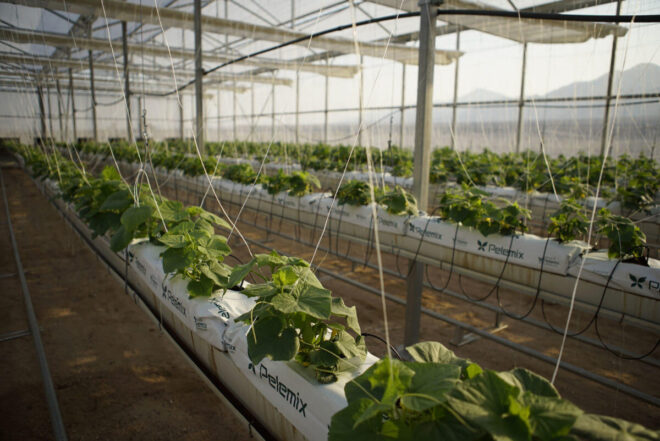
Sahara Forest Project

How do you build a biomachine?

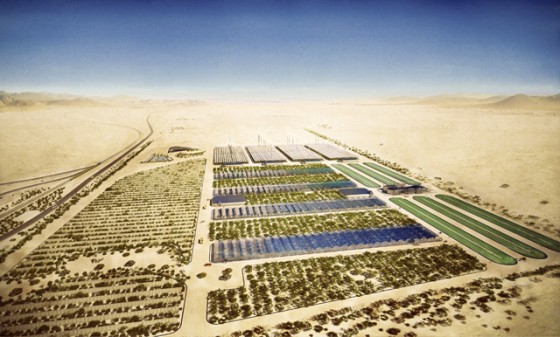
The Norway-based company operates on a threefold premise: construct saltwater-cooled greenhouses, generate electricity from concentrated solar power (CSP), and reintroduce desert flora. The technologies are complementary, and integrated to work as a holistic “biomachine”.

The first concept study of SFP was launched in 2009 at the United Nations climate negotiations in Copenhagen. The developers boldly assert that their engineered oasis has potential to produce enough energy for the Middle East – North Africa region and all of Europe.

Saltwater will be used to provide evaporative cooling and humidification within the greenhouses. Seawater will also be tapped as interstitial coolant within the walls, producing distilled water as a byproduct. Potable water requirements are thus minimized, while maximizing crop yields.
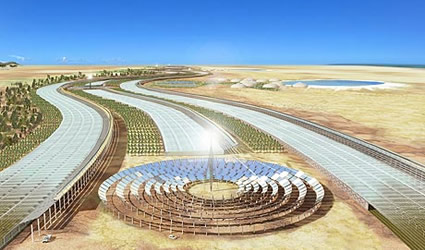
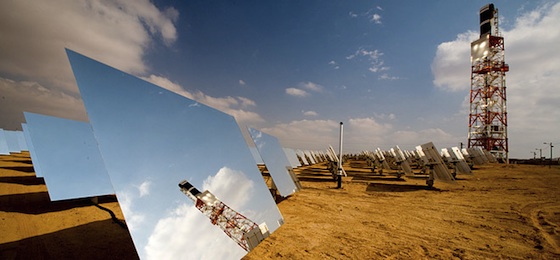
sahara desert project with solar panels
Sahara Desert Project

The Aqaba Special Economic Zone Authority and SFP signed a memorandum of understanding kicking off three feasibility studies for the project, which were financed by the Norwegian Ministry of Foreign Affairs.

The results of the studies were announced last week at a seminar that Hauge says, “…marks the start of a dialogue between international and Jordanian experts and policy makers, which we believe will establish the necessary framework for establishing a test and demonstration center in Jordan.”

That proposed center will serve as a testing ground, and as the project’s educational and innovation epicenter. This micro-Masdar will be sited at an unspecified Aqaba location, approximately 15 km inland and 40 m above sea level.  The 20 hectare pilot center will be designed to allow easy expansion to a 200 hectare commercial facility.

Support for the Jordan project will be via private and public funding: total price tag is estimated at $105 million. A pilot project is also underway in Qatar.

Downsides to the Sahara Desert Project

The project sounds logical. Seawater greenhouses and CSP (concentrated solar photovoltaic) technologies are well-suited to work in hot, dry climates.

It’s also impractical. Generating energy so far from end-users will never be a winning cost model: that’s one of the biggest challenges facing wind and wave technologies. Same argument works against commercial crops: these ultra-organic and carbon neutral veggies will be priced out of most Jordanians reach.  Shipping produce to urban centers will raise its carbon footprint up a few shoe sizes.
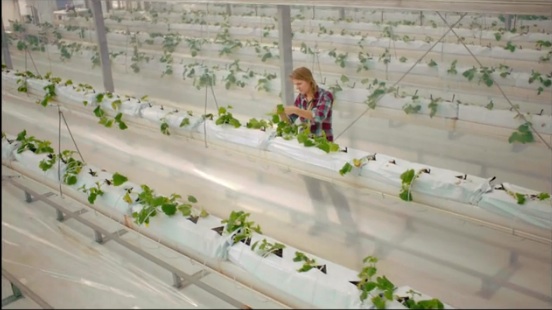
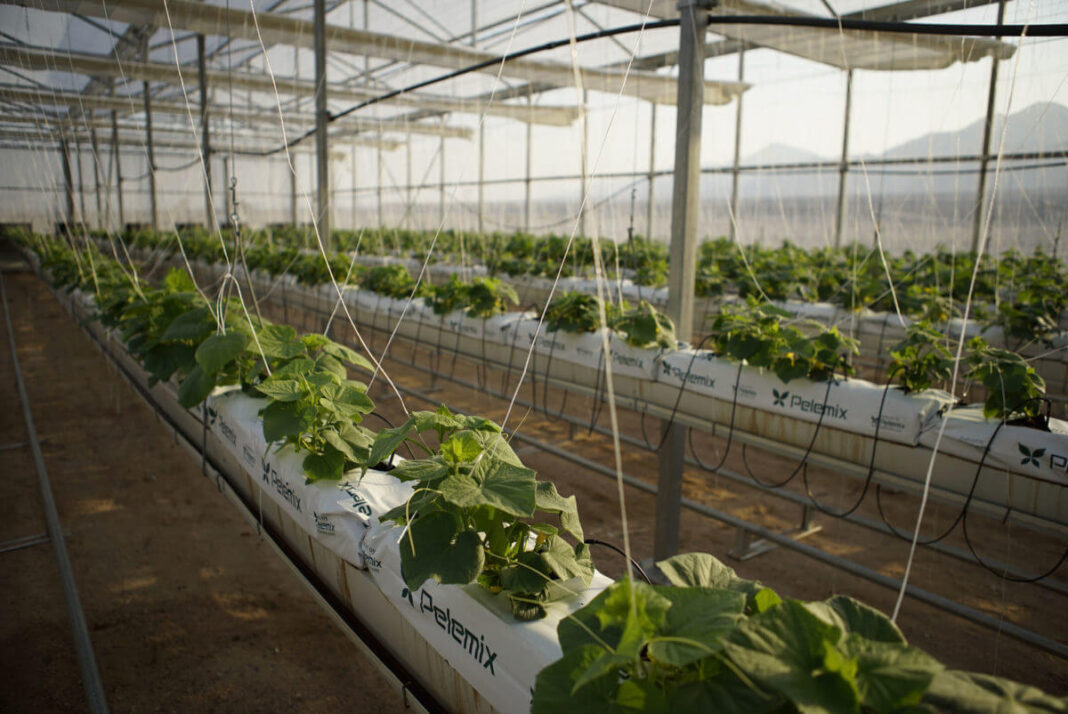
sahara forest project cucumbers desalination solar

And as for assisting local populations with green jobs? Consider instead training local farmers how to preserve and store water and employ efficient irrigation. Enact a program of biochar soil enhancement: desert land that’s useless for farming can be converted to rich agricultural land over time through this technique.  Commence  reforestation even on the smallest scale, efforts, irrigation infrastructures and micro-manage erosion.

Greening up the world’s deserts is simply fantastic – in the most literal sense.

::Sahara Forest Project

Read More

TRENDING

Cities promise net zero. A new UN-aligned checklist asks them to prove it

At COP31 in Türkiye, a new climate checklist challenges cities to prove their net-zero promises with measurable action, transparent reporting and real emissions cuts.

Petra by Night returns as Jordan tries brings tourists back to Wadi Rum

The Nabataeans understood that prosperity in the desert depended on respecting environmental limits. Two thousand years later, Petra's greatest attraction may still be the wisdom of the people who learned to live within them.

The pulsing planet and the earthquakes that shape our world

One of the most persistent questions in seismology concerns whether scientists will eventually be able to predict major earthquakes before they happen.

Amman’s traffic crisis is about more than cars. It’s about how we think

I believe Jordan needs a cultural transformation alongside its infrastructure investments. We must begin by redefining social prestige. Why should ownership of an expensive car be considered a greater achievement than making an environmentally responsible transportation choice? Why should travelling by bus carry a social stigma?

Why water-starved Amman keeps flooding and how underground rain tanks could help

Jordan's capital faces a troubling paradox: chronic water shortages and destructive winter floods. Hydrogeological expert Dr. Osama MN Gazal explains how underground rainwater tanks and green infrastructure could help Amman capture precious rainfall, reduce flooding and build a more water-secure future.

Why Bronwyn Finnegan Chose the Nonprofit Sector Over Politics or Corporate Life

Bronwyn Finnegan could have pursued a career in politics or corporate leadership. Instead, she chose the nonprofit sector, where she focuses on financial sustainability, governance and helping mission-driven organizations build the capacity to survive and grow.

Scientists make lead-free perovskite solar cells that can weather the elements

Scientists have developed a “raincoat” for lead-free tin perovskite solar cells, helping them withstand air, moisture and heat while maintaining high efficiency.

The Essential Guide To Sustainability in Project Management

Sustainability is an approach where businesses and individuals balance the environmental, social, and economic aspects of a project such that current and future stakeholders are not overburdened with the impacts of the project in future.

Yerukim Forms a New Green Economy Where the Money is Really Green

The Yerukim members who pick up the recyclables get to keep the monetary reward, the public earns "green" bills that can be used in shops, and business owners get to be associated with environmentalism.

Choosing Riyadh over Dubai? What Investors Should Know

Saudi Arabia is deploying capital at unmatched scale to catalyze tourism and advanced industry while rewiring its power-and-water backbone. The investable frontier is widening—especially in renewables, grid storage, water efficiency/desal retrofits, and hospitality operating platforms. Prudent investors will insist on phased delivery, enforceable KPIs (energy, water, biodiversity), and RHQ/zone compliance—while pricing political-economy and reputational risks alongside growth upside.

Sell your cooking oil for biodiesel money

Want to make money on old french fry oil? Sell it.

Qatar Alternative Energy Summit Pairs Investors And Innovators

Alternative energy investors and innovators can meet n' greet in Doha, Qatar March 16 and 17.

Here’s How To Implement The Four Pillars Of Employee Engagement

If you throw a party for your work team and they are vegans, don't make it a barbecue. Know the sustainability values of your team to boost moral and retain good people.

Popular Categories