Ziad Tassabehji is one of the most influential men in the new green Middle East. Until now he’s kept pretty quiet about his involvement in Masdar.
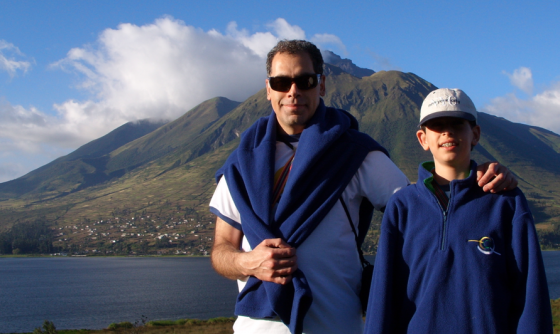
He came from the dot-com market with a boom and a bust, but in the Arab world. Ziad Tassabehji (pictured above with his son) has always been an entrepreneur at heart. Born in Lebanon and now living in the UK after more than two decades in the United Arab Emirates, Ziad started his first Internet company before there was even Internet in Dubai in 1995. By 2002 after a major downsizing to keep his tech company afloat, he changed course and moved into renewable energy and sustainable development.
Ever hear of Masdar, the zero-energy city in Abu Dhabi? The city that has moonscape mashrabiya surfaces, people podcar movers and a student body whose coffee is brewed by solar power?
Masdar was Ziad’s idea presented to officials in the Arab world. Ziad was sure that Middle East governments and decision-makers needed to diversify their economies from oil and gas into renewables. The idea struck a cord and flew.
Masdar today is a renewable energy cluster that includes a zero carbon city, a research driven institute, several investments in technology companies and projects and a carbon portfolio. To complement the initiative and give it a more global reach, it also sponsors the World Future Energy Summit, a green powerhouse conference held in Abu Dhabi ending today, and the Zayed International Prize for the Environment.
This all lept from Ziad’s vision.
“I wanted to do something that has a legacy,” he tells me. “To make an impact on people, planet and on profits. Money was not a strong enough motivation and I was frustrated by the dot-coms because I could see how this industry could make fundamental changes to the way we live, yet at the same time it was hard to get funded. I wanted to move into a bigger league, impacting more peoples’ lives and being that change agent.
“You could say I was a treehugger without knowing it.”
Leaders he spoke with in the United Arab Emirates got it. Checkbooks were opened and Ziad landed the dream job. He catalyzed all these impressive achievements in a region where seemingly limitless oil production didn’t breed any kind of sustainable future for jobs, societies, real estate and energy use. He started by giving himself crash courses on renewables, learning all he could.
Another bust in 2009: real estate in the Gulf and Abu Dhabi came to a grinding halt. Markets tumbled and it was clear from Masdar’s parent company that there was no appetite for new investments. Ziad (considered the founding father of Masdar) used this opportunity to gracefully leave the region and relocate with his family to London.
There he he co-founded Grenea a zero carbon zero waste company that catalyzes the creation of sustainable communities. Grenea aspires to make green communities efficient and profitable. He finds governments or landowners and helps them build communities for people to live, work and play all in the same community, but built sustainably of course. He has two projects just started in China.
Linking stakeholders — land owners, governments — with green architects, suppliers and financiers: “We are the glue that ensures that all stakeholders that haves something to gain.”
If you like the idea already, read more on Grenea here. Want more behind the scenes on Masdar? The untold story? Read my Q&A with Ziad below.
Q: So, I heard that you are the man behind the Masdar concept. How did this whole thing happen?
In 2004, I made a proposal to senior Abu Dhabi officials making the case that they needed to diversify their economy and develop a new sector around renewable energy. This initiative required mixing several ingredients together in order to create a knowledge based economy that promotes sustainable technologies including ventures funds, a research driven university, outward investments in companies that own promising technologies, local projects to promote adoption and a science and technology park that houses this new community.
The idea was been well received by the Mubadala board (Abu Dhabi Sovereign Fund) and senior management who saw the potential for such a sector and adopted it. My partners and I were then retained as advisors to evolve the concept into a full business plan. By early 2006, we were had several strategic partnerships lined up like MIT for the University, Credit Suisse for the fund and several other leading companies who were willing to engage with us on projects.
The project was then escalated to the Abu Dhabi Crown Prince who has the vision and risk appetite to make this unconventional step towards something that seemingly was against his self-interest.
The rest is really history. I changed my status from advisor to director of Investments and Innovation. I had a blank canvas to make the right deals with virtually open budgets to make things happen. Many great investments were made including Torresol in Spain, London Array offshore wind farm, 2 VC funds and many more.
Q: Is the idea still valid today in 2011 as it was in 2004?
Absolutely. Everyone knows that fossil fuels are a limited resource and burning them is harmful to the environment. What will Abu Dhabi sell to stimulate its economy in fifty or a hundred years from now?
Furthermore, in spite of having impressive wealth, the Middle East sadly remains one of the areas with the least amounts of innovation, patents, research papers and any scientific breakthroughs. Masdar was a promise to change all that and be that catalyst of change.
Q: You said “was”. What is happening at Masdar? Is the project still progressing as planned?
I left the company more than a year ago so I am not up to date with latest details. I do know however that many projects were stopped or at least slowed down. You also need to put things into context; the real estate market in the UAE suffered a major collapse that triggered a lot of uncertainty about future demand for Masdar city properties. Furthermore, some of the most prominent global publicly listed renewable energy companies are trading at 10 to 20% of their all time high price levels. Masdar is a global project that happened to be based in Abu Dhabi so naturally it would also be affected. I would however be extremely sad if the government ever decides to stop supporting Masdar.
Q: In hindsight, what would you have done differently?
Not much actually. I still believe that the fundamentals for a project like Masdar to exist in Abu Dhabi are very strong. Many excellent investments were made. We also picked a few “dogs” along the way but you would expect that as portfolio investor.
Masdar Institute in collaboration with MIT to germinate local talent was also a great achievement and something needed by the region and certainly Abu Dhabi.
If I was to criticize myself and the organization looking back a few years I would say sometimes hired too fast in our zeal to do more projects and always trying to run faster.
Q: What are you planning to do next?
Even when I started thinking about the Masdar idea, I strongly believed that my projects should include a people, planet and profit dimension. I am very sad to see that Climate Change dropped in priority almost everywhere as policy makers now are primarily focused on saving their economies and pleasing citizens. At the same time I do believe that the renewable energy industry is destined to only grow going forward.
Personally, I will always work in the area of sustainability as we are far from solving any crisis. Sustainable food production is challenge and a sector where an innovative approach is needed. Grenea, our new startup focused on zero carbon development will include food production in addition to renewable energy, energy efficiency, water and waste.
::Grenea