

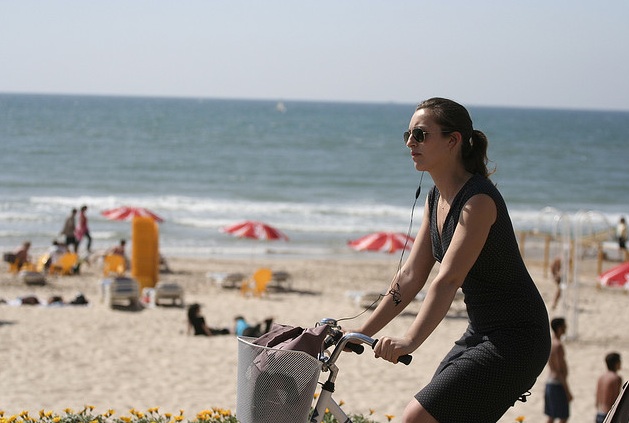
 You can lose your life cycling on the roads in Israel. Almost once a month, a cyclist gets killed by a car by a drunk or negligent driver. Despite the risks, the sport is catching on like wildfire.
Bonnie Eshel, president of the Israel Cycling Federation says biking in Israel today is super-dangerous: “We live today facing the threat of death every time we decide to hit the road on a bike.
“Practically every day there are accidents, and the fact that we don’t have a higher number of fatalities is more a matter of luck. I feel this personally. One time they will throw things at me from a car that is traveling 80 kilometers an hour, another time they spray water, and once they even held a knife to me from out of the car window,” she says.
“Just last Friday, a truck passed me and honked when it was right next to me as it tried to get close to me and just at the last minute I managed to control the bike, but I was very close there to sprawling onto the road.”
Despite the dangers, Bonnie joins a growing number of Israelis who are buying road and mountain bikes and who are hitting the city streets, highways and cycling trails. Cycling in Israel, and cycling in the Middle East as eco-tourism has a lot of benefits. This piece looks at the cycling movement in Israel.
Picture this: Screaming down ancient roads in Jerusalem in a ‘Look Ma! No hands!’ pose during a night cycling ‘raid;’ or peddling through the valley where David slew Goliath with the taste of the local vineyards still on your tongue. Perhaps you’d prefer a more rugged ride, challenging Israel’s deserts, forests and mountains, while getting to know the local Bedouin and Druze, or maybe just a leisurely cycle around Jerusalem’s Old City?
Whatever your bicycle passion or fantasy adventure, Israel has become a cycling destination hotspot. Yet to be discovered en masse by tourists, increasing numbers of Israelis sporting the finest and fittest bodies in skin-tight cycling pants are now biking to work, to their favorite cafés on the weekends, or to trendy off-road destinations.
So popular has the pastime and eco-friendly mode of transportation become that the Tourism Ministry recently announced that it will spend about $30 million on cycling infrastructure and trails.
Prof. Nurit Kliot, Dr. Noga Collins-Kreiner and their master’s student Paz Raveh from Israel’s University of Haifa (UH) were the first to document the growing popularity of cycling in the country in a report they published this year on the profile of Israeli cyclists. Their work is based on a survey of 539 mountain bikers at six locations throughout Israel.
Most popular is flat or mild-incline terrain, they report, with preferred routes being through forests and on single-track trails. Growing at a rate of about 15 percent a year, there are approximately 200,000 active cyclists in Israel, the researchers estimate, with 90 percent of these easy-riders well-educated and between the ages of 31 to 50. They are people who ride their bikes one to three times a week, mostly for fun.
Who is the Israeli cyclist?
Not a cyclist herself, Collins-Kreiner tells ISRAEL21c that Israel has joined the worldwide trend to balance on two wheels. While in some countries, like China, locals forego the traditional bike for the more prestigious four-wheel car, Israel is joining a European and North American trend.
“It’s about awareness of the environment, awareness of health, an interest of people to get involved in sports, and an increase in money and status,” she relates. Some people, she notes, are spending up to $6,000 on a fancy bike and cycling gear with all the rims and trimmings.
The researchers identified Israel’s cycling meccas as the northern Negev Desert in the Be’eri region outside Ashkelon; Beit Shemesh outside Jerusalem; Latrun (a hilltop in the Ayalon Valley overlooking the road to Jerusalem); and Mount Carmel (the coastal mountain range in the north, where the city of Haifa is located).
It has almost become a competition, she says, with numerous biking trails being blazed by the Jewish National Fund and local municipalities. She mentions the country’s longest bike trail, in the city of Netanya just outside Tel Aviv, and the stunning trail leading to the sea in Haifa, that includes some hilly terrain.
The longest trail will be the one that will eventually span the country from its northern tip down to the south in Eilat, paralleling Israel’s national hiking trail, which can be walked from one end of the country to the other.
“Biking is a trend,” says Collins-Kreiner, “Infrastructure’s been planned for the last two years with the country’s Prime Minister’s Office invested in it.”
Cycle tourism is on the way
Israel’s Tourism Minister Stas Misezhnikov says: “The development of a national cycling infrastructure will contribute to enriching the range of tourism products in the periphery and generate momentum for small and medium businesses, while creating new jobs.
“About 80% of all the cycling paths will be developed in the Negev and Galilee and there’s no doubt that this investment will bear fruit both regionally and in terms of its contribution to the economy generally. It’s important to note that creating this infrastructure will also make Israel an attractive destination for cyclists from around the world and a marketing program will also be prepared accordingly,” he adds.
Collins-Kreiner notes that Israel is also building biking destinations for families, with the Alexander River being the ultimate cycling venue for family fun. Once a year, the roads are closed around the Sea of Galilee, and people can cycle the perimeter safely, at a leisurely pace.
While increasing numbers of Israelis are cycling to work, the lack of work-place showers, especially on hot and muggy days, is a drawback for some, especially those in business attire (this young designer has a solution to the sweaty bike ride). Another trend identified by the study is cycling races and other competitions.
Paz Razeh, 27, who lives in Kfar Chet in the Sharon area outside Tel Aviv, participated in the UH bike study. The owner of a $600 “Hard Rock – Specialized” brand mountain bike, he says that: “It’s the lowest price for a good mountain bike that you can take off-road in Israel.”
Good for the health
“Why do I like cycling? It’s good for my health and it makes me feel better. I cycle in the Sharon area and like to bike across creeks in the Carmel area – nature cycling,” says Raveh, who is concerned that the popularity of the sport may lead to damage to protected areas of forests and deserts. His awareness of the need for defined trails and cycling laws was part of the impetus for his becoming more involved in the local cycling trend.
“I was interested in investigating Israeli cycling behavior because there are so many new cyclists that we’ve seen in the past five years. The numbers have been growing and now everyone is cycling in Israel. It was important to us to see who these people are, what they like to do, and how we can build more trails for riding, while improving existing trails,” he says.
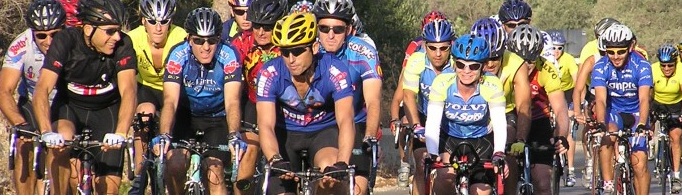 Road warriors in Israel. Image via Israel Cycling.
While cycling tourism is still in its infancy in Israel, people like Gonen Harpaz of Israel Cycling Tours are working to make sure that it does. After many triathlons and 25-plus years of cycling, which included the treacherous feat of cycling the Canadian Rockies and the Iron Man Challenge in Switzerland, Harpaz decided to open up his own business to provide unique biking tours in Israel. Israel Cycling Tours takes groups through the country’s remarkable outdoors and also exposes participants to the culture entwined with the landscape.
“Most of the people who travel with us are Israelis who come for weekend rides, and from time to time we get some Americans, as individuals and couples,” says Harpaz who organizes trips around overnight hostel and hotel stays. “The idea is to expose the cyclists to new and different ways of seeing the country,” he explains, while the locale of choice really depends on the season. In the summer it’s more pleasant in the north, while the warmer, drier south of Israel is preferable in winter.
“We combine the ride experience with the landscape and the other natural resources we have in Israel like the sea,” Harpaz says, mentioning itineraries that take cyclists to see the ancient Eilat mountains in shades of purples, pinks and oranges; the Negev Desert that include meeting with the local Bedouins; and trips to the Galilee where participants meet with the Druze in the north.
Culture on wheels
Bike trips may be planned around holy places as well, during which “we get to meet different cultures and religions,” says Harpaz, pointing out that “there are people other than Jews and Arabs in Israel.”
Harpaz, who provides bikes, equipment, transportation and an itinerary, and will be taking a bike group to follow the Tour de France this summer, says that straddling a bicycle is a softer, more natural way to meet and enter into knowing a new culture.
For those who prefer not to hire a bike tour guide, the Ministry of Tourism offers many suggested bike itineraries that can keep you in the saddle for weeks. These can be accessed through the GoIsrael.com website.
Itineraries on the GoIsrael site offer the must-see destinations in Israel and suggested ways of reaching them, and include Masada, the Dead Sea, the holy Christian sites around the Sea of Galilee, and routes through cities which take the cyclist on a tour of the people and culture of Israel.
While it’s a challenge to negotiate Jerusalem by bike the ministry offers creative options, including tours that have stops at the main tourist attractions like the Old City. Counter-culture cyclists can check out local bicycle shops that offer night rides that tear down ancient streets, through ancient cultures, providing nocturnal vistas of the city that make a trip to Jerusalem unforgettable.
The best way to explore Israel
Michael Green, 31, from North London, a keen day- and night-time cyclist (and a Green Prophet writer), spent some time in Israel living in Jerusalem and working as a reporter. “Bikes have been my favorite form of transport ever since I learned to ride one. Apart from anything else, cycling is the fastest and cheapest way of getting around in the cities where I lived in England,” he tells ISRAEL21c.
“So when I moved to Jerusalem buying a bike was the natural first thing to do. Most locals seemed bemused, preferring their air-conditioned cars for taking on the steep hills and hot climate.
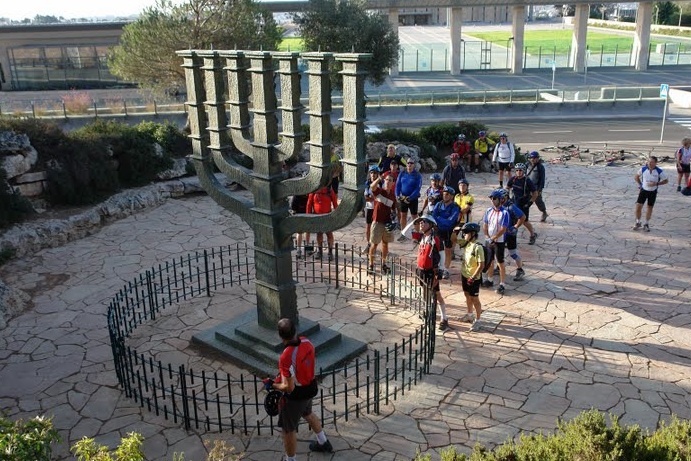 EcoBike tour company offers cycling trips around Jerusalem.
“But soon, cycling became more than just transport – it is the best way to explore a small country like Israel. I joined the weekly night rides organized by [the bike store] Nitzan Bikes in Jerusalem who would go on nocturnal journeys anywhere from the Old City to the Jerusalem Forest, seeing places from a perspective that you can only get on two wheels.
“In just 20 minutes you can be surrounded by nature, leaving the city and traffic far behind,” Green enthuses.
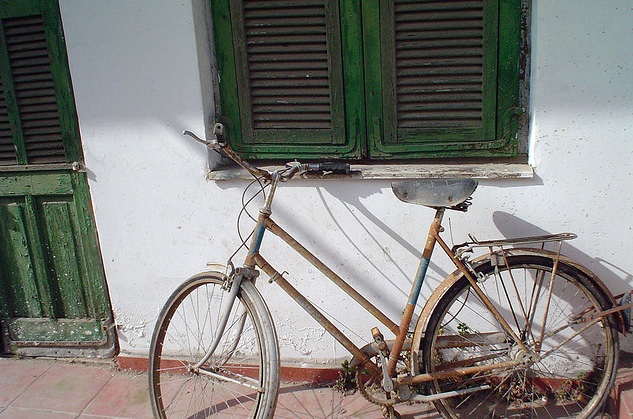 A bike in Tel Aviv. Via raindog808
In Tel Aviv – a city with flat terrain which is perfect for cycling – bike riding has become part of the local culture. There’s a well-maintained boardwalk for cycling along the sea and at least three Tel Aviv cafés rent bikes or give away rentals when you buy a coffee. You can find almost any trend that exists in European cities, like the “peddlers” from the Good Energy Initiative, cyclists who pump up Earth Hour concerts with carbon-free energy.
 You may also come upon semi-naked cyclists protesting helmet laws (left), or new courier companies like Cicleta with ‘underground’ cyclists weaving in and out of traffic as they deliver packages on bikes instead of on mopeds or in vans.
You may also catch sight of the beautiful young people in Tel Aviv, cycling back from the open-air Carmel Market with their purchases in the baskets attached to the handlebars of their bikes.
Read more on cycling in Israel and the Middle East:
Yinon Lehrer Designs Hanging/Bike Shower For Urban Cycling
A Quick Guide to Cycling in the Middle East
Is Petrified Bike a Metaphor for Dying Dead Sea?
Cycling Through Israeli Wine and History
Tel Aviv Cafe Offers Great Cappuccino and Bike Rentals
Bike Messengers Take Over Tel Aviv
Haifa University Generates Profile of the Average Israeli Cyclist
The Cycling Nightlife in Jerusalem
(Most of this story was first published on ISRAEL21c – www.israel21c.org. Top image via Ilan Photos.

You mean “pedalers”.