
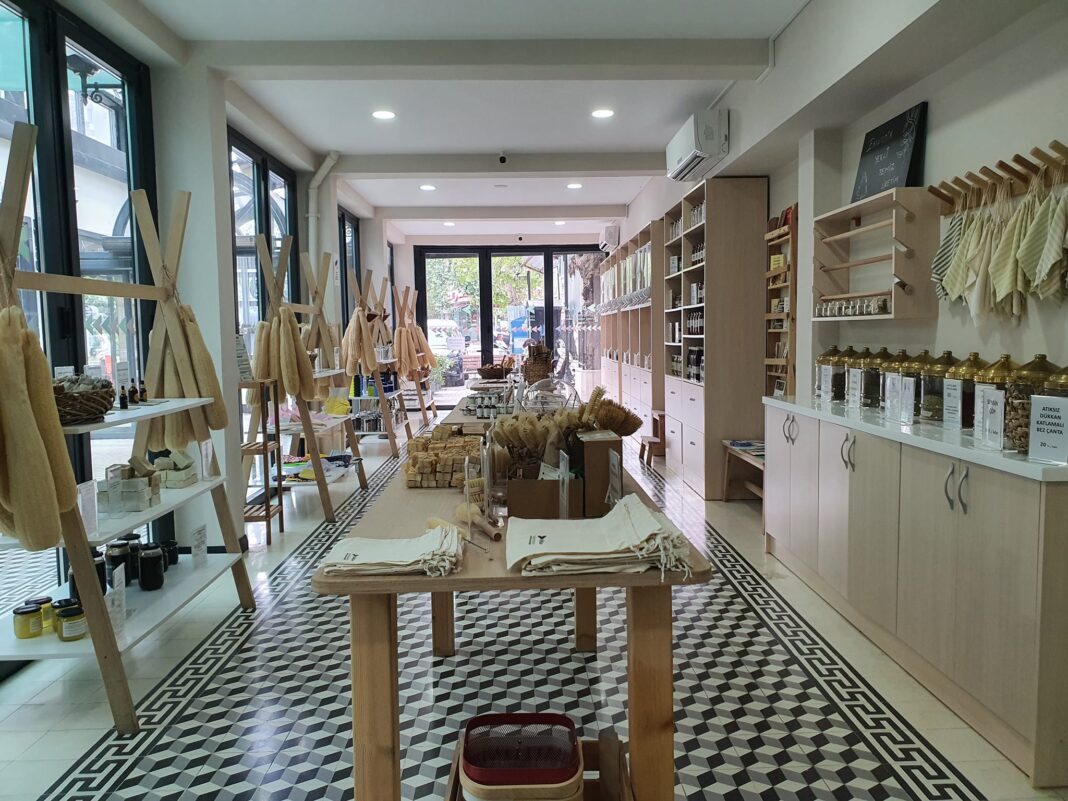
Kadıköy’s zero waste shop Dukkan features the circular economy in Istanbul

zero waste shop istanbul

Hang out in a hip neighbourhood of Montreal and zero-waste shops are as common as a fruit stand. But zero-waste shops that expect customers to refill and reuse packaging to remove plastic from landfill, aren’t easy to come by in the Middle East. Stuff a single apple or cola can in a bag, please. Plastic is too cheap and it’s too easy a habit to break. But entrepreneurs in Istanbul are showing how it can be done in culturally relevant ways.

The Dukkan Waste Free Shop initiated by the Kadıköy Municipality of Istanbul on World Environment Day a few years ago, is commended for being one of the best projects according to the ICLEI Europe, the European Council of International Local Environmental Initiatives.

Turkey is eager to join the European Union but still hasn’t made the grade according to European directives. But to ICLEI Europe, of which Kadıköy Municipality is a member, this may be one in a string of projects that can show the EU how local government practice can help the public kick the plastic addiction

The Kadıköy Dukkan shop offers unpackaged, bulk, and ecological products instead of disposable products, with all this supporting the circular economy. The concept shop also brings together the consumer with local products and producers allowing for a larger number of cottage businesses to thrive. Packaging costs are also absorb by the producers so finding new ways to bring products into people’s homes is desirable.

Kadıköy's Waste Free Shop is on the European agenda!
Kadıköy waste free shop called Dukkan

Cleaning, living, food, kitchenware and personal care are the range of items sold in the shop and I love seeing the Middle East’s favorite nature scrub, the luffa, appear in such prominence. You can find luffas at street corner shops because some people just can’t live without them. 

Customers are also invited to bring their own reusables to the shop, and women entrepreneurs are given a special boost when it comes to featuring their products. Shop second in Istanbul for some great clothing finds. 

But when a local named A (who doesn’t want her name published) went to visit the shop she found their sustainability policies a little out of sync with reality. She tells Green Prophet: “You can buy a local version of liquid Castile soap there but the thing that annoyed me is that they forced me to buy a plastic bottle to fill; I couldn’t use my own container. So I actually increased plastic use by going there.”

This is the first such initiative in Turkey, making the Waste-Free Shop a good practice example for others seeking to provide access to durable, sustainable and ecological products, which support a circular economy as an alternative to single-use plastics.

Zero waste circular shop in Istanbul

Due to increasing environmental pollution and resulting health problems, consumers have been in search for and demanding more natural, chemical-free and non-toxic products. On the other hand, small scale local producers in Kadikoy providing ecological and natural products need markets for their goods, and have been so far trying to reach consumers through women’s or farmers’ cooperatives. The Waste-Free Shop fills this gap, bridging these two parties without intermediaries.

dukkan zero waste shop istanbul

Other nearby countries like Israel are slow to catch on, but that said there is still a thriving market culture in Israel and other Middle East countries like Turkey, Egypt, Jordan and Syria. People love shopping for spices from bulk and fresh vegetables and fruit harvested that morning. The success of the Middle East diet is that the food is fresh, and buying it at a local market means you can’t get fresher than that. If you are looking to shop local and fresh, get our In Season Guides for each month of the year. Vegetables and fruits bought and eaten in season, locally, are the best for you and the planet.

Among the examples of good practice by ICLEI Europe; In the Dukkan shop where local producers, women’s and farmer cooperatives meet with consumers without intermediaries, there are healthy foods produced from local seeds and available in season, as well as long-lasting and ecological products such as daily life, cleaning, personal care and kitchenware. Products sold unpackaged or in recyclable packaging are offered to the consumer in glass jars, cloth bags or containers to be brought from home.

Getting to it?

::Dukkan

Gazi Muhtar Paşa Sokak No 57/1 Feneryolu, Kadikoy

The climate in Turkey regarding social media posts is fraught with risk (you can be detained for things posted online) so people we spoke with in this article do not want to be named. 

Karin Kloosterman
Karin Kloostermanhttp://www.greenprophet.com
Karin Kloosterman is an award-winning journalist, innovation strategist, and founder of Green Prophet, one of the Middle East’s pioneering sustainability platforms. She has ranked in the Top 10 of Verizon innovation competitions, participated in NASA-linked challenges, and spoken worldwide on climate, food security, and future resilience. With an IoT technology patent, features in Canada’s National Post, and leadership inside teams building next-generation agricultural and planetary systems — including Mars-farming concepts — Karin operates at the intersection of storytelling, science, and systems change. She doesn’t report on the future – she helps design it. Reach out directly to [email protected]

Read More

TRENDING

Kansas City’s Second Attempt at a Conversion Therapy Ban: What the Proposed Ordinance Does and Why It’s Being Rewritten

Kansas City is attempting to revive protections against conversion therapy with a new ordinance carefully designed to withstand recent First Amendment challenges. Rather than banning conversion therapy by name, the proposal targets harmful therapeutic practices linked to increased risks of depression and self-harm, creating what supporters hope could become a legal model for other U.S. cities.

What to Look for in a Senior Living Community That Truly Delivers

Choosing a sustainable senior living community means looking beyond appearances to care quality, nutrition, safety, social connection, and long-term well-being.

NuCicer — Chickpeas Move to the Center of the Plate

NuCicer has developed Nuchi, a new class of chickpea with 50% more protein and 25% less fat than conventional varieties. Co-founder Kathryn Cook explains how wild chickpea genetics, AI-guided breeding, and centuries-old biodiversity could transform the future of sustainable protein.

How Torvinen Jaakko’s ugly wood can lay the foundations for green building

Canada's forests generate billions of dollars in economic value each year, yet vast amounts of irregular timber are downgraded to wood chips or biomass. A collaboration between researchers at Carleton University and Aalto University is challenging that model, demonstrating how "ugly wood" can be transformed into high-value architecture while reducing waste and storing more carbon in buildings.

A Face Swap Tool for Training and Internal Comms

Corporate training videos often require repeated filming, travel, and production resources every time policies or personnel change. AI-powered face swap tools offer a more sustainable approach by extending the life of digital training content, reducing unnecessary reshoots, and helping organizations communicate more efficiently—provided they are used transparently with clear consent and ethical governance.

The Essential Guide To Sustainability in Project Management

Sustainability is an approach where businesses and individuals balance the environmental, social, and economic aspects of a project such that current and future stakeholders are not overburdened with the impacts of the project in future.

Yerukim Forms a New Green Economy Where the Money is Really Green

The Yerukim members who pick up the recyclables get to keep the monetary reward, the public earns "green" bills that can be used in shops, and business owners get to be associated with environmentalism.

Choosing Riyadh over Dubai? What Investors Should Know

Saudi Arabia is deploying capital at unmatched scale to catalyze tourism and advanced industry while rewiring its power-and-water backbone. The investable frontier is widening—especially in renewables, grid storage, water efficiency/desal retrofits, and hospitality operating platforms. Prudent investors will insist on phased delivery, enforceable KPIs (energy, water, biodiversity), and RHQ/zone compliance—while pricing political-economy and reputational risks alongside growth upside.

Sell your cooking oil for biodiesel money

Want to make money on old french fry oil? Sell it.

Qatar Alternative Energy Summit Pairs Investors And Innovators

Alternative energy investors and innovators can meet n' greet in Doha, Qatar March 16 and 17.

Here’s How To Implement The Four Pillars Of Employee Engagement

If you throw a party for your work team and they are vegans, don't make it a barbecue. Know the sustainability values of your team to boost moral and retain good people.

Locals From Rishon Fight IKEA

Big Box stores are a pretty new concept in Israel, and thank God that not every Israeli city wants them in their backyard. A word from someone who has see the beautiful farmland around her hometown Newmarket, Ontario stripped and converted into vulgar strip malls of big box shops: they have no place in a healthy and sustainable town or city.

The Jewish National Fund Meets An Inconvenient Truth

According to the JNF, it has transformed thousands of acres of barren land into green forests in Israel. They state that each person emits about 23 tons of carbon per year, estimating that each tree planted can absorb one ton of carbon in its lifetime. That's a whole lot of trees you'd need to be planting. Could so many fit in Israel?

Popular Categories