
What Does it Take to Bring a Product From Prototype to Market?

nest labs google
The Nest, a smart thermostat acquired by Google for billions is a great case study on how to develop a product and fit it to the market. Plus this one’s sustainable! It saves energy.

Getting your product – whatever it is – from its initial prototype to store shelves is a very involved process. If you look around online you can find plenty of articles on the cycle of product development, so right now we’re going to skip the first few steps and assume you’ve already passed through Idea generation, product scope, and prototyping.

After Prototyping – Initial Design

So, you’ve made a prototype of your product. Right now it’s just a mockup, something to show people the idea you’ve got and demonstrate its function, but it’s not quite complete yet. Now you’ve got to get it into that more complete format. Now you need to make it look like something that could be on a product shelf. So, the first thing you need to do is get everything you need to make your product, and actually make it!

Depending on how developed your prototype is this may take more or less effort, but in many ways, this is the first real stress test of your product. You’ll probably find yourself making changes to the product itself – maybe using cheaper materials, or altering the order in which things are put together – and this is where you’ll have to actually start paying people for their time. Artists, designers, materials, all of these things cost money and if you’ve got stakeholders this is the time you’ll need to convince them that your product is worth investing in.

Throughout this process, you should keep up constant contact with your shareholders and the people who have an investment in your product. Not only do you need to keep them invested, but if you need people to test or experience your product these are probably going to be the first people to do it – and soliciting their feedback is going to be important for maintaining their interest in the long term.

electric car oman, mats motors
Prototype from Mays Motors, the first electric car of the Middle East Starts production in 2023. It looks wow!

Depending on your product and industry, your priorities and decisions in this stage may vary, but the most important step is maintaining investor interest. Without those investors, you will get nowhere – especially if the only investor is yourself – and having someone to report progress to is a great stimulus for actually making progress. Finally, if you don’t have any investors, this is definitely the time to start getting some because you’re going to want them for the next phase…

Product Testing

This is possibly the most important phase in the process of getting a product to the shelf. With enough money, connections and support, any product can get on the shelf, but quality can only be obtained through repeated and rigorous testing. Let’s face it, if your product relies in any way on consumer opinion, maintaining an acceptable level of quality is going to be critical.

By now you should already have gotten some initial feedback on your product – even if it’s just from the concept or initial design stages. Review this feedback and make sure that what you’ve made is meeting or addressing those queries and concerns. Then, find someone within your group to try the product out. Be open about it, tell them what it’s supposed to do and supposed to achieve and let them tell you if it does that. If those initial tests are successful, then you’re ready to start releasing it to wider audiences.

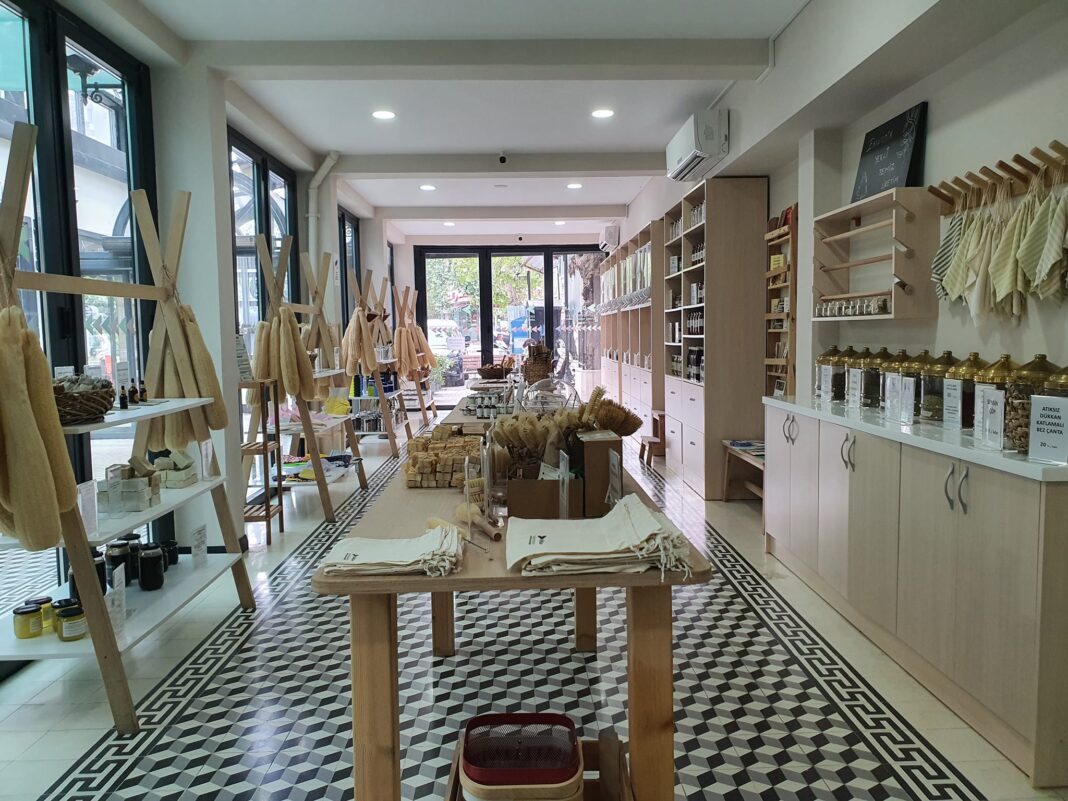
Design a store that carries products that support the circular economy. Test them out in pop up shops for consumer feedback.

The field of Quality Assurance Testing is a field in its own right, but in short, you need to give as little input as possible, find people who are as close to your target audience as possible, but also give them clear guidelines on what sort of tests you want them to do and what sort of feedback you are looking for. Tests like this need to be done in every function of the product, possibly including the supply line and even should be a part of market research. How many tests you’ll have to do will vary based on the product, but the most important thing is to get enough tests for consistent feedback, which usually requires at least twenty or so tests for numbers to start getting meaningful.

Now we hit the final stage.

Commercialisation

This is it. The final step is before your product gets on the shelf. You’ve got the product, you’ve tested it, and now you’ve got to make it accessible.

At this stage, you should be working on producing the product and making deals to get it on shelves. If your business is entirely online, this is when you should start marketing your product, releasing websites and preparing everything for the actual launch. If you haven’t already done so, this is where you’ll need to be in touch with fast-moving consumer goods industry (FMCG) branding agencies or similar to get your product from the supply line and into the hands of consumers. Think you don’t need them? Well maybe not, but there’s a lot to cover in the commercialisation phase. Not only do you need to have pleased your investors, but this is the stage where you need to have found your target audience, completed your market research, gotten clear benchmarks for the cost of production, set up the supply lines, set up advertising, set up any and all automation, contact all the companies you may need to work with and strike deals with all of them. And all of this may be happening while you may still be working on product testing. This is potentially the most intensive part of the process, negotiating between a range of staff and companies, and every part of it needs to be done right. You only get one launch day and that launch needs to make an impact.

Once this step is finished, you should be days away from your launch date. Congratulate yourself on making it this far. You’ve successfully launched your prototype.

Bhok Thompson
Bhok Thompsonhttp://www.greenprophet.com
Bhok Thompson is an “eco-tinkerer” who thrives at the intersection of sustainability, business, and cutting-edge technology. With a background in mechanical engineering and a deep fascination with renewable energy, Bhok has dedicated his career to developing innovative solutions that bridge environmental consciousness with profitability. A frequent contributor to Green Prophet, Bhok writes about futuristic green tech, urban sustainability, and the latest trends in eco-friendly startups. His passion for engineering meets his love for business as he mentors young entrepreneurs looking to create scalable, impact-driven companies. Beyond his work, Bhok is an avid collector of vintage mechanical watches, believing they represent an era of precision and craftsmanship that modern technology often overlooks. Reach out: [email protected]

Read More

TRENDING

Are the Great Lakes polluted?

The Great Lakes may look pristine, but a new cleanup report reveals a growing tide of plastic pollution beneath the surface. From cigarette butts and food wrappers to tiny plastic fragments and discarded nicotine pouches, researchers are finding evidence that everyday consumer waste is making its way into North America's largest freshwater ecosystem. New technologies, including Canada's first BeBot beach-cleaning robot, are helping scientists understand how plastic travels through lakes, shorelines and stormwater systems before breaking down into microplastics.

What Makes a Hair Care Review Trustworthy?

Looking for natural hair care reviews?

Can a one trillion-Dollar SpaceX IPO change life on earth?

A SpaceX IPO could become one of the most consequential financial events of the century, creating thousands of millionaires and fueling investment across the New Space economy. From orbital robotics and African space programs to launch infrastructure and satellite networks, the ripple effects may extend far beyond Earth—while forcing investors to reconsider whether generative AI remains the most compelling technology bet of the decade.

Anthropic, Google and Stripe put nearly $1 Billion on carbon removal

A coalition led by Frontier, backed by Stripe, Google, Salesforce and newly joined AI company Anthropic, has committed an additional $915 million to remove carbon dioxide from the atmosphere. The pledge adds to a previous $1 billion commitment and brings Frontier's total buying power to nearly $2 billion.

Bathroom dad Tyler Brodsky shows us why Americans need more common sense

Oklahoma father Tyler Brodsky became the center of a national debate after accompanying his young daughters into a women's restroom during a road trip. For many parents, the story is less about politics and more about a simple question: how do you help your children feel safe when public bathrooms often fail families?

Yerukim Forms a New Green Economy Where the Money is Really Green

The Yerukim members who pick up the recyclables get to keep the monetary reward, the public earns "green" bills that can be used in shops, and business owners get to be associated with environmentalism.

Choosing Riyadh over Dubai? What Investors Should Know

Saudi Arabia is deploying capital at unmatched scale to catalyze tourism and advanced industry while rewiring its power-and-water backbone. The investable frontier is widening—especially in renewables, grid storage, water efficiency/desal retrofits, and hospitality operating platforms. Prudent investors will insist on phased delivery, enforceable KPIs (energy, water, biodiversity), and RHQ/zone compliance—while pricing political-economy and reputational risks alongside growth upside.

Sell your cooking oil for biodiesel money

Want to make money on old french fry oil? Sell it.

Qatar Alternative Energy Summit Pairs Investors And Innovators

Alternative energy investors and innovators can meet n' greet in Doha, Qatar March 16 and 17.

Here’s How To Implement The Four Pillars Of Employee Engagement

If you throw a party for your work team and they are vegans, don't make it a barbecue. Know the sustainability values of your team to boost moral and retain good people.

Locals From Rishon Fight IKEA

Big Box stores are a pretty new concept in Israel, and thank God that not every Israeli city wants them in their backyard. A word from someone who has see the beautiful farmland around her hometown Newmarket, Ontario stripped and converted into vulgar strip malls of big box shops: they have no place in a healthy and sustainable town or city.

The Jewish National Fund Meets An Inconvenient Truth

According to the JNF, it has transformed thousands of acres of barren land into green forests in Israel. They state that each person emits about 23 tons of carbon per year, estimating that each tree planted can absorb one ton of carbon in its lifetime. That's a whole lot of trees you'd need to be planting. Could so many fit in Israel?

How to quiet noise from construction in your office

Streets need to be resurfaced in New York but the humming and grinding noise is unsettling. Noise is environmental pollution. 

Popular Categories