
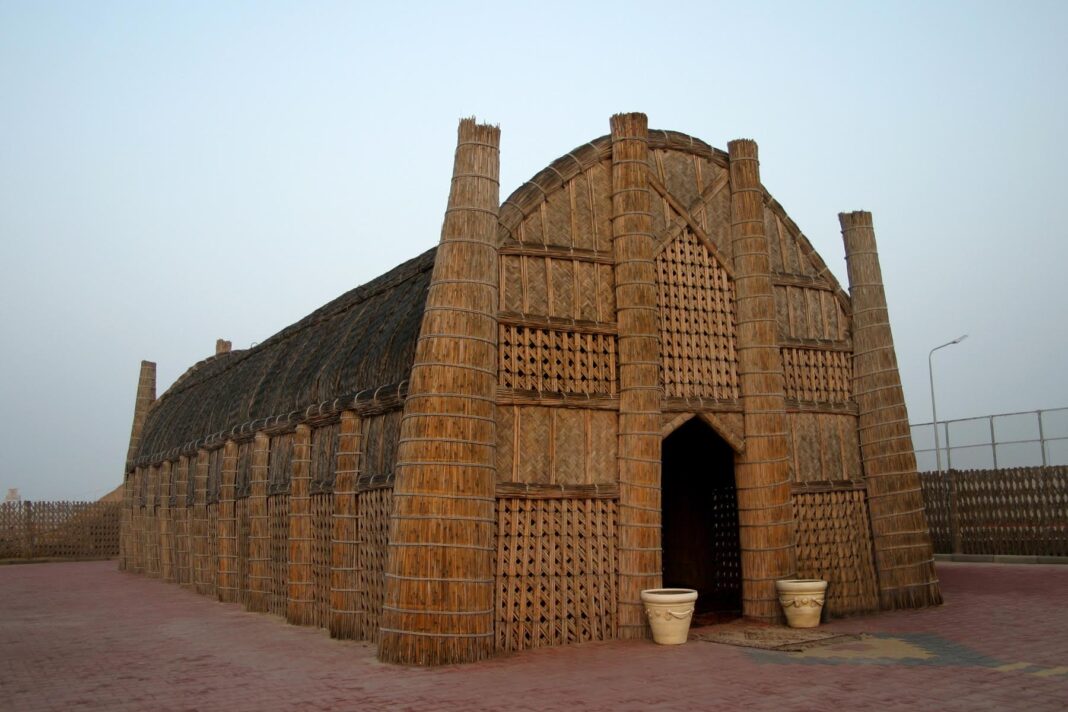
Mudhif, an Iraqi guesthouse, from reed grass connects American veterans to their trauma

Mudhif reed house iraq

Building with invasive plants; Healing through shared war stories

U.S. Veterans, Iraqi refugees and the public will join environmental artist Sarah Kavage and Iraqi designer Yaroub Al-Obaidi in constructing an Iraqi guest house, called a mudhif. Constructed of phragmites, an invasive reed grass, this traditional Iraqi marshland structure will be built on the grounds of the Schuylkill Center for Environmental Education in Northwest Philadelphia. 

Mudhifs have traditionally been used for town meetings and ceremonies. At the Roxborough site, it will serve as a gathering place to share experiences of war through storytelling, healing and recovery among U.S. Veterans, Iraqi immigrant communities and the public.

The construction of the cutting-edge art installation Al-Mudhif will kick off on Memorial Day, Monday, May 31, with a dedication ceremony. The building process involves tying bundles of reeds into 20-foot-long columns, and then shaping them into huge parabolic arches. Hand-woven mats are then tied over and between the columns, forming a roof. Finally, crafted lattice panels are attached to the sides, allowing for both sunlight and airflow into the interior and enclosing the entire hut.

mudhif Iraq
The Ahwar of Southern Iraq: Refuge of Biodiversity and the Relict Landscape of the Mesopotamian Cities: A view of the method of construction of the reed houses. Jasim Al-Asady

Connecting with Iraqi communities in nature through the building process of this sanctuary offers a significant memorable and cultural space for U.S. Veterans who were deployed in Iraq to connect with local Iraqi communities and culture.

“It is not often that Veterans are able to heal and connect with residents from areas that were engaged in conflict,” said RADM Karen Flaherty-Oxler, Director of the Corporal Michael J. Crescenz (Philadelphia) VA Medical Center. “Opportunities such as this help bring their experience full circle, often providing closure, healing and building bridges across cultures.”

South Philadelphian Marine Corps Veteran Leroy Anthony Enck says, ”For some veterans and military members, our time in Iraq was marked with loss and destruction: losing fellow service-members in body or spirit, witnessing a similar loss among indigenous communities in Iraq, and observing—despite our best efforts—the environmental destruction our presence and operations facilitated. 

“Some of us have struggled with the larger moral implications of this impact, and after participating in the difficult work of moral engagement, have decided to dedicate ourselves to this work as atonement. Now, we have an opportunity to engage in the hefty work of building: constructing the first mudhif outside of Iraq, building new community with our brethren among the former Iraqis who now call Philadelphia home, and giving—rather than taking—an opportunity for generations young and old to experience greater understanding of people and flora displaced through no choice of their own.”

The involvement of Iraq War Veterans in the project was facilitated by Reverend Chris Antal, a Staff Chaplain at CMCVAMC. Antal had this to say, “Some Veterans who served in Iraq are often burdened by difficult memories and painful emotions. Collaborations such as this help build trust, foster reconciliation and create a sanctuary amidst the calming presence of nature.”

The project is part of a larger art initiative Lenapehoking~Watershed with the Alliance for Watershed Education (AWE) for which Sarah will create multiple site-specific, temporary installations along the Delaware River circuit trail, exclusively using natural materials such as meadow grasses and invasive phragmites. We will activate the installation of the Al-Mudhif with an accompanying exhibition and extended programming around the exchange of war experiences, healing, and intercultural encounters from June to October 2021.


Karin Kloosterman
Karin Kloostermanhttp://www.greenprophet.com
Karin Kloosterman is an award-winning journalist, innovation strategist, and founder of Green Prophet, one of the Middle East’s pioneering sustainability platforms. She has ranked in the Top 10 of Verizon innovation competitions, participated in NASA-linked challenges, and spoken worldwide on climate, food security, and future resilience. With an IoT technology patent, features in Canada’s National Post, and leadership inside teams building next-generation agricultural and planetary systems — including Mars-farming concepts — Karin operates at the intersection of storytelling, science, and systems change. She doesn’t report on the future – she helps design it. Reach out directly to [email protected]

Read More

TRENDING

Black fathers live longer than non-fathers, new study

Researchers found that fatherhood was associated with lower rates of early death among Black men, while early fatherhood was linked to poorer long-term health outcomes.

Can Scientists Predict Coral Bleaching Before It Happens?

Now researchers at the Woods Hole Oceanographic Institution (WHOI) in the US say they have developed a way to predict coral bleaching five to six months before it occurs, potentially giving reef managers enough time to intervene and save vulnerable corals.

AI data centers are triggering panic, instead of cleantech opportunities

AI may unintentionally become the economic engine that finally modernizes America’s aging grid. California is experiencing a massive AI data center boom, ranking 3rd in the U.S. with 227 operating centers and 54 more in development as of April 2026, according to Stanford.

Abortion Pills, Plan B and Mifepristone and what the new US mail ban means

Abortion pills, often confused with Plan B (the morning-after pill), and historically referred to as RU486 (mifepristone), are part of a broader category of reproductive health medications that women have been using for decades. But they are not the same thing.

SunZia comes online and America’s 11B, and largest renewable project begins wind power

The impact is already being felt. California has broken its wind generation record multiple times in recent weeks as SunZia begins feeding electricity into the grid. It’s a glimpse of what a renewable-powered future could look like when large-scale infrastructure finally comes online. Can we start saying goodbye to Saudi Aramco and Arabian Gulf oil? 

Yerukim Forms a New Green Economy Where the Money is Really Green

The Yerukim members who pick up the recyclables get to keep the monetary reward, the public earns "green" bills that can be used in shops, and business owners get to be associated with environmentalism.

Choosing Riyadh over Dubai? What Investors Should Know

Saudi Arabia is deploying capital at unmatched scale to catalyze tourism and advanced industry while rewiring its power-and-water backbone. The investable frontier is widening—especially in renewables, grid storage, water efficiency/desal retrofits, and hospitality operating platforms. Prudent investors will insist on phased delivery, enforceable KPIs (energy, water, biodiversity), and RHQ/zone compliance—while pricing political-economy and reputational risks alongside growth upside.

Sell your cooking oil for biodiesel money

Want to make money on old french fry oil? Sell it.

Qatar Alternative Energy Summit Pairs Investors And Innovators

Alternative energy investors and innovators can meet n' greet in Doha, Qatar March 16 and 17.

Here’s How To Implement The Four Pillars Of Employee Engagement

If you throw a party for your work team and they are vegans, don't make it a barbecue. Know the sustainability values of your team to boost moral and retain good people.

Locals From Rishon Fight IKEA

Big Box stores are a pretty new concept in Israel, and thank God that not every Israeli city wants them in their backyard. A word from someone who has see the beautiful farmland around her hometown Newmarket, Ontario stripped and converted into vulgar strip malls of big box shops: they have no place in a healthy and sustainable town or city.

The Jewish National Fund Meets An Inconvenient Truth

According to the JNF, it has transformed thousands of acres of barren land into green forests in Israel. They state that each person emits about 23 tons of carbon per year, estimating that each tree planted can absorb one ton of carbon in its lifetime. That's a whole lot of trees you'd need to be planting. Could so many fit in Israel?

How to quiet noise from construction in your office

Streets need to be resurfaced in New York but the humming and grinding noise is unsettling. Noise is environmental pollution. 

Popular Categories