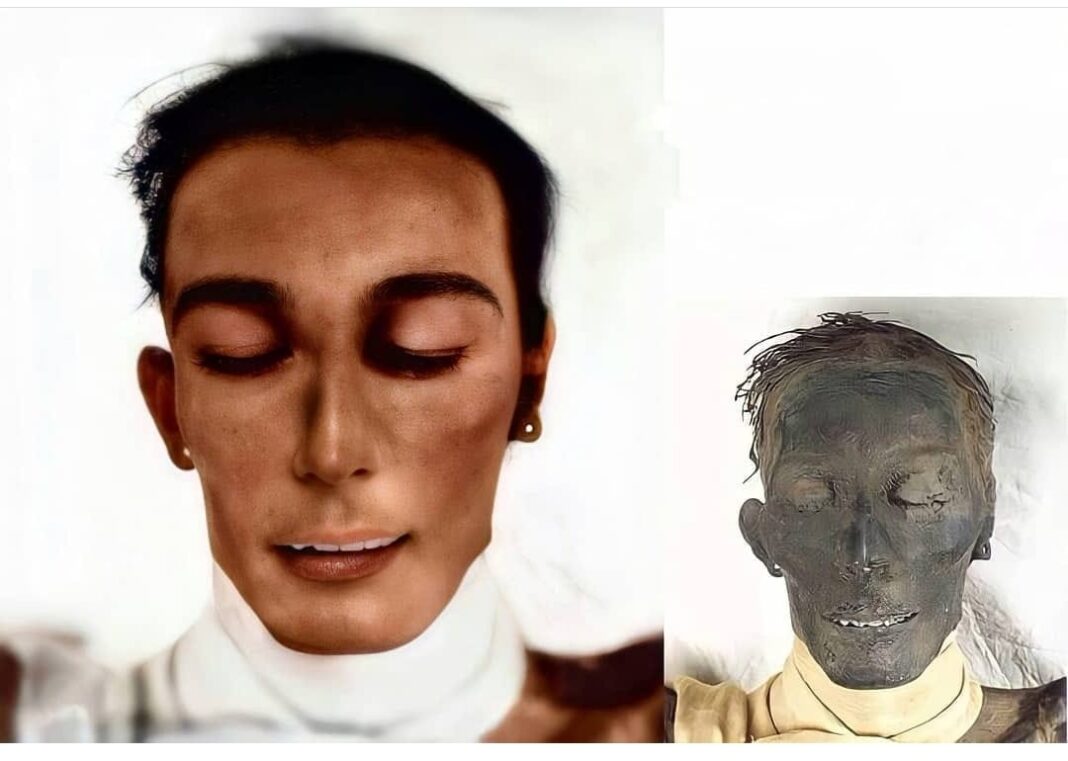

Meet the face of Pharaoh Thutmoses IV

image-thutmose-iv-pharaoh
Thutmose IV and his emaciated mummy.

Thutmose IV was the 8th Pharaoh of the 18th Dynasty of Egypt. He ruled in the 14th century BC, but not for long. His reign lasted only eight to ten years. He was lucky that his tomb wasn’t invaded and his mummified remains torn apart for sale, as tomb robbers have done over the centuries. Karin wrote about a recent foiled mummy heist here

thutmose worshiping
Thutmose IV bringing offerings to Amun.

Not much is known about his time on the Egyptian throne. He constructed chapels; was victorious in a minor skirmish protecting gold mine routes from Nubian attackers; made an astute political marriage with a princess from the rival Mittani kingdom (in today’s Syria).

Thutmose also completed the work on the eastern obelisk at the Temple of Karnak started by Thutmose III, which, at 105 feet, was the tallest obelisk ever erected in Egypt. But his greatest act was to restore the Great Sphinx of Giza, which was buried up to its neck in sand .

The Sphinx, millennial guardian of secrets, also guards a hint that Thutmose may have employed fratricide to clear the way to the throne. His older brothers should have been successors after their father, but these brother disappeared into history just as Thutmose grew old enough to dream of kingship.  The hint is unwittingly contained in a monument known as the Dream Stele.

On attaining the throne, Thutmose built a chapel between the paws of the Sphinx, and its back wall was a 12-foot-tall granite slab inscribed with a story. This is the Dream Stele. On it is inscribed a dream in which the Sphinx speaks to Thutmose, promising him kingship in exchange for releasing it from its burial in the sand and restoring its awe-inspiring beauty.

image-dream-stele
Some of the inscription has faded, but the Dream Stele still bears its story.

Thutmose, reads the Dream Stele, had spent the day hunting lions with friends. He grew tired by noon, and lay down for a nap under the shadow of the Sphinx’s gigantic head. In the elaborate style of the time, the Dream Stele reads,

“One of those days it came to pass that the King’s Son Thothmes came, coursing at the time of mid-day, and he rested in the shadow of this Great God. Sleep seized him at the hour when the sun was in its zenith, and he found the Majesty of this Revered God speaking with his own mouth, as a father speaks with his son, saying: ‘Behold thou me, my son, Thothmes. I am thy father, Hor-em-akhet-Kheperi-Ra-Atum; I will give to thee my Kingdom upon earth at the head of the living. Thou shalt wear the White Crown and the Red Crown upon the Throne of Geb, the Hereditary Prince.

The land shall be thine, in its length and in its breath, that which the eye of the All-Lord shines upon. The food of the Two Lands shall be thine, the great tribute of all countries, the duration of a long period of years. My face is directed to you, my heart is to you; Thou shalt be to me the protector of my affairs, because I am ailing in all my limbs. The sands of the Sanctuary, upon which I am, have reached me; turn to me in order to do what I desire. I know that thou art my son, my protector; behold; I am with thee, I am thy leader.’”

In other words, the Sphinx told young Thutmose that he, not his brothers, was the real king.

image thutmose
Thutmose IV looking cheerful and well-fed.

It’s possible that the Dream Stele was a piece of propaganda set up to make Thutmose’s unexpected rise to the throne look legitimate.  This theory is supported by the discovery of three previously made stelae that show  Thutmose’s brothers making offerings to the Sphinx – but their names had been carefully struck off to erase them.

Egyptologist Selim Hassan‘s interpreted this to mean that Thutmose removed his brothers and even their names, so that they may be forgotten.

“I am afraid that this theory does not present Thothmes IV in a very favourable light, and if he was not actually a wholesale murderer (and there seems to be grounds for supposing that he was), at least he was a cold-hearted egoist,” wrote Hassan.

image-dream-stele-sphinx
The Dream Stele between the paws of the Sphinx.

Yet Thutmose had the common people in mind, because he built a chapel for those who wanted to worship at the Karnak temple but were denied entry. It was a place “where the god Amun would hear the prayers of the townspeople.” In a time where worship was as vital as bread, it was an act of kindness.

The reconstruction of his face is so startlingly real that you feel he’s still with us,  just waking up from that famous nap in the shadow of the Sphinx. But what can we tell of this short-lived Pharaoh? For he died before he was thirty.

Presumably he fell ill in his last years. Statutes and carvings depicting him as king show a well-fed man with almost chubby cheeks, but his mummy is gaunt.

A surgeon at Imperial College London studied the lives of Thutmose and his ancestors, many of whom died young. He concluded that they suffered from familial temporal epilepsy, a form of epilepsy that often involves shattering spiritual visions during violent seizures. If true, it could have been the reason for Thutmose’s early death, and for the dream, and for what he did to fulfil that dream.
 

Miriam Kresh
Miriam Kreshhttps://www.greenprophet.com/
Miriam Kresh is an American ex-pat living in Israel. Her love of Middle Eastern food evolved from close friendships with enthusiastic Moroccan, Tunisian and Turkish home cooks. She owns too many cookbooks and is always planning the next meal. Miriam can be reached at miriam (at) greenprophet (dot) com.

Read More

TRENDING

Mysterious metal space balls wash up on Australian shore

Mysterious metallic spheres dubbed "space balls" washed ashore on Forrest Beach in Queensland, Australia. The objects were identified by the Australian Space Agency as pressure vessels from a space launch vehicle that re-entered Earth's atmosphere, and crews successfully removed the safe debris.

Kansas City’s Second Attempt at a Conversion Therapy Ban: What the Proposed Ordinance Does and Why It’s Being Rewritten

Kansas City is attempting to revive protections against conversion therapy with a new ordinance carefully designed to withstand recent First Amendment challenges. Rather than banning conversion therapy by name, the proposal targets harmful therapeutic practices linked to increased risks of depression and self-harm, creating what supporters hope could become a legal model for other U.S. cities.

What to Look for in a Senior Living Community That Truly Delivers

Choosing a sustainable senior living community means looking beyond appearances to care quality, nutrition, safety, social connection, and long-term well-being.

NuCicer — Chickpeas Move to the Center of the Plate

NuCicer has developed Nuchi, a new class of chickpea with 50% more protein and 25% less fat than conventional varieties. Co-founder Kathryn Cook explains how wild chickpea genetics, AI-guided breeding, and centuries-old biodiversity could transform the future of sustainable protein.

How Torvinen Jaakko’s ugly wood can lay the foundations for green building

Canada's forests generate billions of dollars in economic value each year, yet vast amounts of irregular timber are downgraded to wood chips or biomass. A collaboration between researchers at Carleton University and Aalto University is challenging that model, demonstrating how "ugly wood" can be transformed into high-value architecture while reducing waste and storing more carbon in buildings.

The Essential Guide To Sustainability in Project Management

Sustainability is an approach where businesses and individuals balance the environmental, social, and economic aspects of a project such that current and future stakeholders are not overburdened with the impacts of the project in future.

Yerukim Forms a New Green Economy Where the Money is Really Green

The Yerukim members who pick up the recyclables get to keep the monetary reward, the public earns "green" bills that can be used in shops, and business owners get to be associated with environmentalism.

Choosing Riyadh over Dubai? What Investors Should Know

Saudi Arabia is deploying capital at unmatched scale to catalyze tourism and advanced industry while rewiring its power-and-water backbone. The investable frontier is widening—especially in renewables, grid storage, water efficiency/desal retrofits, and hospitality operating platforms. Prudent investors will insist on phased delivery, enforceable KPIs (energy, water, biodiversity), and RHQ/zone compliance—while pricing political-economy and reputational risks alongside growth upside.

Sell your cooking oil for biodiesel money

Want to make money on old french fry oil? Sell it.

Qatar Alternative Energy Summit Pairs Investors And Innovators

Alternative energy investors and innovators can meet n' greet in Doha, Qatar March 16 and 17.

Here’s How To Implement The Four Pillars Of Employee Engagement

If you throw a party for your work team and they are vegans, don't make it a barbecue. Know the sustainability values of your team to boost moral and retain good people.

Locals From Rishon Fight IKEA

Big Box stores are a pretty new concept in Israel, and thank God that not every Israeli city wants them in their backyard. A word from someone who has see the beautiful farmland around her hometown Newmarket, Ontario stripped and converted into vulgar strip malls of big box shops: they have no place in a healthy and sustainable town or city.

The Jewish National Fund Meets An Inconvenient Truth

According to the JNF, it has transformed thousands of acres of barren land into green forests in Israel. They state that each person emits about 23 tons of carbon per year, estimating that each tree planted can absorb one ton of carbon in its lifetime. That's a whole lot of trees you'd need to be planting. Could so many fit in Israel?

Popular Categories