Japan builds desalination plants for Bahrain and the Emirates

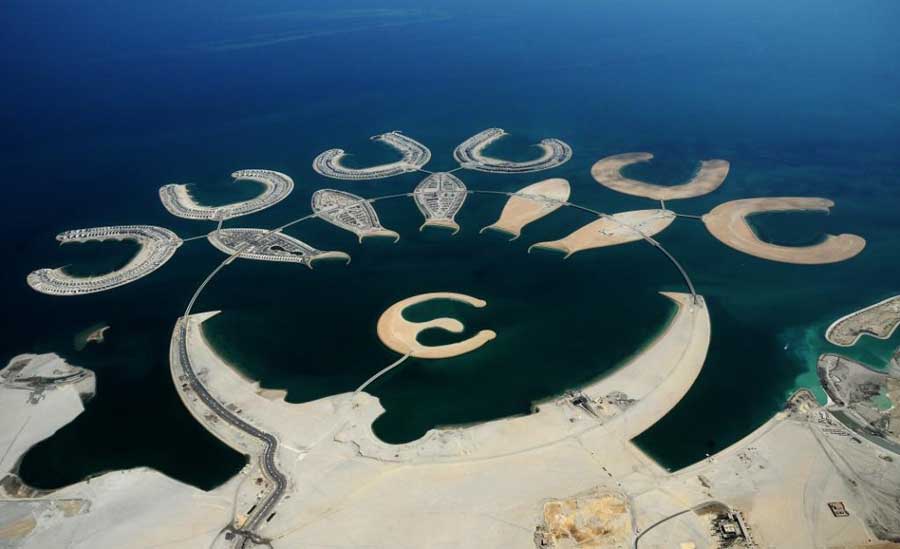
Durrat Bahrain
Durrat artificial islands in Bahrain are fed desalinated water. There is no other way for the thirsty and growing Persian Gulf nations.

Two dry Persian Gulf countries are amping up their desalination capacity: Bahrain, and the United Arab Emirates. Both have access to Persian Gulf waters but very little freshwater access inland.

Toray, the Japanese builder of desalination plants sent us the official news that they will build two new reverse osmosis plants (RO Plants), the Al Dur 2 Desalination Plant in the Kingdom of Bahrain and Umm Al Quwain Desalination Plant in the United Arab Emirates.
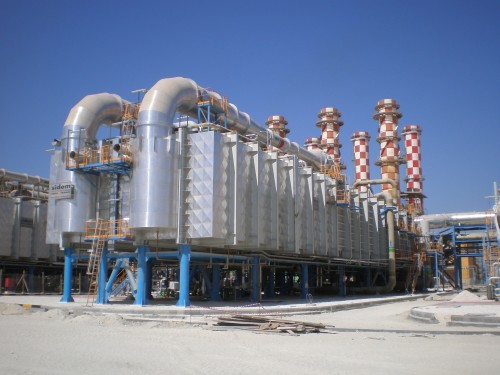
Bahrain desalination plant
A desalination plant. They all look the same. Lots of pipes and tubes.

An estimated 1,500 seawater desalination plants are operating in the Gulf. Most of these plants, including the 24 largest (based on production capacity ≥100,000 (m3/day), are located on the Arabian coast near the shallow southwestern region of the Gulf (Global Water Intelligence). The Gulf region consumes about 57.9% of the world’s desalinated water

In the new plants, the combined water capacity will amount to 911,000 m3 /day, and the Umm Al Quwain Desalination Plant alone will hold one of the world’s largest capacity with 681,000 m3 /day fresh water production.

Toray will provide the membranes which are regarded to be the most sophisticated element in a desalination plant. The membrane filters out salt and other impurities, which leaving brine behind.

Persian Gulf countries are heavily investing in water desalination to supply water to a growing population with growing needs in agriculture and industry. The RO desalination plants built by Toray and which countries like Israel also specialises in, consume less energy to operate compared to thermal desalination plants. The world’s largest desalination plant using RO was in Israel. Researchers at  its major universities are developing new membrane technologies to make the process more efficient. 

It is assumed that desalination is a sweet spot of cooperation between Israel and the Emirates now that peace has been embraced warmly by both sides, and an interest in serious financial investment from both sides. See the Phoenix and Ourcrowd story

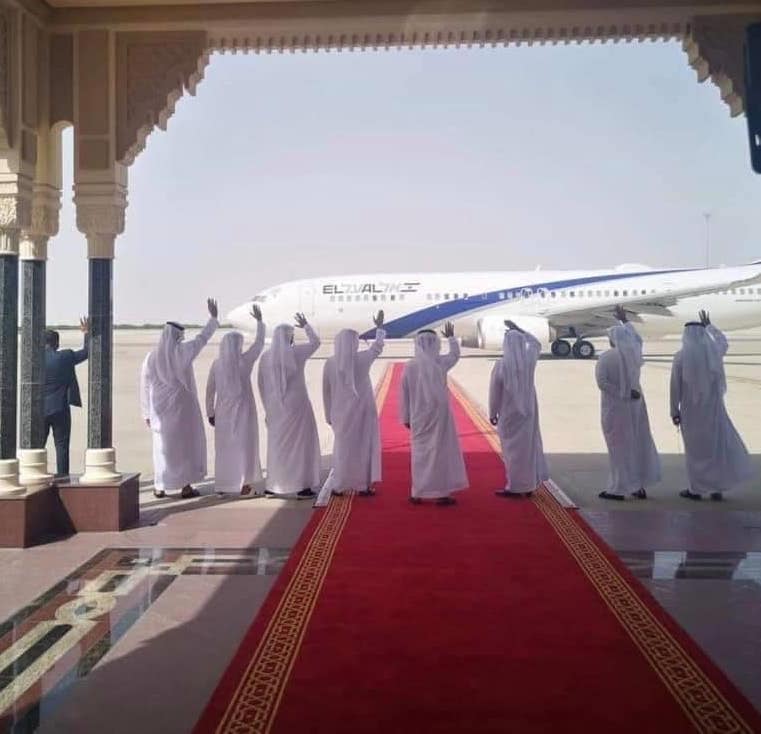
Israelis wave goodbye to Elal flight, rewenable energy

Critics of desalination plants say the energy investment to run them is too high and contributes to an unnecessary amount of carbon dioxide emissions, as well as polluting brine which is fed back to the sea. 

bahrain and the Emirates

The Al Dur 2 Desalination Plant:

Al Dur, Kingdom of Bahrain Production capacity: 230,000 cubic meters daily Expected Operation: 2022 EPC Contractor: SIDEM Veolia (France).

Bahrain, or the Kingdom of Bahrain, is a sovereign state in the Persian Gulf. The island nation comprises a small archipelago made up of 51 natural islands and an additional 33 artificial islands, centered around Bahrain Island which makes up around 83 percent of the country’s landmass.

Bahrain does not operate hydroelectic dams, centralized irrigation systems or large water wellfields. Its water infrastructure consists mainly of desalination and wastewater treatment plants.

In the water supply sector the Bahrain government has developed plans for meeting the increasing water (and electricity) demand over the next 15 years. It is expected that by 2030, the total desalinated water production will increase from its current level of 0.82 MCM/d (300 MCM/yr) to 1.41 MCM/d (515 MCM/yr), an increase of about 72%, according to Fanack Water.

It is also expected that all these new desalination plants will be implemented and managed by the private sector, i.e. an independent water and power plant.

Umm Al Quwain Desalination Plant Location:

Umm Al Quwain, United Arab Emirates Production capacity: 681,000 cubic meters daily Expected Operation: 2022 Engineering and Procurement: SIDEM Veolia (France)

The United Arab Emirates sometimes just called the Emirates or the UAE is a sovereign state in Western Asia at the eastern end of the Arabian Peninsula. It borders with Oman and Saudi Arabia, and has maritime borders in the Persian Gulf with Qatar and Iran.

While Abu Dhabi, one of the Emirates nations claims that it is developing technologies to increase rainfall over its desert nation, in reality desalination plants are critical for supplying freshwater to a growing population.

Abu Dhabi’s energy resources and financial wealth from oil and gas make it able to meet water and food needs using desalintion, but these systems can be seen as fragile, and vulnerable in the event there is conflict in the region. 

Seawater desalination is not an efficient process, also follow this article with Gidon Bromberg, with unit water costs reaching 5 to 10 times higher than extracting water from an aquifer. The desalination process is damaging to local environmental systems and over time the process becomes even more inefficient as thick saline residues build up. over time due to the thick saline residue left over from desalination. The Gulf States don’t have much of an option and now rely on about 1,500 desalination plants to supply its freshwater. 

More on desalination:
Saudi Arabia to Use Sun Power at Desalination Plant
New Hadera Desalination Plant Could Revive the Dying Jordan River
Japan and Saudi Arabia Co-develop Desalination Technologies


Karin Kloosterman
Karin Kloostermanhttp://www.greenprophet.com
Karin Kloosterman is an award-winning journalist, innovation strategist, and founder of Green Prophet, one of the Middle East’s pioneering sustainability platforms. She has ranked in the Top 10 of Verizon innovation competitions, participated in NASA-linked challenges, and spoken worldwide on climate, food security, and future resilience. With an IoT technology patent, features in Canada’s National Post, and leadership inside teams building next-generation agricultural and planetary systems — including Mars-farming concepts — Karin operates at the intersection of storytelling, science, and systems change. She doesn’t report on the future – she helps design it. Reach out directly to [email protected]

Read More

TRENDING

Weston Higginbotham’s Funeral Set for June 17 as Family and Friends Honor Environmentalist

The family of environmentalist and eco-engineer in training, James "Weston" Higginbotham will gather with friends, classmates, and supporters on June 17 in Birmingham, Alabama, to celebrate the life of the Auburn University student whose death in a Kyoto forest in Japan touched people around the world.

Before Funeral, Auburn University Creates Environmental Scholarship in Memory of Weston Higginbotham

The James "Weston" Higginbotham Endowed Scholarship will support Auburn students pursuing ecological engineering, ensuring that the work Weston cared about so deeply continues long after his passing.

Weston Higginbotham’s Family Declines to Release Cause of Death in Kyoto Forest

The family of Weston Higginbotham,an Auburn University student whose disappearance and death in the mountains near Kyoto, Japan, drew international attention, has declined to publicly release the cause of his death.

Dan Zaslavsky’s energy tower dream is rising again in Iran and China

The Energy Tower idea never made the leap from drawings and engineering studies to full-scale construction. But nearly two decades after most people stopped talking about it, the concept is quietly evolving in two unexpected places: China and Iran. The concept let dreamers dream and doers do - figuring out more pleasing designs and engineering.

A visit to Amirim, Israel’s first all-vegetarian village in the Galilee

Just 15 kilometers from Tzfat there is a moshav that was founded in the late 50s that was ideologically influenced by organic, vegetarian and vegan principles. My hostess at Ohn-Bar, the tzimmer where I stayed, explained that the people of Amirim were among the pioneers of Israel’s strong vegetarian movement.

Yerukim Forms a New Green Economy Where the Money is Really Green

The Yerukim members who pick up the recyclables get to keep the monetary reward, the public earns "green" bills that can be used in shops, and business owners get to be associated with environmentalism.

Choosing Riyadh over Dubai? What Investors Should Know

Saudi Arabia is deploying capital at unmatched scale to catalyze tourism and advanced industry while rewiring its power-and-water backbone. The investable frontier is widening—especially in renewables, grid storage, water efficiency/desal retrofits, and hospitality operating platforms. Prudent investors will insist on phased delivery, enforceable KPIs (energy, water, biodiversity), and RHQ/zone compliance—while pricing political-economy and reputational risks alongside growth upside.

Sell your cooking oil for biodiesel money

Want to make money on old french fry oil? Sell it.

Qatar Alternative Energy Summit Pairs Investors And Innovators

Alternative energy investors and innovators can meet n' greet in Doha, Qatar March 16 and 17.

Here’s How To Implement The Four Pillars Of Employee Engagement

If you throw a party for your work team and they are vegans, don't make it a barbecue. Know the sustainability values of your team to boost moral and retain good people.

Locals From Rishon Fight IKEA

Big Box stores are a pretty new concept in Israel, and thank God that not every Israeli city wants them in their backyard. A word from someone who has see the beautiful farmland around her hometown Newmarket, Ontario stripped and converted into vulgar strip malls of big box shops: they have no place in a healthy and sustainable town or city.

The Jewish National Fund Meets An Inconvenient Truth

According to the JNF, it has transformed thousands of acres of barren land into green forests in Israel. They state that each person emits about 23 tons of carbon per year, estimating that each tree planted can absorb one ton of carbon in its lifetime. That's a whole lot of trees you'd need to be planting. Could so many fit in Israel?

How to quiet noise from construction in your office

Streets need to be resurfaced in New York but the humming and grinding noise is unsettling. Noise is environmental pollution. 

Popular Categories