This ancient Arab irrigation system invented before Rome’s aqueduct

Qanat in Iran persia aerial photo of water irrigation system
The Persian Qanat: An aerial view. A qanat or kariz or foggaras, is a system for transporting water from an aquifer or water well to the surface, through an underground aqueduct.

Falaj, also known as qanat or aflaj, is an ancient water management system, that has watered the Arabian Peninsula’s arid lands for centuries. Qanat comes from the Semetic word meaning to dig and some say that the qanat systems are as long as the distance from the earth to the moon. Long-ago tribesmen found underground springs in the foothills of the region, and engineered a technology that channels the water over the land, irrigating farms and oases and supplying households with water as needed.  Although some say that falaj is a concept 3000 years old, others claim 5000 years. We reported on the Al-Baydha project for regenerative agriculture in Saudi Arabia with similar aims here.

What we do know is how admirable and sustainable the falaj system is, built entirely from local materials and hewed out of rock and earth by hand.  First deep wells were dug, or  underground springs redirected, to flow into tunnels that emerge on land and into stone channels containing the streaming water. The waterflow moves across miles of land, as determined by the ancients, entirely by gravity. 

Falaj system

Shafts whose function is to regulate the flow of water are sunk in the channels about every 20 meters.  Today, field irrigation is managed by government-appointed overseers, who monitor which fields receive water, and for how many hours. This is done in some areas by removing covers of brick, stones and sheep fleeces from the openings of the shafts to let the water run in another given direction, then replacing the covers to force the water back.

Aflaj, qanat UAEThe Aflaj Irrigation Systems of Oman are ancient water channels from 500 AD located in the regions of Dakhiliyah, Sharqiyah and Batinah. However, they represent a type of irrigation system as old as 5000 years in the region named as Qanat or Kariz as originally named in Persia. This one is in the UAE.

In other falaj,  slab-like barriers are inserted into points built into the channel walls to divert the water, then put back as needed.

Falaj comes from the word aflaj, meaning split, or divided. As the photo above shows, the channels may be split to provide field irrigation on one side, and household water on the other.

Walk through a village in Oman, and you’ll  see pure, channeled water flowing in the streets and between houses. Some channels may be partially covered with slabs of stone placed at regular intervals over the top, to prevent night animals that come to drink from falling in and polluting the water.  

There might even be a bath house for the community, with the water provided by the falaj. In the 14th and 15th centuries, governments whose falaj systems had deteriorated rebuilt the tunnels and overland channels. Recognizing the huge value of the ancient waterways,  today’s Emirati and Omani governments have repaired many and put them back in use. Some areas in Oman have over 50 working falaj.
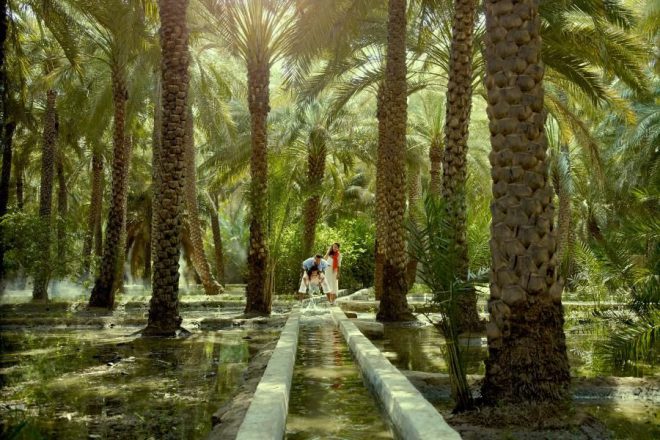
Al Ain oasis
Al Ain oasis

In the UAE there are seven oases, the largest in Al Ain. The stream rippling and burbling between thriving date palms and water greenery is a beautiful thing to see, and it also irrigates 1.200 acres of land, supplying over 550 farms. 

Community areas were once cleared around the mouths of the channels, where the tribes met to take their share of the crop and hold festivities.  Forts and castles were built around the Al Ain oasis to protect it from marauders, and important archaeological discoveries have been made there. UNESCO declared five of the UAE falaj systems to be heritage sites in 2011. 

The falaj system is said to have originated in ancient Iran early in the first millennium BCE, spreading to China and India.  Tribal laborers known as muqannis hand-built and maintained the water channels and shafts, as their descendants do to this day. 

 

Miriam Kresh
Miriam Kreshhttps://www.greenprophet.com/
Miriam Kresh is an American ex-pat living in Israel. Her love of Middle Eastern food evolved from close friendships with enthusiastic Moroccan, Tunisian and Turkish home cooks. She owns too many cookbooks and is always planning the next meal. Miriam can be reached at miriam (at) greenprophet (dot) com.

Read More

TRENDING

Is Qatar paying UNESCO to turn a blind eye on the Seychelles?

Is UNESCO being paid off by Qatar so it can own a private airstrip in a strategic location in the Seychelles?

Art from Oman at the Venice Biennale

Oman is returning to the Venice Biennale with Zīnah, an immersive installation by artist and curator Haitham Al Busafi that transforms a traditional form of horse adornment into a large-scale sensory experience.

Botoxed camels disqualified at beauty pageant

At this year’s 2026 Camel Beauty Show Festival in Al Musanaa in Oman, judges had to disqualify some of the contestants for the enhancements such as Botox used to look their best.

The US leaves 66 United Nations organizations to “put America first”

The world needs a reset and to restart well intentioned cooperation projects from start. Because right now the UN and EU projects look like software built on code from the 80s, rickety, patched, slow to adapt, and prone to crashing under the weight of outdated assumptions.

UNESCO forest being developed in Iran

Environmental activists in Iran often face significant personal risk when speaking out about illegal land grabs, deforestation, or the destruction of protected areas. In recent years, several high-profile environmentalists have been detained, interrogated, or imprisoned on broad national-security charges, sometimes without transparent legal proceedings.

Yerukim Forms a New Green Economy Where the Money is Really Green

The Yerukim members who pick up the recyclables get to keep the monetary reward, the public earns "green" bills that can be used in shops, and business owners get to be associated with environmentalism.

Choosing Riyadh over Dubai? What Investors Should Know

Saudi Arabia is deploying capital at unmatched scale to catalyze tourism and advanced industry while rewiring its power-and-water backbone. The investable frontier is widening—especially in renewables, grid storage, water efficiency/desal retrofits, and hospitality operating platforms. Prudent investors will insist on phased delivery, enforceable KPIs (energy, water, biodiversity), and RHQ/zone compliance—while pricing political-economy and reputational risks alongside growth upside.

Sell your cooking oil for biodiesel money

Want to make money on old french fry oil? Sell it.

Qatar Alternative Energy Summit Pairs Investors And Innovators

Alternative energy investors and innovators can meet n' greet in Doha, Qatar March 16 and 17.

Here’s How To Implement The Four Pillars Of Employee Engagement

If you throw a party for your work team and they are vegans, don't make it a barbecue. Know the sustainability values of your team to boost moral and retain good people.

Locals From Rishon Fight IKEA

Big Box stores are a pretty new concept in Israel, and thank God that not every Israeli city wants them in their backyard. A word from someone who has see the beautiful farmland around her hometown Newmarket, Ontario stripped and converted into vulgar strip malls of big box shops: they have no place in a healthy and sustainable town or city.

The Jewish National Fund Meets An Inconvenient Truth

According to the JNF, it has transformed thousands of acres of barren land into green forests in Israel. They state that each person emits about 23 tons of carbon per year, estimating that each tree planted can absorb one ton of carbon in its lifetime. That's a whole lot of trees you'd need to be planting. Could so many fit in Israel?

How to quiet noise from construction in your office

Streets need to be resurfaced in New York but the humming and grinding noise is unsettling. Noise is environmental pollution. 

Popular Categories