
Venomous creatures adapt their sting when it doesn’t work

Many animals use venom to protect themselves from predators and to catch prey.  Some, like jellyfish, have tentacles, while others, like bees and snakes use stingers and fangs to inject their prey with venomous toxins.

For a long time scientists believed that an animal’s venom was consistent over time: once a venomous creature, always a venomous creature.  However, through a close study of sea anemones, Dr. Yehu Moran of Hebrew University’s Alexander Silberman Institute of Life Science, found that animals change their venom several times over the course of a lifetime, adapting the potency and recipe of their venom to suit changing predators and aquatic environments.

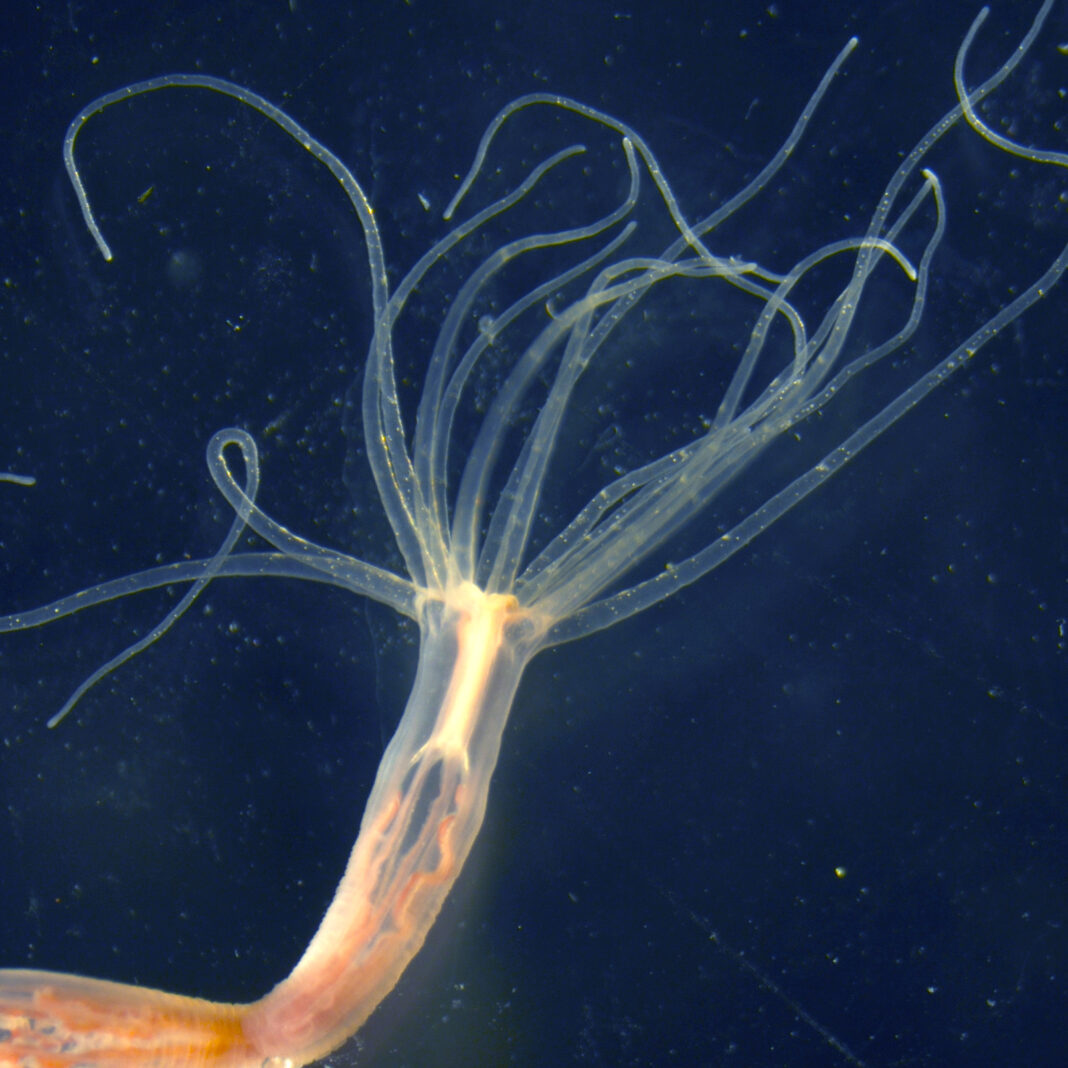
Today, in a study published in eLife Science Magazine, Moran and his team describe their spectacular findings. They studied the Nematostella, a relative of the jellyfish, from cradle to grave. Nematostella are sea anemones that belong to the Cnidaria family of jellyfish and corals.  They begin their life as tiny larvae and grow into animals measuring several inches long.  While in the larvae stage, the Nematostella fall prey to larger fish but once mature, they become predators themselves, catching shrimp and small fish with their venomous tentacles.

Dr. Moran found that while in the larvae stage, sea anemones produce uniquely potent venom that causes predators to immediately spit them out if swallowed. Later on, when the sea anemones grow big and become predators themselves, their venom adapts to their new lifestyle by producing a different kind of toxin, one best suited to catch small fish and shrimp.  Over the course of a lifetime, as the Nematostella’s diet changes and they move from one aquatic region to another, they adapt their venom to suit their new needs and environment.

“Until now, venom research focused mainly on toxins produced by adult animals. However, by studying sea anemones from birth to death, we discovered that animals have a much wider toxin arsenal than previously thought.  Their venom evolves to best meet threats from predators and to cope with changing aquatic environments”, explained Dr. Yehu Moran.

To track these changes, Moran’s team labeled the sea anemone’s venom-producing cells and monitored them over time. The researchers also recorded significant interactions that Nematostella had over their lifetime—first as prey and later as predators.

These findings are significant for several reasons.  First, venom is often used in medicines and pharmacological compounds.  This study suggests that for animals with a complex life cycle there are many venom components that have remained unknown to researchers since, until now, researchers have only studied venom from adult sea anemones, missing out on the unique compounds that exist in larvae venom.  These “new” compounds could lead to new medicines and drugs.  Second, sea anemones, jellyfish and coral play a significant role in marine environments.  A better understanding of their venomous output and effect on marine life ecology is crucial.

Most fundamentally, Moran’s study sheds more light on the basic mechanisms of Darwinism:  How do animals adapt to their changing world and ecological habitats?  The Nematostella, with its changing venom, provides us yet another clue.

TRENDING

Street Vegan in Sri Thanu is a must-stop family lunch spot on Koh Phangan, Thailand

If you’re anywhere near Sri Thanu on Koh Phangan, Thailand, around the yoga centers: Zen Beach, Haad Yao, or Salad Beach—make time for Street Vegan. It's vegan and so satisfying that one meal might convince you that eating plant-based is not a compromise. I suggest for any vegan restaurant owner or chef to come to this modestly-priced venue to learn from a master.

Plants can eat dust and grow – should we stop dusting them?

Dusty plants? Let them eat their hearts out.

Paris Modest Fashion Week offers style without exposure for Muslims

France is home to around 5 to 7.5 million Muslims according to estimates, and Özlem Şahin, head of the organization behind Modest Fashion Week, has described Paris as "one of the leading modest fashion capitals in Europe".

Kids are vaping. The media shock that made them stop

On one side: aggressive anti-vaping campaigns from the FDA, Truth Initiative, and state programs, backed by over $100 million in annual spending. On the other: a public health crisis. Screenshot

Baby teeth read like tree rings paint a picture of toxins in early life

A new study from the Icahn School of Medicine at Mount Sinai in New York offers a striking insight into how the environments we are born into can quietly shape our brains years later. By analyzing naturally shed baby teeth, the ones tucked under pillows for the tooth fairy, researchers have reconstructed a detailed timeline of exposure to environmental metals during pregnancy and early infancy.

Nobul’s Regan McGee on Shareholder Value: “Complacency Is the Silent Killer” 

Why the governance framework designed to protect shareholders so...

Should You Invest in the Private Market?

startustartup Unlike public stock exchanges, which offer daily trading, strict...

How to build a 100-year-company

Kongō Gumi is a Japanese construction company, purportedly founded in 578 A.D., making it the world's oldest documented company. What can we learn about building sustainable businesses from them?

From Pilot Plant to Global Stage: How Aduro Clean Technologies’ 2026 Expansion Signals a Turning Point for Chemical Recycling Investors Like Yazan Al Homsi

The company's Next Generation Process (NGP) Pilot Plant in London, Ontario, has officially moved into initial operating campaigns, generating the kind of structured, repeatable data that separates laboratory promise from commercial viability.

How AI Helps SaaS Companies Reduce Repetitive Customer Support Work

SaaS products are designed for large numbers of users with different levels of experience, and also in renewable energy.

Pulling Water from the Air

Faced with water shortage in Amman, Laurie digs up...

Turning Your Energy Consultancy into an LLC: 4 Legal Steps for Founders in Texas

If you are starting a renewable energy business in Texas, learn how to start an LLC by the books.

Tracking the Impacts of a Hydroelectric Dam Along the Tigris River

For the next two months, I'll be taking a break from my usual Green Prophet posts to report on a transnational environmental issue: the Ilısu Dam currently under construction in Turkey, and the ways it will transform life along the Tigris River.

Related Articles

Popular Categories