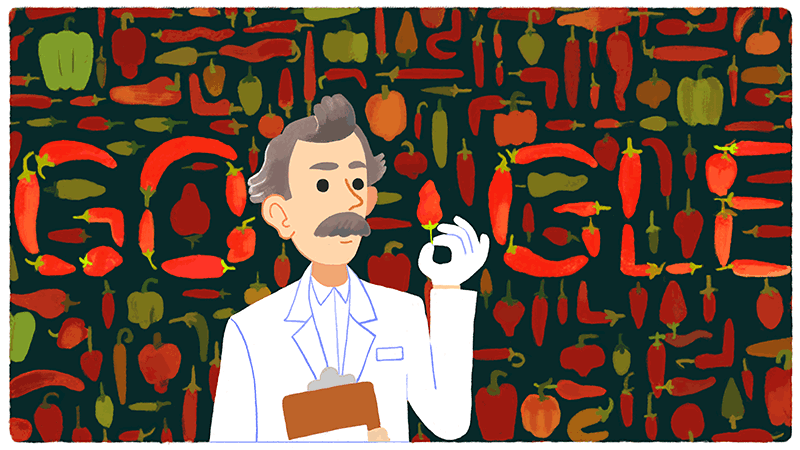
 Google did a doodle marking the 151st birthday of the pharmacist who helped us navigate the chili peppers, the tiny veggie with the power to drop diners to their knees. Wilbur Scoville was the first person to measure the heat of peppers. His heat scale is still in use today, scoring the piquancy of peppers. (What would Wilbur think about the heat scale of planet Earth?)
Scoville devised his “Scoville Organoleptic Test” in 1912 while working at the Parke-Davis pharmaceutical company in Connecticut, US. Now know as the Scoville scale, his metric measures the level of spiciness – or heat – of various chili peppers. The original process involved a panel of tasters trying increasingly diluted pepper solutions. That’s an enviable business card.
Modern methods simply test the capsaicin content of each variety, that’s the chemical that gives peppers their kick. Variability in growth conditions can have a tremendous impact on hotness, but the scale gives reliable comparisons between pepper.
Chili peppers have been a part of the human diet in the Americas since at least 7500 BCE, domesticated more than 6000 years ago in Mexico, and quickly spread to Europe, Asia, North Africa and the Middle East by the rock stars of Old World sea exploration.
The vegetable made it to Syria most likely by way of the Silk Road, and the halaby pepper (also known as the Aleppo pepper) gained popularity in both Syria and Turkey primarily as a spice – fresh peppers are dried, ground or flaked. (try this recipe for muhamarra spread). The Aleppo pepper is rated “moderate” with a heat level of about 10,000 on the Scoville scale.
Middle Eastern cuisines have embraced chili peppers, cultivating locally grown varieties named after their home cities such as Maraş, Urfa, and as mentioned, Aleppo. Syrian and Turkish immigrant communities are credited with popularizing its use in America, where widespread pepper consumption was almost non-existent before the start of the 20th Century.
Some hot facts about ubiquitous chilies:
- Birds are responsible for natural dispersal of pepper seeds. They forage on the brightly colored veggies but, unlike mammals, aren’t affected by capsaicin. Chilies can be grown anywhere under most any condition.
- Peppers improve food’s flavor and its nutritional quality. The rice and grain-dependent Old World Middle East diets improved with addition of chilies which are high in vitamins A and C, iron, calcium, and other minerals.
- In 1937, Hungarian physiologist Albert Szent-Györgyi earned a Nobel Prize for isolating vitamin C, using vitamin-rich capsicums.
- Hot pepper consumption has a positive effect on your mental and physical health. When you eat a hot pepper, pain receptors in your mouth react with the capsaicin. This reaction also triggers an endorphin release that produces a natural feeling of well-being.
- It can also act as a natural pain reliever. (If your tongue is on fire, you will forget that broken toe).
- The hottest pepper in the world is the Carolina reaper, which measures at 1.6m Scoville units, which is 1,600 times hotter than a jalapeno.
- Jalapeno peppers were the first peppers to travel into outer space.
Can’t stand the heat? Opt for an angelic bell pepper. They have zero Scovilee heat units.
Image of Scoville Doodle by Google