100 million trees dry, rather than green, the UAE’s western desert

Richard Allenby-Pratt, eco-art, photography, western desert, greening the western desert, desalination

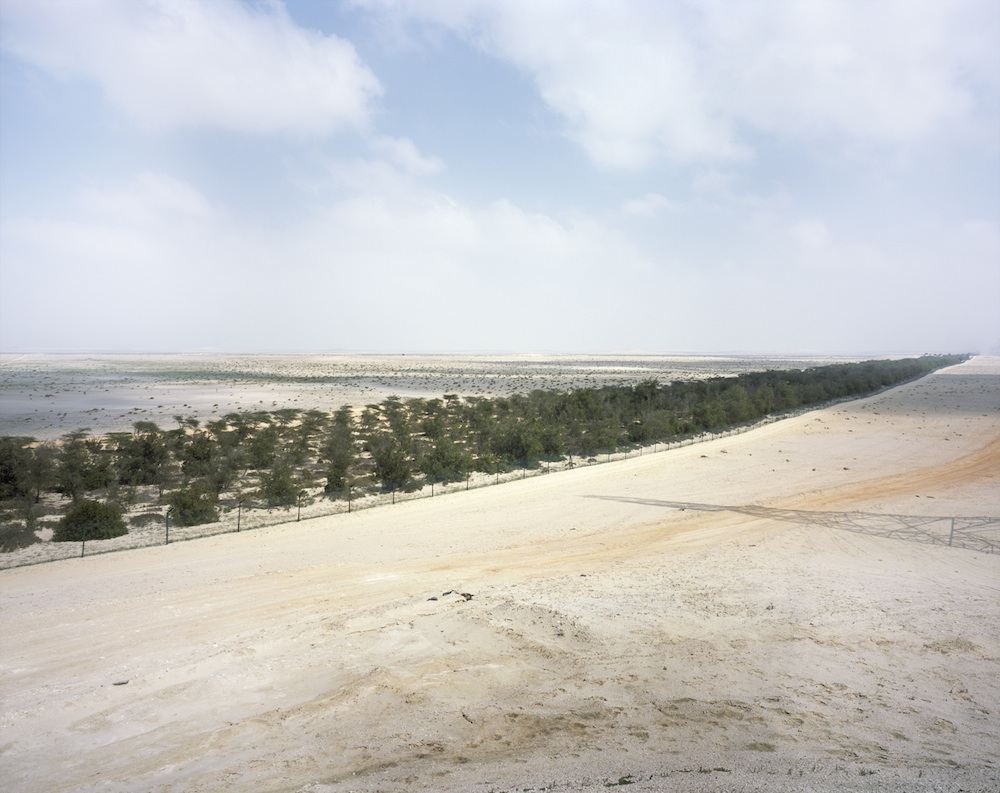
In an attempt to ‘greenify’ the UAE’s Western Region desert, (some claim in the hope of creating a milder micro-climate in the UAE) more than 100 million trees have been planted, often as buffer zones like the one depicted, and irrigated, mostly, with precious groundwater. 

The Abu Dhabi environment agency now admits they have a critical situation with groundwater sources diminishing rapidly and become increasingly saline.

The UAE’s groundwater was deposited 10,000 years ago during the last ice age. It doesn’t replenish quickly, unless we are considering it in a climatic and geological timescale.

Once it is gone, irrigation water will have to be produced entirely through desalination, an energy-intensive and waste-producing process. The highly-saline brine that is returned to the sea after desalination is raising the salinity along the coast.

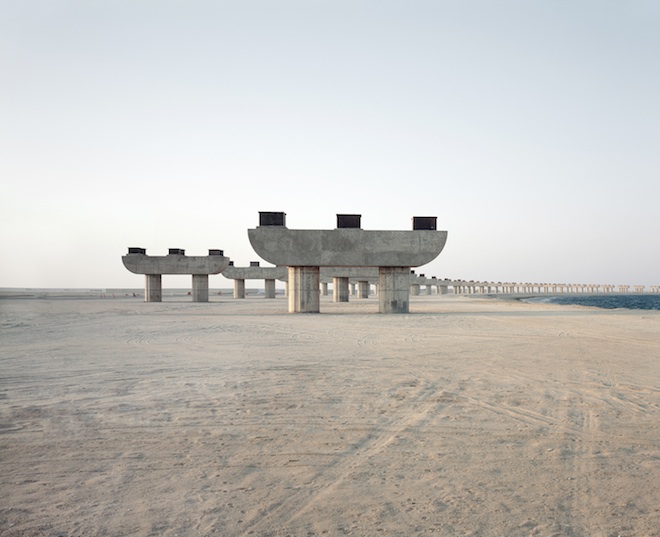
Related: Abu Dhabi pylons confuse perceptions of “land” use

The final result could be a second ‘dead’ sea in the region. But for now, current levels of desalination are drastically reducing seawater quality, damaging fragile marine ecosystems and encouraging toxic algal blooms, such as the ‘red tide’ which residents have seen more frequently in recent years.

So in trying to create a forest where there was never meant to be one we may inadvertently end up destroying a precious marine ecosystem. Plans for underwater hotels might have to be shelved when developers realise guests will just be viewing an underwater graveyard.

To get an idea of the scale of the forestry project have a look at the area around here 23’59’ 48.75N 52’32’51.82E where I took this shot.

Note from the editor: this photograph is part of a series called “Consumption” that seeks to document consumerism’s impact on the environment. From resource extraction and commodity production all the way down the supply chain to retail stores and waste processing facilities, Richard artfully examines what nature has come to mean in a world that depends on buying stuff. 
Richard Allenby Pratt
Richard is a British photographer living and working in Dubai, UAE. His concerns about the sustainability of the way we live and our economic systems only really became urgent after the birth of his son in 2008. As a landscape photographer he found the obvious way to express these concerns was by making photographs of the places impacted on by human activity, and particularly those places that best display the terrifying scale of our consumption. His basic method is to study google earth and then visit the most intriguing and inexplicable places thereby discovered.

Read More

1 COMMENT
  1. Hi,
    Thank you for your article. In some farms the water is withdrawn too quickly and so the minerals are sucked out and the water becomes saline. First the farms plant what can take a higher level of salt, such as olive trees. but then the salinity is too high and the wells are closed. seen some farms closing their wells within 5 to 10 years only. you could desalinate on-site but best is to withdraw that quickly in the first place. plus a large part of the crops is exported as your profit is way higher than by selling in the local market. logics of short term profit (and of profit more generally speaking) screw up nature and people.

TRENDING

Desalination experts debunk Aqua Solaire, the floating desalination barge

AI makes it easy to dream, develop, and create images of what could be world-changing ideas, until the reality sets in. A new project making the rounds is Aqua Solaire, an allged French concept for a solar-powered desalination vessel designed to bring drinking water to coastal communities facing drought, storms, and infrastructure failures.

Jordan’s $6 Billion Aqaba–Amman Desalination Project from the Red Sea Moves Forward

In 2025, the Jordanian government signed agreements with a consortium led by Meridiam and SUEZ, alongside VINCI Construction and Orascom Construction. Under a 30-year concession agreement, the consortium will design, build, finance, operate, and maintain the system before transferring it back to the Jordanian government. The total investment is estimated at approximately $6 billion USD.

The Saudi Startup Turning Desalination’s Toxic Waste Into Its Own Disinfectant

For millennia, the Middle East's water crisis seemed an immutable fact of geography — a region defined as much by what it lacked as by what lay beneath its sands. Today, a convergence of plummeting solar costs, advancing membrane technology, and hard-won engineering expertise is rewriting that story.

10 Proven Israeli Technologies to Help Somaliland Build Food, Water, and Energy Security

Israel’s water and agricultural technologies didn’t emerge from ideal conditions. They were developed under pressure: low rainfall, saline water, political isolation, lack of energy resources, and the constant need to feed a growing population with limited land. Over the years, I’ve written about many of these companies not as miracle-makers, but as problem-solvers. That’s what makes them relevant to places like Somaliland. Israel was the first country in the world to recognize Somaliland as an independent state although Ethiopia has been treating the nation as such for decades.

Dead shark on beach injured by fishing nets

  A dead shark that washed ashore this week at...

Yerukim Forms a New Green Economy Where the Money is Really Green

The Yerukim members who pick up the recyclables get to keep the monetary reward, the public earns "green" bills that can be used in shops, and business owners get to be associated with environmentalism.

Choosing Riyadh over Dubai? What Investors Should Know

Saudi Arabia is deploying capital at unmatched scale to catalyze tourism and advanced industry while rewiring its power-and-water backbone. The investable frontier is widening—especially in renewables, grid storage, water efficiency/desal retrofits, and hospitality operating platforms. Prudent investors will insist on phased delivery, enforceable KPIs (energy, water, biodiversity), and RHQ/zone compliance—while pricing political-economy and reputational risks alongside growth upside.

Sell your cooking oil for biodiesel money

Want to make money on old french fry oil? Sell it.

Qatar Alternative Energy Summit Pairs Investors And Innovators

Alternative energy investors and innovators can meet n' greet in Doha, Qatar March 16 and 17.

Here’s How To Implement The Four Pillars Of Employee Engagement

If you throw a party for your work team and they are vegans, don't make it a barbecue. Know the sustainability values of your team to boost moral and retain good people.

Locals From Rishon Fight IKEA

Big Box stores are a pretty new concept in Israel, and thank God that not every Israeli city wants them in their backyard. A word from someone who has see the beautiful farmland around her hometown Newmarket, Ontario stripped and converted into vulgar strip malls of big box shops: they have no place in a healthy and sustainable town or city.

The Jewish National Fund Meets An Inconvenient Truth

According to the JNF, it has transformed thousands of acres of barren land into green forests in Israel. They state that each person emits about 23 tons of carbon per year, estimating that each tree planted can absorb one ton of carbon in its lifetime. That's a whole lot of trees you'd need to be planting. Could so many fit in Israel?

How to quiet noise from construction in your office

Streets need to be resurfaced in New York but the humming and grinding noise is unsettling. Noise is environmental pollution. 

Popular Categories