

Middle East and Swiss Researchers: Bugs Not Gay

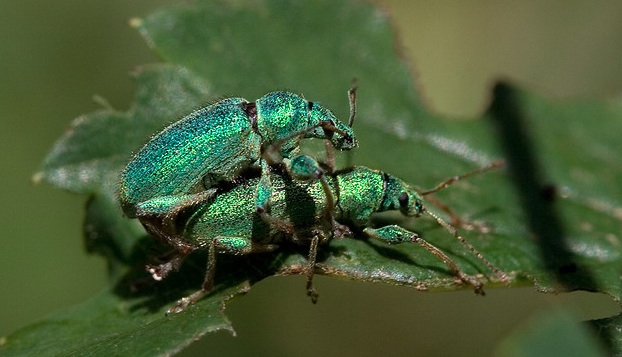
mating bugs beetles

We have to laugh at this research, given the latest news that there is a gay test being developed by Kuwait to weed out homosexuals from Gulf regions: scientists from Israel and Switzerland find that while many kinds of insects and spiders “act” gay, they probably are gay by accident.

Inon Scharf of Tel Aviv University’s Department of Zoology and Oliver Martin of ETH Zurich have found that homosexual behavior in bugs is probably accidental in most cases.

In the rush to produce offspring, bugs do not take much time to inspect their mates’ gender, potentially leading to same-sex mating, found their study now published in the journal Behavioral Ecology and Sociobiology.

“Insects and spiders mate quick and dirty,” Scharf observes. “The cost of taking the time to identify the gender of mates or the cost of hesitation appears to be greater than the cost of making some mistakes.”

Friends without benefits? 

In birds and mammals, homosexual behavior has been shown to have evolutionary benefits. It provides “practice” for young adults and maintains alliances within groups. Scientists have recently tried to find explanations for similar behavior in insects, suggesting it could serve to prepare for heterosexual courtship, dispose of old sperm, discourage predators, and distract competitors.

But in reviewing research on some 110 species of male insects and spiders, the researchers found that the available evidence weakly supports such adaptive theories. In general there is no clear benefit to homosexual behavior in insects.

The costs, on the other hand, can be considerable. Homosexual mating is at least as risky as the heterosexual kind, expending sperm, wasting time that could go toward other activities, and boosting the risk of injury, disease, and predation.

In a previous study, the researchers found that all of these factors shorten the lives of heterosexually active males by an average of 25 percent. They expect homosexual behavior to be similarly costly.

And yet, in some species, up to 85 percent of males engage in homosexual behavior. The researchers say this is not because bugs directly benefit from the behavior, but because they mistake other males for females. Almost 80 percent of the cases of homosexual behavior the researchers appeared to be the result of misidentification or belated identification of gender. In some cases, males carry around the scents of females they have just mated with, sending confusing signals to other males. In other cases, males and females look so similar to one another that males cannot tell if potential mates are female until after they have mounted them

The researchers say insects and spiders probably have not evolved to be more discriminating in their mating choices because the cost of rejecting an opportunity to mate with a female is greater than that of mistakenly mating with a male.

This explanation is supported by the fact that many species that exhibit homosexual behavior also mate with related species or inanimate objects, like beer bottles — indicating a general tendency toward misidentification. It is also possible that sexual enthusiasm in bugs is related to other evolutionarily beneficial traits, the researchers say.

“Homosexual behavior may be genomically linked to being more active, a better forager, or a better competitor,” says Schart. “So even though misidentifying mates isn’t a desirable trait, it’s part of a package of traits that leaves the insect better adapted overall.”

To confirm their theory, the researchers plan to study the conditions that make homosexual behavior more or less likely in bugs. They also want to look more deeply into male resistance to homosexual mating.

As for Kuwait and the gay test: We guess the bugs will be allowed to stay.

Image via dominiqs

Read More

TRENDING

40 more migratory animals need protecting, warns UN group

The Convention on the Conservation of Migratory Species of Wild Animals (CMS), governments agreed to extend protection to 40 more migratory species, from cheetahs and striped hyenas to snowy owls, giant otters, and great hammerhead sharks. Too many of them are slipping toward extinction .

Koh Phangan’s angels for the dogs and the cats

Koh Phangan may be known for yoga, detox retreats, and full moon parties, but beyond the curated paradise lies a different reality—one of injured stray animals and the quiet work of rescue. This story explores PACS (Phangan Animal Care for Strays), a grassroots animal shelter tackling overpopulation, disease, and neglect on the island. Through firsthand experience with teens, it reveals how meaningful travel, volunteerism, and compassion offer a deeper kind of healing—far from the Instagram version of paradise.

Everything is better when you spend 5 days in a cave

She spent 5 days in a cave in the dark. See what it did to her body.

What is the Jewish Climate Trust?

Jewish Climate Trust has quickly attracted the attention and support of some of the most influential voices in Jewish philanthropy, drawing backing from prominent family foundations and business leaders connected to the Bronfman and Schusterman philanthropic networks, alongside climate-focused investors and community builders aligned with founding leader Nigel Savage. Together, these donors have committed many millions of dollars to build a serious, long-term climate platform for the Jewish world — not as a symbolic gesture, but as a strategic intervention in one of the defining challenges of this generation.

Microplastics Are Becoming Superbug Highways — New Study Warns Beachgoers to Wear Gloves

Prof. Pennie Lindeque added that microplastics “act as carriers for antimicrobial-resistant bacteria, enhancing their survival and spread… each particle becomes a tiny vehicle capable of transporting pathogens from sewage works to beaches, swimming areas and shellfish-growing sites.”

How to quiet noise from construction in your office

Streets need to be resurfaced in New York but the humming and grinding noise is unsettling. Noise is environmental pollution. 

EarthX and a blueprint for sustainable investing

Trammell S. Crow, a Dallas-based businessman and father of four, is focusing his efforts on impact investing, and media that focuses on saving the planet through EarthX.

Mining Afghanistan’s Mineral Discoveries Similar to Avatar

Now that American forces in Afghanistan are commemorating the longest period of any war that America has been involved in, including the 1965-73 Vietnam War, the recent discoveries of large and extremely valuable mineral and metal deposits may finally bring to light a reason to continue the presence of US fighting forces in this war torn and backward country.

From Pilot Plant to Global Stage: How Aduro Clean Technologies’ 2026 Expansion Signals a Turning Point for Chemical Recycling Investors Like Yazan Al Homsi

The company's Next Generation Process (NGP) Pilot Plant in London, Ontario, has officially moved into initial operating campaigns, generating the kind of structured, repeatable data that separates laboratory promise from commercial viability.

Nobul’s Regan McGee on Shareholder Value: “Complacency Is the Silent Killer” 

Why the governance framework designed to protect shareholders so...

Should You Invest in the Private Market?

startustartup Unlike public stock exchanges, which offer daily trading, strict...

How to build a 100-year-company

Kongō Gumi is a Japanese construction company, purportedly founded in 578 A.D., making it the world's oldest documented company. What can we learn about building sustainable businesses from them?

How AI Helps SaaS Companies Reduce Repetitive Customer Support Work

SaaS products are designed for large numbers of users with different levels of experience, and also in renewable energy.

Popular Categories